Protect America’s Innovation and Economic Security from CCP Act
Sponsor
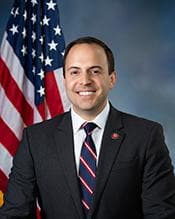
Full profile: /officials/G000589
Source: Congress.gov · FEC
Cosponsors (13)
Members who have signed on to support this bill since introduction. Source: Congress.gov.
- Andrew Ogles (R-TN-5)Original· 2025-02-21
- Ben Cline (R-VA-6)Original· 2025-02-21
- Lauren Boebert (R-CO-4)Original· 2025-02-21
- Mike Kennedy (R-UT-3)Original· 2025-02-21
- Pat Fallon (R-TX-4)Original· 2025-02-21
- Thomas P. Tiffany (R-WI-7)Original· 2025-02-21
- Darin LaHood (R-IL-16)· 2025-02-26
- Jennifer A. Kiggans (R-VA-2)· 2025-02-26
- John H. Rutherford (R-FL-5)· 2025-02-26
- Rudy Yakym III (R-IN-2)· 2025-02-26
- Scott Franklin (R-FL-18)· 2025-03-03
- Adrian Smith (R-NE-3)· 2025-03-11
- Mark B. Messmer (R-IN-8)· 2025-05-21
Latest Action
The most recent step in the bill's legislative path. Committee Activity below shows referrals and reports; the full action-by-action history including floor proceedings lives at Congress.gov →
Committee Activity
Currently in
- House Committee on the JudiciaryReported By · 2026-06-15
Previously
- Judiciary CommitteeMarkup By · 2026-03-26
- House Committee on the JudiciaryMarkup By · 2026-03-26
- Judiciary CommitteeReferred To · 2025-02-21
- House Committee on the JudiciaryReferred To · 2025-02-21
Plain-English Summary
Protect America’s Innovation and Economic Security from CCP Act This bill reestablishes an initiative in the National Security Division of the Department of Justice (DOJ) to combat espionage, theft of intellectual property and trade secrets, and threats to critical infrastructure posed by the Chinese government. A similar initiative was launched in 2018 and discontinued in 2022. Specifically, this bill establishes the CCP (Chinese Communist Party) Initiative and sets forth its objectives, including to curb spying by the Chinese Communist Party on U.S. intellectual property and academic institutions; develop an enforcement strategy for technology transfers by nontraditional collectors (e.g., researchers in labs or at universities) to Chinese individuals and entities or their agents contrary to U.S. interests; and address China-related risks arising from foreign investments in U.S. businesses and real estate. The bill further specifies that the CCP Initiative must prioritize the identification and prosecution of trade secret theft, hacking, and economic espionage; the protection of critical infrastructure in the United States; and the identification of intellectual property theft from U.S. businesses. Under the bill, the CCP Initiative terminates six years after enactment.
Plain-English rewrite of the Congressional Research Service summary published on Congress.gov. Cached and reviewed.
Subjects
Full Bill Text
Verbatim text published on Congress.gov via GovInfo. Use Cmd+F / Ctrl+F to search within this excerpt.
[Congressional Bills 119th Congress] [From the U.S. Government Publishing Office] [H.R. 1468 Introduced in House (IH)] <DOC> 119th CONGRESS 1st Session H. R. 1468 To establish the CCP Initiative program, and for other purposes. _______________________________________________________________________ IN THE HOUSE OF REPRESENTATIVES February 21, 2025 Mr. Gooden (for himself, Mr. Tiffany, Mr. Kennedy of Utah, Mr. Ogles, Ms. Boebert, Mr. Fallon, and Mr. Cline) introduced the following bill; which was referred to the Committee on the Judiciary _______________________________________________________________________ A BILL To establish the CCP Initiative program, and for other purposes. Be it enacted by the Senate and House of Representatives of the United States of America in Congress assembled, SECTION 1. SHORT TITLE. This Act may be cited as the ``Protect America's Innovation and Economic Security from CCP Act of 2025''. SEC. 2. CCP INITIATIVE. (a) Establishment.--There is established in the National Security Division of the Department of Justice the CCP Initiative to-- (1) counter nation-state threats to the United States; (2) curb spying by the Chinese Communist Party on United States intellectual property and academic institutions in the United States; (3) develop an enforcement strategy concerning nontraditional collectors, including researchers in labs, universities, and the defense industrial base, that are being used to transfer technology contrary to United States interests; (4) implement the Foreign Investment Risk Review Modernization Act of 2018 (title XVII of division A of the John S. McCain National Defense Authorization Act for Fiscal Year 2019 (Public Law 115-232; 132 Stat. 2173)) for the Department of Justice, including by working with the Department of the Treasury to develop regulations under that Act; (5) identify cases under the Foreign Corrupt Practices Act of 1977 (Public Law 95-213; 91 Stat. 1494) involving Chinese companies that compete with United States businesses; (6) prioritize-- (A) identifying and prosecuting those engaged in trade secret theft, hacking, and economic espionage; (B) protecting the critical infrastructure in the United States against external threats through foreign direct investment and supply chain compromises; and (C) identifying Chinese Communist Party theft of intellectual property from small businesses; and (7) investigate investments made by Chinese companies included on the Entity List maintained by the Bureau of Industry and Security of the Department of Commerce or the People's Republic of China Military Companies list maintained by the Department of Defense, and report to the Secretary of Commerce and the Secretary of Defense on any findings of such investigations, including findings related to subsidiaries or other entities controlled by such companies, whether or not such subsidiaries or other entities are registered in or operate in the People's Republic of China. (b) Consultation.--In executing the CCP Initiative's objectives as set forth in subsection (a), the Attorney General, acting through the Assistant Attorney General for National Security, shall consult with relevant components of the Department of Justice as necessary, and coordinate activities with the Federal Bureau of Investigation and any other Federal agency as necessary. (c) Requirement.--Under the CCP Initiative-- (1) the Initiative shall be separate from and not under the authority or discretion of any other Department of Justice initiative dedicated to countering nation-state threats; and (2) all resources used for the CCP Initiative shall solely be set aside for the CCP Initiative and shall not be combined to support any other Department of Justice program, including other programs and initiatives dedicated to countering nation- state threats. (d) Annual Report.--The Attorney General shall submit annually a written report to the Committee on Homeland Security and Governmental Affairs and the Committee on the Judiciary of the Senate, and the Committee on Homeland Security and the Committee on the Judiciary of the House of…
Show the remaining 263 wordsHide the remaining 263 words
Representatives, on the progress and challenges of the CCP Initiative over the preceding year, including-- (1) its progress in accomplishing the objectives set forth in subsection (a); (2) the amount and sufficiency of resources provided to, and expended by, the CCP Initiative; (3) the level and effectiveness of coordination with the Federal Bureau of Investigation and other Federal agencies; (4) the status of efforts by and the financial intelligence capabilities of the Chinese Communist Party to engage in trade secret theft, hacking, and economic espionage; (5) an analysis of the use of unmanned aircraft and associated elements (including communication links and the components that control the unmanned aircraft required for the operator to operate safely and efficiently in the national airspace system) by the CCP; (6) the impact of the CCP Initiative on those efforts of the Chinese Communist Party; (7) the level and effectiveness of coordination and information sharing between Government agencies and private companies about economic espionage threats; and (8) an assessment of the economic loss to the United States as a result of hacking and trade secret theft by the Chinese Communist Party. (e) Sunset.--This Act shall take effect on the date of enactment of this Act and cease to be in effect on the date that is 6 years after that date. (f) Severability.--If any provision of this Act, or the application of such provision to any person or circumstance, is held to be unconstitutional, the remainder of this Act, and the application of the provisions of such to any person or circumstance, shall not be affected thereby. <all>
Related legislation
Bills by the same sponsor or covering overlapping subjects.
- HR10272End Gas Station Heroin ActReferred to Committee · 2026-09-03
- HR9276Federal Cryptocurrency Theft Enforcement and Coordination ActReferred to Committee · 2026-06-11
- HR8685Protect the Presidency ActReferred to Committee · 2026-05-07
- HR7612End Sanctuary Cities Act of 2026Referred to Committee · 2026-02-20