HR5032Referred to Committee
Nitazene Control Act
Introduced
In Committee
3
Passed One Chamber4
Passed Both5
Signed into Law119th
Congress
2025-08-22
Introduced
4
Cosponsors
HR
ⓘType
Sponsor
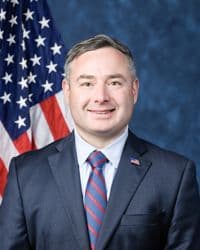
Eugene Simon Vindman
Democrat · VA · Representative
Votes with party: 91.2% (668 recorded votes)
Top industries funding sponsor:
- Veterans$4,000k
Full profile: /officials/V000138
Source: Congress.gov · FEC
Cosponsors (4)
Members who have signed on to support this bill since introduction. Source: Congress.gov.
Latest Action
The most recent step in the bill's legislative path. Committee Activity below shows referrals and reports; the full action-by-action history including floor proceedings lives at Congress.gov →
Referred to the Committee on Energy and Commerce, and in addition to the Committee on the Judiciary, for a period to be subsequently determined by the Speaker, in each case for consideration of such provisions as fall within the jurisdiction of the committee concerned.
2025-08-22
Source: Congress.gov
Committee Activity
Currently in
- House Committee on Energy and CommerceReferred To · 2025-08-22
- House Committee on the JudiciaryReferred To · 2025-08-22
Plain-English Summary
This bill would make nitazene, a synthetic opioid drug, illegal to manufacture, distribute, or possess without a prescription, similar to how other controlled substances are regulated. The legislation aims to address the growing public health threat from nitazene, which has been found in illicit drug supplies and is linked to overdose deaths. Law enforcement agencies would gain authority to prosecute people involved in nitazene trafficking, while medical professionals could still prescribe it for legitimate pain management purposes.
AI-assisted summary generated from the official bill metadata (title, subjects, actions) sourced from Congress.gov. Cached and reviewed. Always verify against the official text linked below.
Subjects
Crime and Law Enforcement
Full Bill Text
Verbatim text published on Congress.gov via GovInfo. Use Cmd+F / Ctrl+F to search within this excerpt.
[Congressional Bills 119th Congress] [From the U.S. Government Publishing Office] [H.R. 5032 Introduced in House (IH)] <DOC> 119th CONGRESS 1st Session H. R. 5032 To amend the Controlled Substances Act to permanently schedule the class of benzimidazole-opioids known as nitazenes, and for other purposes. _______________________________________________________________________ IN THE HOUSE OF REPRESENTATIVES August 22, 2025 Mr. Vindman (for himself and Mr. Baumgartner) introduced the following bill; which was referred to the Committee on Energy and Commerce, and in addition to the Committee on the Judiciary, for a period to be subsequently determined by the Speaker, in each case for consideration of such provisions as fall within the jurisdiction of the committee concerned _______________________________________________________________________ A BILL To amend the Controlled Substances Act to permanently schedule the class of benzimidazole-opioids known as nitazenes, and for other purposes. Be it enacted by the Senate and House of Representatives of the United States of America in Congress assembled, SECTION 1. SHORT TITLE. This Act may be cited as the ``Nitazene Control Act''. SEC. 2. FINDINGS. Congress finds the following: (1) Nitazenes are a class of synthetic opioids first synthesized in the 1950s that exhibit extreme potency at the mu-opioid receptor, with some analogs exceeding the potency of fentanyl. (2) The Drug Enforcement Administration (DEA) has temporarily or permanently scheduled multiple nitazene compounds under Schedule I of the Controlled Substances Act due to their high abuse potential and lack of accepted medical use. (3) Nitazenes and nitazene analogues have emerged in the illicit drug supply as designer drugs and contribute to overdose and fatal poisonings in the United States. (4) A class-wide permanent scheduling of nitazenes is necessary to preemptively address the proliferation of new analogs, streamline enforcement, and protect public health. SEC. 3. SCHEDULE I CLASSIFICATION OF NITAZENES. (a) Amendment.--Section 202(c) of the Controlled Substances Act (21 U.S.C. 812(c)) is amended by adding at the end of Schedule I the following: ``(f) Benzimidazole-opioids, commonly referred to as nitazenes, including any substance (including its salts, isomers, and salts of isomers) that has a chemical structure that is substantially similar to that of etonitazene or isotonitazene, including: ``(1) A benzimidazole core substituted at the 2-position with a benzyl or substituted benzyl group; and ``(2) A basic nitrogen-containing side chain at the 1- position; and ``(3) Exhibits agonist activity at the mu-opioid receptor. Such substances include, but are not limited to: etonitazene, clonitazene, metonitazene, isotonitazene, protonitazene, butonitazene, etodesnitazene, flunitazene, N-pyrrolidino etonitazene, N-desethyl isotonitazene, and N-piperidinyl etonitazene.''. (b) Removal of Temporary Status.--Any substance included in the amendment to section 202(c) of the Controlled Substances Act made by this section that was temporarily scheduled under section 201(h) of the Controlled Substances Act shall be deemed permanently scheduled and subject to the requirements of Schedule I as of the date of enactment of this Act. (c) Rulemaking Authority.--The Attorney General, in consultation with the Secretary of Health and Human Services, may issue rules to clarify the scope of the nitazene class as necessary to enforce this section, provided such rules are consistent with the chemical definition in subsection (a)(1). (d) Research Exemption.-- (1) Notwithstanding the amendments made by subsection (a), a researcher who, as of the date of enactment of this Act, is conducting research involving a substance described in subsection (a) that was not previously listed in Schedule I of section 202(c) of the Controlled Substances Act (21 U.S.C. 812(c)), shall not be required to obtain a registration under section 303(f) of such Act (21 U.S.C. 823(f)) solely due to the inclusion of that substance in Schedule I, provided that: (A) the research is being conducted pursuant to an active investigational…
Show the remaining 139 wordsHide the remaining 139 words
new drug (IND) application or other applicable regulatory exemption recognized by the Food and Drug Administration or Drug Enforcement Administration; (B) the research was approved by an institutional review board (IRB) prior to the enactment of this Act; and (C) the researcher notifies the Attorney General, in a manner determined by the Attorney General, within 90 days of enactment of this Act. (2) The exemption under paragraph (1) shall remain in effect for a period not to exceed 18 months from the date of enactment, during which time the researcher may apply for a registration under section 303(f), and the Attorney General shall expedite such applications to ensure continuity of research. (3) Nothing in this subsection shall be construed to authorize the initiation of new research using substances described in subsection (a) without proper registration and scheduling compliance. <all>
Related legislation
Bills by the same sponsor or covering overlapping subjects.
- HR10838To extend the statute of limitations for making false statements to Congress, and for other purposes.Referred to Committee · 2026-10-15
- HR10837To prohibit individuals convicted of bribery, ethics violations, or violations of the Foreign Agents Registration Act from serving in the executive branch of the Federal Government, and for other purposes.Referred to Committee · 2026-10-15
- HR10836To amend the Uniform Code of Military Justice to prohibit the live broadcast of military executions, and for other purposes.Referred to Committee · 2026-10-15
- HR10809Make Data Centers Pay ActReferred to Committee · 2026-10-13