HR8140Referred to Committee
Money Where Our Mouths Are Act
Introduced
In Committee
3
Passed One Chamber4
Passed Both5
Signed into Law119th
Congress
2026-03-27
Introduced
0
Cosponsors
HR
ⓘType
Sponsor
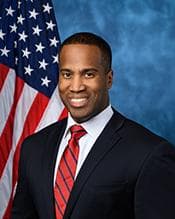
John James
Republican · MI · Representative
Votes with party: 97.4% (606 recorded votes)
Full profile: /officials/J000307
Source: Congress.gov · FEC
Cosponsors (0)
Members who have signed on to support this bill since introduction. Source: Congress.gov.
No cosponsors on record. Bills can pass without cosponsors — this often means the sponsor introduced the bill alone, either because it's a messaging bill, a chairman's mark, or simply early in the legislative cycle.
Latest Action
The most recent step in the bill's legislative path. Committee Activity below shows referrals and reports; the full action-by-action history including floor proceedings lives at Congress.gov →
Referred to the Committee on House Administration, and in addition to the Committee on Oversight and Government Reform, for a period to be subsequently determined by the Speaker, in each case for consideration of such provisions as fall within the jurisdiction of the committee concerned.
2026-03-27
Source: Congress.gov
Committee Activity
Currently in
- House Committee on Oversight and Government ReformReferred To · 2026-03-28
- House Committee on House AdministrationReferred To · 2026-03-28
Previously
- Committee on House AdministrationReferred To · 2026-03-28
- Oversight and Government Reform CommitteeReferred To · 2026-03-28
Plain-English Summary
This bill would require members of Congress to use the same healthcare system and follow the same laws that apply to ordinary Americans, rather than having access to special congressional benefits. The measure aims to make lawmakers more accountable by having them experience firsthand the healthcare and regulatory requirements they impose on the general public. It affects Congress members and could influence how they write legislation affecting healthcare and other areas where they currently receive different treatment than constituents.
AI-assisted summary generated from the official bill metadata (title, subjects, actions) sourced from Congress.gov. Cached and reviewed. Always verify against the official text linked below.
Subjects
Congress
Full Bill Text
Verbatim text published on Congress.gov via GovInfo. Use Cmd+F / Ctrl+F to search within this excerpt.
[Congressional Bills 119th Congress] [From the U.S. Government Publishing Office] [H.R. 8140 Introduced in House (IH)] <DOC> 119th CONGRESS 2d Session H. R. 8140 To prohibit the pay of Members of Congress during periods in which a Government shutdown is in effect, and for other purposes. _______________________________________________________________________ IN THE HOUSE OF REPRESENTATIVES March 27, 2026 Mr. James introduced the following bill; which was referred to the Committee on House Administration, and in addition to the Committee on Oversight and Government Reform, for a period to be subsequently determined by the Speaker, in each case for consideration of such provisions as fall within the jurisdiction of the committee concerned _______________________________________________________________________ A BILL To prohibit the pay of Members of Congress during periods in which a Government shutdown is in effect, and for other purposes. Be it enacted by the Senate and House of Representatives of the United States of America in Congress assembled, SECTION 1. SHORT TITLE. This Act may be cited as the ``Money Where Our Mouths Are Act''. SEC. 2. PROHIBITING PAY OF MEMBERS OF CONGRESS IN RESPONSE TO GOVERNMENT SHUTDOWN. (a) Prohibition of Pay.--If on any day during a pay period a Government shutdown is in effect, the payroll administrator of each House of Congress shall exclude from the payments otherwise required to be made with respect to that pay period for the compensation of each Member of Congress who serves in that House of Congress an amount equal to the product of-- (1) an amount equal to one day's worth of pay under the annual rate of pay applicable to the Member under section 601(a) of the Legislative Reorganization Act of 1946 (2 U.S.C. 4501); and (2) the number of 24-hour periods during which the Government shutdown is in effect which occur during the pay period. (b) Role of Secretary of the Treasury.--The Secretary of the Treasury shall provide the payroll administrators of the Houses of Congress with such assistance as may be necessary to enable the payroll administrators to carry out this section. (c) Payroll Administrator Defined.--In this section, the ``payroll administrator'' of a House of Congress means-- (1) in the case of the House of Representatives, the Chief Administrative Officer of the House of Representatives, or an employee of the Office of the Chief Administrative Officer who is designated by the Chief Administrative Officer to carry out this section; and (2) in the case of the Senate, the Secretary of the Senate, or an employee of the Office of the Secretary of the Senate who is designated by the Secretary to carry out this section. (d) Effective Date.--This section shall apply with respect to days occurring during the One Hundred Twentieth Congress and each succeeding Congress. SEC. 3. DETERMINATION OF GOVERNMENT SHUTDOWN. For purposes of this Act, a Government shutdown shall be considered to be in effect if there is a lapse in appropriations for any Federal agency or department as a result of a failure to enact a regular appropriations bill or continuing resolution. SEC. 4. MEMBER OF CONGRESS DEFINED. In this Act, the term ``Member of Congress'' means an individual serving in a position under subparagraph (A), (B), or (C) of section 601(a) of the Legislative Reorganization Act of 1946 (2 U.S.C. 4501). <all>
Related legislation
Bills by the same sponsor or covering overlapping subjects.
- HR10759Tariff Relief for American Development and Employment Act of 2026Referred to Committee · 2026-10-06
- HR10560Skilled JOBS ActReferred to Committee · 2026-09-24
- HR9783CANADA FIRE ActReferred to Committee · 2026-07-20
- HRES1347Recognizing the roles and contributions of automotive workers in the United States, with particular recognition of their impact in Michigan, and expressing support for the designation of September 2026 as "American Automotive Worker Recognition Month".Referred to Committee · 2026-06-08