BAN Act
Sponsor
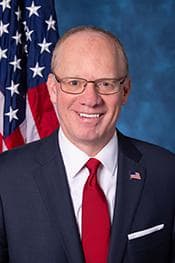
Full profile: /officials/R000612
Source: Congress.gov · FEC
Cosponsors (0)
Members who have signed on to support this bill since introduction. Source: Congress.gov.
No cosponsors on record. Bills can pass without cosponsors — this often means the sponsor introduced the bill alone, either because it's a messaging bill, a chairman's mark, or simply early in the legislative cycle.
Latest Action
The most recent step in the bill's legislative path. Committee Activity below shows referrals and reports; the full action-by-action history including floor proceedings lives at Congress.gov →
Committee Activity
Currently in
- House Committee on the JudiciaryReferred To · 2026-07-22
Plain-English Summary
The legislation would make it illegal for foreign nationals to enter the United States with the primary intention of giving birth so their child can automatically become a U.S. citizen. The bill would allow immigration officials to deny entry or visas to pregnant women suspected of coming to the country specifically to have a baby, and would impose penalties on people who help organize or profit from birth tourism schemes. This would affect pregnant foreign visitors, immigration officials enforcing the rules, and companies that market childbirth services to international clients.
AI-assisted summary generated from the official bill metadata (title, subjects, actions) sourced from Congress.gov. Cached and reviewed. Always verify against the official text linked below.
Subjects
Full Bill Text
Verbatim text published on Congress.gov via GovInfo. Use Cmd+F / Ctrl+F to search within this excerpt.
[Congressional Bills 119th Congress] [From the U.S. Government Publishing Office] [H.R. 9876 Introduced in House (IH)] <DOC> 119th CONGRESS 2d Session H. R. 9876 To prohibit birth tourism, and for other purposes. _______________________________________________________________________ IN THE HOUSE OF REPRESENTATIVES July 22, 2026 Mr. Rose introduced the following bill; which was referred to the Committee on the Judiciary _______________________________________________________________________ A BILL To prohibit birth tourism, and for other purposes. Be it enacted by the Senate and House of Representatives of the United States of America in Congress assembled, SECTION 1. SHORT TITLE. This Act may be cited as the ``Birthright Abuse and Nationality Act'' or the ``BAN Act''. SEC. 2. FINDINGS. Congress finds the following: (1) On June 30, 2026, the Supreme Court of the United States held in Trump v. Barbara that ``children born in the United States to parents unlawfully or temporarily present are `subject to the jurisdiction' of the United States and are citizens at birth under the Fourteenth Amendment's Citizenship Clause''. (2) The majority opinion in Trump v. Barbara, joined by Chief Justice Roberts and Justice Barrett, adopts an unduly narrow and formalistic interpretation of the Fourteenth Amendment that ignores the real-world consequences of birth tourism and reflects a departure from common-sense understandings of jurisdiction, sovereignty, and the proper limits of the Citizenship Clause. (3) Justice Clarence Thomas authored an outstanding and blistering dissent in Trump v. Barbara, rigorously dismantling the majority's reasoning and warning that its expansive interpretation of the Citizenship Clause dangerously devalues American citizenship and invites further abuse of birthright citizenship by those unlawfully or temporarily present in the United States. (4) Businesses, facilitators, and foreign-based agencies openly advertise and sell packages designed to enable foreign nationals to travel to the United States for the primary purpose of obtaining United States citizenship for a child, thereby treating American citizenship as a commercial product. (5) American citizenship is a sovereign privilege that should never be bought, sold, marketed, or otherwise commercialized, and that the continued operation of the birth tourism industry undermines public confidence in the integrity of the Nation's immigration system. (6) The laws of numerous democratic nations, including the United Kingdom, Ireland, Australia, New Zealand, France, and Germany, require a meaningful legal connection between a child and the nation, such as the citizenship or lawful residence of a parent, before citizenship is conferred at birth. (7) The widespread abandonment of unconditional birthright citizenship by many democratic nations reflects a recognition that citizenship is appropriately tied to enduring allegiance and legal attachment to the sovereign, rather than the mere geographic location of birth. (8) Congress retains broad authority under Article I of the Constitution to regulate immigration, determine the conditions of admission of aliens, and establish grounds of inadmissibility under section 212 of the Immigration and Nationality Act (8 U.S.C. 1182). (9) Congress has repeatedly amended section 212(a) of the Immigration and Nationality Act (8 U.S.C. 1182(a)) to create new grounds of inadmissibility when it has determined that certain conduct is contrary to the national interest and the proper administration of the immigration laws. (10) The practice commonly known as ``birth tourism'' exploits the benefits associated with United States citizenship and undermines the integrity of the Nation's immigration system. SEC. 3. BIRTH TOURISM DEFINED. Section 101(a) of the Immigration and Nationality Act (8 U.S.C. 1101(a)) is amended by adding at the end the following: ``(53) Birth tourism.--The term `birth tourism'-- ``(A) means the act of an alien visiting the United States for the primary purpose of giving birth to a child who does not have a parent who is a national of the United States;…
Show the remaining 441 wordsHide the remaining 441 words
and ``(B) does not include visiting the United States for medical treatment that is determined necessary by the Secretary of Health and Human Services on a case- by-case basis.''. SEC. 4. BIRTH TOURISM GROUND OF INADMISSIBILITY. Section 212(a) of the Immigration and Nationality Act (8 U.S.C. 1182(a)) is amended by adding at the end the following: ``(28) Birth tourism.-- ``(A) Birthing alien.--Any alien who seeks admission to the United States to engage in birth tourism is inadmissible. ``(B) Family members.--Any alien who is a spouse, partner, or other immediate family member of an alien described in subparagraph (A) and knowingly participates in or facilitates birth tourism is inadmissible. ``(C) Evidence.--In determining whether an alien is seeking admission to engage in birth tourism under subparagraph (A), an immigration officer shall consider, among other relevant evidence, whether the alien-- ``(i) is in the third trimester of pregnancy at the time admission is sought; ``(ii) has an expected delivery date during the anticipated period of stay; or ``(iii) seeks admission in a temporary nonimmigrant classification while pregnant.''. SEC. 5. CRIMINAL OFFENSE. Section 1546 of title 18, United States Code, is amended by adding at the end the following: ``(d)(1) Whoever-- ``(A) being an alien, knowingly fails to disclose a pregnancy or intentionally misrepresents material facts for the purpose of seeking admission to the United States by birth tourism shall constitute birth tourism visa fraud punishable by up to 10 years in prison; ``(B) being the spouse, partner, or immediate family member of an alien described in subparagraph (A), knowingly participates in, facilitates, or materially assists in the concealment of birth tourism or the commission of fraud described in subsection 3(a) shall likewise be subject to visa revocation, expedited removal or removal; or ``(C) being an individual or entity, knowingly participating in, organizing, advertising, promoting, financing, managing, or otherwise facilitating a commercial enterprise that arranges or assists birth tourism, shall be fined under title, imprisoned for not more than 10 years, or both. ``(2) Notwithstanding any other provision of law, a United States district court shall have jurisdiction to enter a judicial order of removal at the time of sentencing against any alien who is convicted of an offense under this subsection. ``(3) In this subsection, the term `birth tourism'-- ``(A) means the act of an alien visiting the United States for the primary purpose of giving birth to a child who does not have a parent who is a national of the United States; and ``(B) does not include visiting the United States for medical treatment that is determined necessary by the Secretary of Health and Human Services on a case- by-case basis.''. <all>
Related legislation
Bills by the same sponsor or covering overlapping subjects.
- HR10478To direct the Secretary of Veterans Affairs to establish a pilot program to arrange for qualified pension assistance organizations to provide claims development support to veterans and beneficiaries, and for other purposes.Referred to Committee · 2026-09-17
- HR7993Somaliland Economic Access and Opportunity ActReferred to Committee · 2026-03-19
- HR7775CDFI Fund Transparency ActReferred to Committee · 2026-03-03
- HR6293Housing Supply Expansion Act of 2025Referred to Committee · 2025-11-25