S1133Reported by Committee
Sunshine in the Courtroom Act of 2025
Introduced
In Committee
3
Passed One Chamber4
Passed Both5
Signed into Law119th
Congress
2025-03-26
Introduced
5
Cosponsors
S
ⓘType
Sponsor
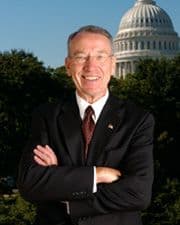
Chuck Grassley
Republican · IA · Senator
Votes with party: 77.0% (891 recorded votes)
Full profile: /officials/G000386
Source: Congress.gov · FEC
Cosponsors (5)
Members who have signed on to support this bill since introduction. Source: Congress.gov.
Latest Action
The most recent step in the bill's legislative path. Committee Activity below shows referrals and reports; the full action-by-action history including floor proceedings lives at Congress.gov →
Placed on Senate Legislative Calendar under General Orders. Calendar No. 444.
2026-06-23
Source: Congress.gov
Committee Activity
Currently in
- Senate Committee on the JudiciaryReported By · 2026-06-23
Previously
- Senate Committee on the JudiciaryMarkup By · 2026-06-18
- Senate Committee on the JudiciaryReferred To · 2025-03-26
Plain-English Summary
Sunshine in the Courtroom Act of 2025 This bill establishes a framework to allow federal court proceedings—in district courts, in circuit courts, and at the Supreme Court—to be photographed, recorded, broadcast, or televised. Specifically, it authorizes the presiding judge to permit media coverage of court proceedings, subject to requirements and limitations.
Plain-English rewrite of the Congressional Research Service summary published on Congress.gov. Cached and reviewed.
Subjects
Law
Full Bill Text
Verbatim text published on Congress.gov via GovInfo. Use Cmd+F / Ctrl+F to search within this excerpt.
[Congressional Bills 119th Congress] [From the U.S. Government Publishing Office] [S. 1133 Introduced in Senate (IS)] <DOC> 119th CONGRESS 1st Session S. 1133 To provide for media coverage of Federal court proceedings. _______________________________________________________________________ IN THE SENATE OF THE UNITED STATES March 26, 2025 Mr. Grassley (for himself, Ms. Klobuchar, Mr. Durbin, Mr. Blumenthal, Mr. Markey, and Mr. Cornyn) introduced the following bill; which was read twice and referred to the Committee on the Judiciary _______________________________________________________________________ A BILL To provide for media coverage of Federal court proceedings. Be it enacted by the Senate and House of Representatives of the United States of America in Congress assembled, SECTION 1. SHORT TITLE. This Act may be cited as the ``Sunshine in the Courtroom Act of 2025''. SEC. 2. FEDERAL APPELLATE AND DISTRICT COURTS. (a) Definitions.--In this section: (1) Presiding judge.--The term ``presiding judge'' means the judge presiding over the court proceeding concerned. In proceedings in which more than one judge participates, the presiding judge shall be the chief judge or justice so participating. If the chief judge or justice is not participating, the presiding judge shall be the most senior active judge or justice so participating. (2) Appellate court of the united states.--The term ``appellate court of the United States'' means any United States circuit court of appeals and the Supreme Court of the United States. (b) Authority of Presiding Judge To Allow Media Coverage of Court Proceedings.-- (1) Authority of appellate courts.-- (A) In general.--Except as provided under subparagraph (B), the presiding judge of an appellate court of the United States may, at the discretion of that judge, permit the photographing, electronic recording, broadcasting, or televising to the public of any court proceeding over which that judge presides. (B) Exception.--The presiding judge shall not permit any action under subparagraph (A), if-- (i) in the case of a proceeding involving only the presiding judge, that judge determines the action would constitute a violation of the due process rights of any party; or (ii) in the case of a proceeding involving the participation of more than one judge, a majority of the judges participating determine that the action would constitute a violation of the due process rights of any party. (2) Authority of district courts.-- (A) In general.-- (i) Authority.--Notwithstanding any other provision of law, except as provided under clause (iii), the presiding judge of a district court of the United States may, at the discretion of that judge, permit the photographing, electronic recording, broadcasting, or televising to the public of any court proceeding over which that judge presides. (ii) Obscuring of witnesses.--Except as provided under clause (iii)-- (I) upon the request of any witness (other than a party) in a trial proceeding, the court shall order the face and voice of the witness to be disguised or otherwise obscured in such manner as to render the witness unrecognizable to the broadcast audience of the trial proceeding; and (II) the presiding judge in a trial proceeding shall inform each witness who is not a party that the witness has the right to request the image and voice of that witness to be obscured during the testimony of the witness. (iii) Exception.--The presiding judge shall not permit any action under this subparagraph-- (I) if that judge determines the action would constitute a violation of the due process rights of any party; and (II) until the Judicial Conference of the United States promulgates mandatory guidelines under paragraph (5). (B) No media coverage of jurors.--The presiding judge shall not permit the photographing, electronic recording, broadcasting, or televising of any juror in a trial proceeding, or of the…
Show the remaining 491 wordsHide the remaining 491 words
jury selection process. (C) Discretion of the judge.--The presiding judge shall have the discretion to obscure the face and voice of an individual, if good cause is shown that the photographing, electronic recording, broadcasting, or televising of the individual would threaten-- (i) the safety of the individual; (ii) the security of the court; (iii) the integrity of future or ongoing law enforcement operations; or (iv) the interest of justice. (D) Sunset of district court authority.--The authority under this paragraph shall terminate 3 years after the date of the enactment of this Act. (3) Interlocutory appeals barred.--The decision of the presiding judge under this subsection of whether or not to permit, deny, or terminate the photographing, electronic recording, broadcasting, or televising of a court proceeding may not be challenged through an interlocutory appeal. (4) Advisory guidelines.--The Judicial Conference of the United States may promulgate advisory guidelines to which a presiding judge, at the discretion of that judge, may refer in making decisions with respect to the management and administration of photographing, recording, broadcasting, or televising described under paragraphs (1) and (2). (5) Mandatory guidelines.--Not later than 6 months after the date of enactment of this Act, the Judicial Conference of the United States shall promulgate mandatory guidelines that a presiding judge is required to follow for obscuring of certain vulnerable witnesses, including crime victims, minor victims, families of victims, cooperating witnesses, undercover law enforcement officers or agents, witnesses subject to section 3521 of title 18, United States Code, relating to witness relocation and protection, or minors under the age of 18 years. The guidelines shall include procedures for determining, at the earliest practicable time in any investigation or case, which witnesses should be considered vulnerable under this section. (6) Procedures.--In the interests of justice and fairness, the presiding judge of the court in which media use is desired has discretion to promulgate rules and disciplinary measures for the courtroom use of any form of media or media equipment and the acquisition or distribution of any of the images or sounds obtained in the courtroom. The presiding judge shall also have discretion to require written acknowledgment of the rules by anyone individually or on behalf of any entity before being allowed to acquire any images or sounds from the courtroom. (7) No broadcast of conferences between attorneys and clients.--There shall be no audio pickup or broadcast of conferences which occur in a court proceeding between attorneys and their clients, between co-counsel of a client, between adverse counsel, or between counsel and the presiding judge, if the conferences are not part of the official record of the proceedings. (8) Expenses.--A court may require that any accommodations to effectuate this Act be made without public expense. (9) Inherent authority.--Nothing in this Act shall limit the inherent authority of a court to protect witnesses or clear the courtroom to preserve the decorum and integrity of the legal process or protect the safety of an individual. <all>
Related legislation
Bills by the same sponsor or covering overlapping subjects.
- SRES939A resolution expressing the sense of the Senate that it values the active participation of the Republic of Kosovo as the state partner of the Iowa National Guard over the past 15 years.Introduced · 2026-09-30
- S5611SRBIJA ActReferred to Committee · 2026-09-30
- SRES927A resolution designating the week beginning October 18, 2026, as "National Character Counts Week".Introduced · 2026-09-29
- S5583Small Agri-Biodiesel Producer Credit Extension ActReferred to Committee · 2026-09-29