Finding ORE Act
Sponsor
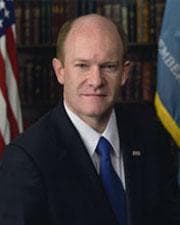
Full profile: /officials/C001088
Source: Congress.gov · FEC
Cosponsors (4)
Members who have signed on to support this bill since introduction. Source: Congress.gov.
Latest Action
The most recent step in the bill's legislative path. Committee Activity below shows referrals and reports; the full action-by-action history including floor proceedings lives at Congress.gov →
Placed on Senate Legislative Calendar under General Orders. Calendar No. 93.
2025-06-18
Source: Congress.gov
Plain-English Summary
This bill would establish or expand programs to help develop and extract mineral resources, likely including rare earth elements and other materials needed for energy production and technology. The legislation would probably affect mining companies, energy producers, and communities where these resources are located by creating new opportunities or requirements for resource development. The bill aims to increase domestic production of critical minerals that are currently imported from other countries.
AI-assisted summary generated from the official bill metadata (title, subjects, actions) sourced from Congress.gov. Cached and reviewed. Always verify against the official text linked below.
Subjects
Full Bill Text
Verbatim text published on Congress.gov via GovInfo. Use Cmd+F / Ctrl+F to search within this excerpt.
[Congressional Bills 119th Congress] [From the U.S. Government Publishing Office] [S. 1463 Introduced in Senate (IS)] <DOC> 119th CONGRESS 1st Session S. 1463 To allow the Secretary of the Interior to enter into memoranda of understanding for the purpose of scientific and technical cooperation in the mapping of critical minerals and rare earth elements, and for other purposes. _______________________________________________________________________ IN THE SENATE OF THE UNITED STATES April 10, 2025 Mr. Coons (for himself, Mr. Young, Mr. Hickenlooper, and Mr. Cornyn) introduced the following bill; which was read twice and referred to the Committee on Foreign Relations _______________________________________________________________________ A BILL To allow the Secretary of the Interior to enter into memoranda of understanding for the purpose of scientific and technical cooperation in the mapping of critical minerals and rare earth elements, and for other purposes. Be it enacted by the Senate and House of Representatives of the United States of America in Congress assembled, SECTION 1. SHORT TITLE. This Act may be cited as the ``Finding Opportunities for Resource Exploration Act'' or the ``Finding ORE Act''. SEC. 2. DEFINITIONS. In this Act: (1) Allied foreign country.--The term ``allied foreign country'' means a country with which the United States has entered into a mutual defense treaty or other mutual defense agreement. (2) Critical mineral.--The term ``critical mineral'' has the meaning given the term in section 7002(a) of the Energy Act of 2020 (30 U.S.C. 1606(a)). (3) Institution of higher education.--The term ``institution of higher education'' has the meaning given the term in section 101 of the Higher Education Act of 1965 (20 U.S.C. 1001). (4) Partner foreign country.--The term ``partner foreign country'' means a country that is a source of a critical mineral or rare earth element. (5) Rare earth element.--The term ``rare earth element'' means cerium, dysprosium, erbium, europium, gadolinium, holmium, lanthanum, lutetium, neodymium, praseodymium, promethium, samarium, scandium, terbium, thulium, ytterbium, or yttrium. (6) Secretary.--The term ``Secretary'' means the Secretary of the Interior, acting through the Director of the United States Geological Survey. SEC. 3. MEMORANDUM OF UNDERSTANDING WITH RESPECT TO THE MAPPING OF CRITICAL MINERALS AND RARE EARTH ELEMENTS. (a) Memorandum of Understanding.--The Secretary may enter into a memorandum of understanding with 1 or more heads of agencies of partner foreign countries with respect to scientific and technical cooperation in the mapping of critical minerals and rare earth elements. (b) Objectives.--In negotiating a memorandum of understanding under subsection (a), the Secretary shall seek to increase the security and resilience of international supply chains for critical minerals and rare earth elements by-- (1) committing to assisting the partner foreign country through cooperative activities described in subsection (c) that help the partner foreign country map reserves of critical minerals and rare earth elements; (2) ensuring that private companies headquartered in the United States or an allied foreign country are offered the right of first refusal in the further development of critical minerals and rare earth elements in the partner foreign country; (3) facilitating private-sector investment in the exploration and development of critical minerals and rare earth elements, including by leveraging preferential financing from entities such as the United States International Development Finance Corporation and the Export-Import Bank of the United States that prioritizes projects committed to processing minerals in the United States or an allied foreign country; and (4) ensuring that mapping data created through the cooperative activities described in subsection (c) is protected against unauthorized access by, or disclosure to, governmental or private entities based in countries that are not-- (A) a party to the memorandum of understanding; or (B) an allied foreign country. (c) Cooperative Activities.--The cooperative activities referred to…
Show the remaining 333 wordsHide the remaining 333 words
in subsection (b) include-- (1) acquisition, compilation, analysis, and interpretation of geologic, geophysical, geochemical, and spectroscopic remote sensing data; (2) prospectivity mapping and mineral resource assessment; (3) analysis of geoscience data, including developing derivative map products that can help more effectively evaluate the mineral resources of the partner foreign country; (4) scientific collaboration to enhance the understanding and management of the natural resources of the partner foreign country to contribute to the sustainable development of the mineral resources sector of that partner foreign country; (5) training and capacity building in each area described in paragraphs (1) through (4); (6) facilitation of education and specialized training in geoscience and mineral resource management at institutions of higher education; (7) training in relevant international standards for relevant officials of the government and private companies of the partner foreign country; and (8) cooperation among entities of the partner foreign country that are a party to the memorandum of understanding and entities in the United States, including Federal departments and agencies, institutions of higher education, research centers, and private companies. (d) Notification to Congress.--The Secretary shall notify Congress not later than 30 days before the Secretary intends to enter into a memorandum of understanding under subsection (a). (e) Collaboration With Secretary of State.--The Secretary shall collaborate with the Secretary of State in-- (1) prioritizing and selecting partner foreign countries with which to enter into a memorandum of understanding under subsection (a); (2) negotiating a memorandum of understanding under subsection (a); and (3) implementing a memorandum of understanding entered into under subsection (a). (f) Consultation With Private Sector.--The Secretary shall consult with relevant private sector actors, as the Secretary determines to be appropriate, in-- (1) prioritizing and selecting partner foreign countries with which to enter into a memorandum of understanding under subsection (a); and (2) assessing how a memorandum of understanding can best facilitate private sector interest in pursuing the further development of critical minerals and rare earth elements in accordance with the objectives described in subsection (b). <all>
Related legislation
Bills by the same sponsor or covering overlapping subjects.
- S5308Afghanistan TPS Act of 2026Referred to Committee · 2026-08-06
- S5307Artificial Intelligence and Innovation Talent ActReferred to Committee · 2026-08-06
- S5313Quantum-GUARD Act of 2026Referred to Committee · 2026-08-06
- S5186ASSET ActReferred to Committee · 2026-07-30