S4107Referred to Committee
Antitrust Accountability and Transparency Act
Introduced
In Committee
3
Passed One Chamber4
Passed Both5
Signed into Law119th
Congress
2026-03-17
Introduced
8
Cosponsors
S
ⓘType
Sponsor
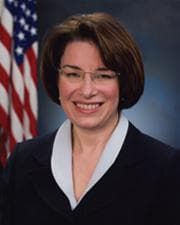
Amy Klobuchar
Democrat · MN · Senator
Votes with party: 81.7% (902 recorded votes)
Full profile: /officials/K000367
Source: Congress.gov · FEC
Cosponsors (8)
Members who have signed on to support this bill since introduction. Source: Congress.gov.
- Christopher Murphy (D-CT)Original· 2026-03-17
- Cory A. Booker (D-NJ)Original· 2026-03-17
- Elizabeth Warren (D-MA)Original· 2026-03-17
- Mazie K. Hirono (D-HI)Original· 2026-03-17
- Peter Welch (D-VT)Original· 2026-03-17
- Richard Blumenthal (D-CT)Original· 2026-03-17
- Richard J. Durbin (D-IL)Original· 2026-03-17
- Sheldon Whitehouse (D-RI)Original· 2026-03-17
Latest Action
The most recent step in the bill's legislative path. Committee Activity below shows referrals and reports; the full action-by-action history including floor proceedings lives at Congress.gov →
Committee Activity
Currently in
- Senate Committee on the JudiciaryReferred To · 2026-03-17
Previously
- Judiciary CommitteeReferred To · 2026-03-17
Plain-English Summary
This bill would require large technology and online companies to be more transparent about their business practices and give the government stronger tools to investigate whether they're unfairly crushing competition. It aims to prevent dominant companies from using their market power to block smaller competitors or favor their own products, affecting how platforms like social media sites and online marketplaces operate. The legislation would make it easier for regulators to challenge anticompetitive behavior in court and impose penalties on companies that violate antitrust laws.
AI-assisted summary generated from the official bill metadata (title, subjects, actions) sourced from Congress.gov. Cached and reviewed. Always verify against the official text linked below.
Subjects
Commerce
Full Bill Text
Verbatim text published on Congress.gov via GovInfo. Use Cmd+F / Ctrl+F to search within this excerpt.
[Congressional Bills 119th Congress] [From the U.S. Government Publishing Office] [S. 4107 Introduced in Senate (IS)] <DOC> 119th CONGRESS 2d Session S. 4107 To amend section 5 of the Clayton Act to include proposed voluntary dismissals in the court's consideration of proposed consent judgments and clarify the public interest, and for other purposes. _______________________________________________________________________ IN THE SENATE OF THE UNITED STATES March 17, 2026 Ms. Klobuchar (for herself, Mr. Durbin, Mr. Booker, Ms. Hirono, Mr. Blumenthal, Mr. Welch, Ms. Warren, Mr. Murphy, and Mr. Whitehouse) introduced the following bill; which was read twice and referred to the Committee on the Judiciary _______________________________________________________________________ A BILL To amend section 5 of the Clayton Act to include proposed voluntary dismissals in the court's consideration of proposed consent judgments and clarify the public interest, and for other purposes. Be it enacted by the Senate and House of Representatives of the United States of America in Congress assembled, SECTION 1. SHORT TITLE. This Act may be cited as the ``Antitrust Accountability and Transparency Act''. SEC. 2. AMENDMENTS. Section 5 of the Clayton Act (15 U.S.C. 16) is amended-- (1) in subsection (a), by striking ``or under section 5 of the Federal Trade Commission Act which could give rise to a claim for relief under the antitrust laws''; (2) in subsection (b)-- (A) in the matter preceding paragraph (1)-- (i) by inserting ``or administrative'' after ``any civil''; (ii) by inserting ``, or in the case of an administrative proceeding, a district court in which 1 or more defendants is incorporated or headquartered,'' after ``the district court before which such proceeding is pending''; (iii) by striking ``published by the United States'' and inserting ``published'' each place it appears; (iv) by striking ``60 days'' and inserting ``45 days''; (v) by inserting ``A district court to which a consent judgment is submitted by the Federal Trade Commission in compliance with this subsection is invested with jurisdiction under this section.'' after ``prior to the effective date of such judgment.''; and (vi) by striking ``sixty-day period'' and inserting ``45-day period''; (B) in paragraph (3), by inserting ``any commitments made by the parties to the United States or Federal Trade Commission not memorialized in the proposal related to the proceeding, how the proposal remedies any material risk that the antitrust laws may be violated,'' after ``thereby,''; and (C) in paragraph (6), by inserting ``or Federal Trade Commission, including any settlement offers, divestitures, or other remedies, including the process through which these proposals were considered'' before the period; (3) in subsection (c) by striking ``60 days'' and inserting ``45 days''; (4) in subsection (d)-- (A) by striking ``during the 60-day period'' and inserting the following: ``(1) during the 45-day period''; (B) in paragraph (1), as so designated-- (i) by striking ``his designee'' and inserting ``a designee thereof''; (ii) by striking ``such 60-day time period'' and inserting ``such 45-day time period''; (iii) by striking ``At the close of'' and inserting ``Not later than 30 days after the close of''; (iv) by inserting ``Parties that submitted comments shall be allowed to submit a reply to the responses published by the United States or Federal Trade Commission.'' before the last sentence; and (v) by adding at the end ``Compliance with this section by the Federal Trade Commission shall satisfy any other notice-and-comment requirements relating to consent judgments.''; and (C) by adding at the end the following: ``(2)(A) In a proceeding brought under section 7, the parties shall continue to hold all assets related to the transaction separate as if they are subject to a waiting period under section 7A until the date that is 15 days…
Show the remaining 950 wordsHide the remaining 950 words
after the United States or Federal Trade Commission files with the district court and causes to be published in the Federal Register a response to comments under this subsection. The court may extend the period during which the parties are required to hold all assets related to the transaction separate upon a finding that-- ``(i) there is a reasonable likelihood that the court will determine that the consent judgment does not meet the requirements in subsection (e)(1); and ``(ii) the balance of the equities favors extending the order. ``(B) In the event that the court extends the period during which the parties are required to hold all assets separate, the court shall make all reasonable efforts to expedite its determination under subsection (e)(1). ``(3) A violation of paragraph (2) shall be treated as a violation of section 7A and parties may be liable for civil penalties pursuant to subsection (g) of that section. ``(4) Any order to hold assets separate shall expire upon a finding by the court that the consent judgment satisfies the requirements under subsection (e)(1).''. (5) in subsection (e)-- (A) in paragraph (1)-- (i) in the matter preceding subparagraph (A), by inserting ``there is a reasonable belief, based on evidence and reasoned analysis, that'' after ``the court shall determine that''; and (ii) in subparagraph (A), by inserting ``, does not permit any transaction, merger, agreement, business practice, or other course of conduct that creates a material risk of violating the antitrust laws, and that the provisions of the consent judgment are reasonably tailored to the violations of the antitrust laws alleged in the complaint'' after ``whether the consent judgment is in the public interest''; (B) in paragraph (2), by striking ``or to require the court to permit anyone to intervene'' and inserting ``, but the court shall take into account any written request for a hearing by any Federal or State agency, including any State attorney general, when determining whether to conduct an evidentiary hearing''; and (C) by adding at the end the following: ``(3) If the court determines that an evidentiary hearing is appropriate, any Federal or State agency, including any State attorney general that made a written request under paragraph (2), shall be allowed to intervene. Nothing shall require the court to permit any other party to intervene. ``(4) A consent judgment filed under this section shall take effect only upon entry by the court. The decision to enter a consent judgment under this section is within the discretion of the court, which need not defer to the United States's predictions about the efficacy of its remedies.''; (6) in subsection (f)-- (A) by inserting ``current or former'' before ``Government officials''; (B) in paragraph (4), by striking ``and'' at the end; (C) by redesignating paragraph (5) as paragraph (7); and (D) by inserting after paragraph (4) the following: ``(5) order the production of the communications that were disclosed or should have been disclosed pursuant to subsection (g), including all related documents and testimony relating to the communications; ``(6) order the production of information or testimony regarding the provision of, or offer to provide, a benefit or concession by any party in the proceeding to the Government or an employee or officer thereof, including payments, donations, or alterations in policy or business practices that the court finds may have a reasonable connection to the proceeding or decision to enter the proposed judgment; and''; (7) in subsection (g)-- (A) by inserting ``, including the Executive Office of the President,'' after ``any officer or employee of the United States''; and (B) by striking ``except that any'' and inserting ``, and shall include the date of each written or oral communication and each author of, recipient of, and participant to each written or oral communication. Any''; (8) in subsection (h), by inserting ``, or by the Federal Trade Commission under section 5 of the Federal Trade Commission Act (15 U.S.C. 45),'' after ``under section 4A of this Act''; and (9) by adding at the end the following: ``(j) Voluntary Dismissals.-- ``(1) In general.--Any proposal to file a motion to voluntarily dismiss any civil proceeding brought by the United States or Federal Trade Commission under the antitrust laws shall be filed with the district court before which such proceeding is pending, and published in the Federal Register not less than 45 days prior to the effective date of such voluntary dismissal. The case shall be stayed during this 45- day period. ``(2) Substitution.--During the 45-day period under paragraph (1), any State attorney general may file a motion for substitution in the proceeding. A court shall grant the motion for substitution unless presented with clear and convincing evidence by the parties that there are no genuine issues of material fact that could support any claim in the proceeding or that the defendant would be entitled to judgment as a matter of law. If the motion for substitution is granted, the action does not abate, but proceeds in favor of or against the remaining parties. ``(3) Transfer.--Upon a grant of a motion for substitution under paragraph (2), the United States or the Federal Trade Commission shall promptly transfer all materials relevant to the litigation that are not subject to the deliberative process privilege to the applicable State attorneys general and the case shall continue on a schedule that will not cause undue delay, as determined appropriate by the court. ``(k) References.--In this section, all references to-- ``(1) the United States or the Attorney General shall be deemed to include the Federal Trade Commission, as applicable; and ``(2) the antitrust laws shall be deemed to include an unfair method of competition under section 5 of the Federal Trade Commission Act (15 U.S.C. 45).''. <all>
Related legislation
Bills by the same sponsor or covering overlapping subjects.
- S2339EARLY Act Reauthorization of 2025Passed Senate · 2026-10-05
- SRES908A resolution supporting the designation of the week of September 21 through September 25, 2026, as "National Hazing Awareness Week".Referred to Committee · 2026-09-24
- SRES858A resolution honoring the life and legacy of the late Constance Benjamin Clery.Referred to Committee · 2026-09-16
- S3467Virginia Graeme Baker Pool and Spa Safety Reauthorization ActReferred to Committee · 2026-09-16