HCONRES80Referred to Committee
Recognizing the duty of Congress to meet the needs of working women.
Introduced
In Committee
3
Passed One Chamber4
Passed Both5
Signed into Law119th
Congress
2026-03-25
Introduced
26
Cosponsors
HCONRES
ⓘType
Sponsor
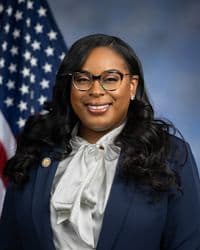
LaMonica McIver
Democrat · NJ · Representative
Votes with party: 98.1% (670 recorded votes)
Full profile: /officials/M001229
Source: Congress.gov · FEC
Cosponsors (26)
Members who have signed on to support this bill since introduction. Source: Congress.gov.
- Daniel S. Goldman (D-NY-10)Original· 2026-03-25
- Debbie Dingell (D-MI-6)Original· 2026-03-25
- Delia C. Ramirez (D-IL-3)Original· 2026-03-25
- Eleanor Holmes Norton (D-DC)Original· 2026-03-25
- Frederica S. Wilson (D-FL-24)Original· 2026-03-25
- Janice D. Schakowsky (D-IL-9)Original· 2026-03-25
- Lateefah Simon (D-CA-12)Original· 2026-03-25
- Paul Tonko (D-NY-20)Original· 2026-03-25
- Raja Krishnamoorthi (D-IL-8)Original· 2026-03-25
- Rosa L. DeLauro (D-CT-3)Original· 2026-03-25
- Sarah McBride (D-DE)Original· 2026-03-25
- Teresa Leger Fernandez (D-NM-3)Original· 2026-03-25
- Adelita S. Grijalva (D-AZ-7)· 2026-03-26
- Alma S. Adams (D-NC-12)· 2026-03-26
- Yvette D. Clarke (D-NY-9)· 2026-03-27
- Andrea Salinas (D-OR-6)· 2026-04-06
- Bonnie Watson Coleman (D-NJ-12)· 2026-04-06
- Chellie Pingree (D-ME-1)· 2026-04-06
- Emily Randall (D-WA-6)· 2026-04-06
- Suzanne Bonamici (D-OR-1)· 2026-04-06
- Brittany Pettersen (D-CO-7)· 2026-04-27
- Judy Chu (D-CA-28)· 2026-04-27
- Steve Cohen (D-TN-9)· 2026-04-27
Latest Action
The most recent step in the bill's legislative path. Committee Activity below shows referrals and reports; the full action-by-action history including floor proceedings lives at Congress.gov →
Committee Activity
Currently in
- House Committee on Education and WorkforceReferred To · 2026-03-25
Previously
- Education and Workforce CommitteeReferred To · 2026-03-25
Plain-English Summary
This resolution expresses Congress's commitment to addressing workplace issues that affect women workers, such as pay equity, childcare access, and protection from discrimination. While it doesn't create new laws or programs, it signals legislative intent to prioritize policies that help working women balance employment with family responsibilities and ensure fair treatment in the workplace. The resolution has been sent to the House Committee on Education and Workforce for consideration.
AI-assisted summary generated from the official bill metadata (title, subjects, actions) sourced from Congress.gov. Cached and reviewed. Always verify against the official text linked below.
Subjects
Labor and Employment
Full Bill Text
Verbatim text published on Congress.gov via GovInfo. Use Cmd+F / Ctrl+F to search within this excerpt.
[Congressional Bills 119th Congress] [From the U.S. Government Publishing Office] [H. Con. Res. 80 Introduced in House (IH)] <DOC> 119th CONGRESS 2d Session H. CON. RES. 80 Recognizing the duty of Congress to meet the needs of working women. _______________________________________________________________________ IN THE HOUSE OF REPRESENTATIVES March 25, 2026 Mrs. McIver (for herself, Ms. DeLauro, Ms. Leger Fernandez, Ms. Norton, Mr. Goldman of New York, Ms. Wilson of Florida, Mr. Tonko, Ms. Schakowsky, Ms. McBride, Mr. Krishnamoorthi, Ms. Simon, Mrs. Dingell, and Mrs. Ramirez) submitted the following concurrent resolution; which was referred to the Committee on Education and Workforce _______________________________________________________________________ CONCURRENT RESOLUTION Recognizing the duty of Congress to meet the needs of working women. Whereas the Congress recognizes its obligation to guarantee equal protection of the law to all workers; Whereas this obligation requires the Congress to safeguard workers from unequal treatment on the basis of real or perceived sex, gender, or nonconformity to norms or stereotypes thereof; Whereas working families are working paycheck to paycheck and deserve a quality, affordable life, which can only be made possible by addressing the needs of the approximately 75,000,000 women in the workforce; Whereas recent executive and administration actions have caused disproportionate harm to women in the broader rollback of workplace rights, freedoms, and protections; Whereas women comprise nearly half of the Nation's workforce, and are essential to the economic stability, growth, and prosperity of the United States, and make indispensable contributions across every sector of the economy, serving as leaders in education, health care, public service, caregiving, and other vital industries; Whereas persistent wage disparities, loopholes in section 6(d) of the Fair Labor Standards Act of 1938 (commonly known as the ``Equal Pay Act of 1963'') (29 U.S.C. 206(d)), occupational segregation, workplace discrimination, and gender-based violence and harassment continue to disproportionately burden working women, particularly women of color; Whereas recent progress toward pay parity and gender equity has been undermined by deliberate, coordinated opposition, including legislative, administrative, and judicial actions weakening civil rights enforcement, removing workplace protections, limiting access to essential health care, and destabilizing programs that support working families; Whereas the administration has specifically targeted for elimination such Federal programs which advance gender equity in the Nation and abroad; Whereas actions of the President have threatened to eliminate the Women's Bureau of the Department of Labor, which was established by Congress in 1920 and is the only Federal agency tasked with advancing economic opportunity for working women and which, for more than 100 years, has concretely worked to improve the wages and working conditions for women across the Nation; Whereas the targeted elimination of equal opportunity obligations under apprenticeship programs of the Department of Labor has undermined women's pathways to high-paid careers in the trades traditionally dominated by men; Whereas the rescission of the ``Enforcement Guidance on Harassment in the Workplace'' of the Equal Employment Opportunity Commission has created intentional confusion and left women vulnerable to harassment in the workplace; Whereas reductions in staffing, funding, and enforcement capacity at Federal agencies charged with protecting workers' rights and enforcing civil rights laws have weakened oversight of workplace discrimination, harassment, wage theft, and retaliation; Whereas women are disproportionately represented in public sector employment, and cuts to public programs and services disproportionately threaten women's employment, wages, and retirement security; Whereas the administration has undertaken reckless mass layoffs which gutted Federal agencies with majority-women workforces, including the Department of Veterans Affairs, Department of Education, Department of Health and Human Services, Department of the Treasury, and Department of Housing and Urban Development; Whereas not only are women of color and immigrant women overrepresented in care work, but…
Show the remaining 660 wordsHide the remaining 660 words
the critical caregiving services women provide are often otherwise taken on as unpaid labor by women; Whereas the lack of Federal actions to create a robust, well-paid care industry harms women's economic opportunity and directly exploits some of the most vulnerable women; Whereas the administration has unjustly sought to push Federal contractors, grant recipients, and even private employers to abandon efforts to promote gender and racial equity at work; Whereas the administration has sought to erode workers' ability to form unions and collectively bargain for their rights, who organized as such have won a narrower gender pay gap; Whereas, consequently-- (1) data from the Bureau of Labor Statistics indicate volatility in women's labor force participation in 2025, with more than 455,000 women exiting the workforce in the United States and the steepest declines among mothers of young children, especially Black mothers; (2) unemployment among women, especially Black women, has increased under the Administration, with Black women's unemployment greater than 7 percent; and (3) the wage gap between women and men has increased for 2 consecutive years, highlighting the compounded effects of the policy failures described herein; Whereas women continue to face barriers to economic advancement, and disproportionate caregiving responsibilities, all of which are exacerbated by the cost of living crisis and rising costs of housing, health care, childcare, food, and education; and Whereas Congress, the first branch of the United States Government, has a duty to act decisively to advance the rights and freedoms of working women in face of these barriers: Now, therefore, be it Resolved by the House of Representatives (the Senate concurring), That Congress-- (1) recognizes an affirmative duty to ensure women have equal opportunity within the workforce, as a prerequisite for economic security, democratic participation, shared prosperity, and full participation in public life; (2) recognizes that the workforce of the Nation is stronger, more innovative, and more competitive when women are able to contribute and lead across all industries; (3) affirms its commitment to economic prosperity for all, including-- (A) equal pay for equal work; (B) pay transparency; (C) workplaces free from discrimination; (D) workplace safety standards and regulations designed to protect the health of the Nation's workers; (E) comprehensive and accessible health care, including reproductive health care; (F) affordable, high-quality childcare and early education; (G) paid family and medical leave; (H) paid sick days; (I) predictable scheduling and fair labor standards; and (J) access to affordable housing, education, and workforce development opportunities; (4) affirms its commitment to ensuring that all women, regardless of race, immigration status, language, or occupation, are able to work with dignity, free from violence, harassment, discrimination, retaliation, and abuse; (5) recognizes the value of all work, especially domestic and part-time work, and recognizes its obligation to ensure that such work is dignified with fair pay, benefits, protections, and working conditions; (6) condemns actions and policies that weaken civil rights enforcement, undermine workplace protections, reduce access to health care and essential services, or otherwise threaten the economic security of working women; (7) commits itself to restoring and strengthening Federal agencies that combat discrimination in the workplace, including the Equal Employment Opportunity Commission and the Office of Federal Contract Compliance Programs; (8) reaffirms its commitment to ensuring all people can live a life with dignity by raising wages, including by raising the Federal minimum wage, and eliminating tipped and subminimum wages; (9) reaffirms its commitment to expanding access to high- paying jobs across gender lines by strengthening programs that dismantle occupational segregation; (10) recognizes the right of every worker to join a union, free from interference and intimidation, and bargain collectively for fair wages and working conditions; (11) calls upon Federal, State, and local governments, employers, labor organizations, and community institutions to work collaboratively to ensure that all working women have the opportunity to thrive and be free from harassment and discrimination; and (12) declares that addressing the immediate needs of working women is essential to the prosperity of the United States. <all>
Related legislation
Bills by the same sponsor or covering overlapping subjects.
- HR10371Ensuring SBA Implementation of GAO Recommendations Act of 2026Reported by Committee · 2026-10-09
- HR9810Small Business Development Centers Improvement Act of 2026Referred to Committee · 2026-07-21
- HR9587Summer Meals REACH Act of 2026Referred to Committee · 2026-07-02
- HR9032RESTORE Third Spaces Act of 2026Referred to Committee · 2026-05-26