HJRES10Referred to Committee
Proposing a balanced budget amendment to the Constitution of the United States.
Introduced
In Committee
3
Passed One Chamber4
Passed Both5
Signed into Law119th
Congress
2025-01-03
Introduced
15
Cosponsors
HJRES
ⓘType
Sponsor
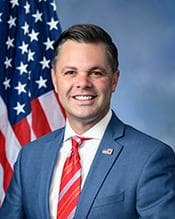
Zachary Nunn
Republican · IA · Representative
Votes with party: 96.1% (641 recorded votes)
Full profile: /officials/N000193
Source: Congress.gov · FEC
Cosponsors (15)
Members who have signed on to support this bill since introduction. Source: Congress.gov.
- Don Bacon (R-NE-2)Original· 2025-01-03
- Erin Houchin (R-IN-9)Original· 2025-01-03
- Glenn Grothman (R-WI-6)Original· 2025-01-03
- J. French Hill (R-AR-2)Original· 2025-01-03
- Ken Calvert (R-CA-41)Original· 2025-01-03
- Rick W. Allen (R-GA-12)Original· 2025-01-03
- Robert E. Latta (R-OH-5)Original· 2025-01-03
- Ron Estes (R-KS-4)Original· 2025-01-03
- Ryan K. Zinke (R-MT-1)Original· 2025-01-03
- Tracey Mann (R-KS-1)Original· 2025-01-03
- Brett Guthrie (R-KY-2)· 2025-01-13
- Michelle Fischbach (R-MN-7)· 2025-01-15
- Derek Schmidt (R-KS-2)· 2025-07-15
- Tony Wied (R-WI-8)· 2025-07-17
- Chuck Edwards (R-NC-11)· 2025-12-09
Latest Action
The most recent step in the bill's legislative path. Committee Activity below shows referrals and reports; the full action-by-action history including floor proceedings lives at Congress.gov →
Committee Activity
Currently in
- House Committee on the JudiciaryReferred To · 2025-01-03
Plain-English Summary
This joint resolution proposes a constitutional amendment prohibiting total outlays for a fiscal year from exceeding total receipts for that fiscal year unless Congress authorizes the excess by a three-fifths roll call vote of each chamber. The prohibition excludes outlays for repayment of debt principal and receipts derived from borrowing. The amendment requires a three-fifths roll call vote of each chamber to increase the public debt limit. It prohibits a bill to increase revenue from becoming law unless it has been approved by a majority roll call vote of each chamber. The amendment also requires the President to submit an annual budget in which total outlays do not exceed total receipts. Congress may waive these requirements due to a declaration of war or a military conflict that causes an imminent and serious military threat to national security.
Plain-English rewrite of the Congressional Research Service summary published on Congress.gov. Cached and reviewed.
Subjects
Economics and Public Finance
Full Bill Text
Verbatim text published on Congress.gov via GovInfo. Use Cmd+F / Ctrl+F to search within this excerpt.
[Congressional Bills 119th Congress] [From the U.S. Government Publishing Office] [H.J. Res. 10 Introduced in House (IH)] <DOC> 119th CONGRESS 1st Session H. J. RES. 10 Proposing a balanced budget amendment to the Constitution of the United States. _______________________________________________________________________ IN THE HOUSE OF REPRESENTATIVES January 3, 2025 Mr. Nunn of Iowa (for himself, Mr. Allen, Mr. Latta, Mr. Zinke, Mr. Hill of Arkansas, Mr. Estes, Mrs. Houchin, Mr. Grothman, Mr. Mann, Mr. Calvert, and Mr. Bacon) submitted the following joint resolution; which was referred to the Committee on the Judiciary _______________________________________________________________________ JOINT RESOLUTION Proposing a balanced budget amendment to the Constitution of the United States. Resolved by the Senate and House of Representatives of the United States of America in Congress assembled (two-thirds of each House concurring therein), That the following article is proposed as an amendment to the Constitution of the United States, which shall be valid to all intents and purposes as part of the Constitution when ratified by the legislatures of three-fourths of the several States within seven years after the date of its submission for ratification: ``Article-- ``Section 1. Total outlays for any fiscal year shall not exceed total receipts for that fiscal year, unless three-fifths of the whole number of each House of Congress shall provide by law for a specific excess of outlays over receipts by a rollcall vote. ``Section 2. The limit on the debt of the United States held by the public shall not be increased, unless three-fifths of the whole number of each House shall provide by law for such an increase by a rollcall vote. ``Section 3. Prior to each fiscal year, the President shall transmit to the Congress a proposed budget for the United States Government for that fiscal year in which total outlays do not exceed total receipts. ``Section 4. No bill to increase revenue shall become law unless approved by a majority of the whole number of each House by a rollcall vote. ``Section 5. The Congress may waive the provisions of this article for any fiscal year in which a declaration of war is in effect. The provisions of this article may be waived for any fiscal year in which the United States is engaged in military conflict which causes an imminent and serious military threat to national security and is so declared by a joint resolution, adopted by a majority of the whole number of each House, which becomes law. Any such waiver must identify and be limited to the specific excess or increase for that fiscal year made necessary by the identified military conflict. ``Section 6. The Congress shall enforce and implement this article by appropriate legislation, which may rely on estimates of outlays and receipts. ``Section 7. Total receipts shall include all receipts of the United States Government except those derived from borrowing. Total outlays shall include all outlays of the United States Government except for those for repayment of debt principal. ``Section 8. This article shall take effect beginning with the fifth fiscal year beginning after its ratification.''. <all>
Related legislation
Bills by the same sponsor or covering overlapping subjects.
- HR10234CLEAR Forms ActReferred to Committee · 2026-09-16
- HR4936TRAPS ActReferred to Committee · 2026-09-16
- HRES1553Expressing support for the designation of the week of September 21, 2026, as the "Ray Gaesser Memorial Farm Safety Week" to recognize the life and legacy of Ray Gaesser, who passed away in a tragic farming accident, and promote farm safety in the honor of Ray Gaesser.Referred to Committee · 2026-09-16
- HR2978GUARD ActPassed House · 2026-09-16