HR10606Referred to Committee
FLAFO Act
Introduced
In Committee
3
Passed One Chamber4
Passed Both5
Signed into Law119th
Congress
2026-09-24
Introduced
1
Cosponsors
HR
ⓘType
Sponsor
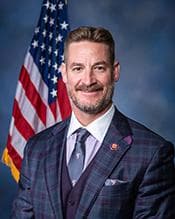
W. Gregory Steube
Republican · FL · Representative
Votes with party: 90.3% (652 recorded votes)
Full profile: /officials/S001214
Source: Congress.gov · FEC
Cosponsors (1)
Members who have signed on to support this bill since introduction. Source: Congress.gov.
Latest Action
The most recent step in the bill's legislative path. Committee Activity below shows referrals and reports; the full action-by-action history including floor proceedings lives at Congress.gov →
Referred to the Committee on Oversight and Government Reform, and in addition to the Committee on the Judiciary, for a period to be subsequently determined by the Speaker, in each case for consideration of such provisions as fall within the jurisdiction of the committee concerned.
2026-09-24
Source: Congress.gov
Committee Activity
Currently in
- House Committee on Oversight and Government ReformReferred To · 2026-09-24
- House Committee on the JudiciaryReferred To · 2026-09-24
Plain-English Summary
Plain-English summary pending. Introduced on 2026-09-24. Check back soon — summaries are generated as bills progress through Congress.
Subjects
Government Operations and Politics
Full Bill Text
Verbatim text published on Congress.gov via GovInfo. Use Cmd+F / Ctrl+F to search within this excerpt.
[Congressional Bills 119th Congress] [From the U.S. Government Publishing Office] [H.R. 10606 Introduced in House (IH)] <DOC> 119th CONGRESS 2d Session H. R. 10606 To prohibit the use of automated license plate reader surveillance systems by governmental entities, and for other purposes. _______________________________________________________________________ IN THE HOUSE OF REPRESENTATIVES September 24, 2026 Mr. Steube introduced the following bill; which was referred to the Committee on Oversight and Government Reform, and in addition to the Committee on the Judiciary, for a period to be subsequently determined by the Speaker, in each case for consideration of such provisions as fall within the jurisdiction of the committee concerned _______________________________________________________________________ A BILL To prohibit the use of automated license plate reader surveillance systems by governmental entities, and for other purposes. Be it enacted by the Senate and House of Representatives of the United States of America in Congress assembled, SECTION 1. SHORT TITLE. This Act may be cited as the ``Facilitating Liberty and Accountability for Flock Observations Act'' or the ``FLAFO Act''. SEC. 2. FINDINGS. Congress finds the following: (1) The Fourth Amendment to the Constitution enshrines the right of the American people to be secured against any unreasonable searches and seizures. (2) Automated license plate reader technology, including those provided by Flock Safety and other similar enterprises, have expanded from systems initially designed to identify vehicles associated with criminal activity into large-scale surveillance mechanisms capable of collecting some of the American people's most sensitive location information. (3) Certain automated license plate reader systems continuously collect information on every vehicle traveling on public roads and neighboring private property, to include not just license plate numbers, but vehicle make, model, color, and other distinguishing characteristics. (4) Such systems incorporate artificial intelligence and machine learning to analyze and process such data into an aggregated and centralized form, thus permitting licensed users to reconstruct an individual's movements, associations, and patterns of life without any individualized suspicion. Lacking adequate safeguards, such a surveillance system may assist a government official in abridging certain constitutionally protected rights of the American people, to include visits to places of worship, medical facilities, political gatherings, and other personal and sensitive sites. (5) It is evident that such technology encroaches upon every American's right against unreasonable searches and seizures as guaranteed by the Fourth Amendment, and the right to peaceful assembly and free exercise of religion as guaranteed by the First Amendment. (6) In the incredible wisdom of Benjamin Franklin, he is quoted in a 1755 reply to the Pennsylvania Assembly by warning them that ``those who would give up essential Liberty, to purchase a little temporary Safety, deserve neither Liberty nor Safety''. That is as true today as it was in 1755. (7) It is incumbent upon Congress to protect the civil liberties of the American people against any threat thereto and prevent the Federal Government from providing any form of support or authorization for activities that violate the Constitution. SEC. 3. PROHIBITION ON NETWORKED SURVEILLANCE. (a) In General.--Except as provided in this Act, no Federal agency may-- (1) purchase, lease, operate, or access a covered system; (2) request that another governmental, public, or private entity provide information from a covered system; or (3) provide information to a covered system. (b) Warrant Requirement.-- (1) In general.--A Federal agency may only access information from a covered system or make a request described in subsection (a)(2) if the agency obtains a warrant, except as provided in paragraph (2). (2) Exception.--A Federal agency may access information from a covered system or make a request described in subsection (a)(2) without a warrant only if the head of the…
Show the remaining 738 wordsHide the remaining 738 words
agency determines that such information is reasonably necessary to-- (A) locate a missing or endangered person; (B) respond to an imminent threat of death, serious bodily injury, kidnapping, or other emergency involving an immediate danger to a person; or (C) conduct an investigation involving a person believed to be associated with terrorism, espionage, sabotage, or an agent of a foreign power. (c) Penalties.-- (1) Criminal penalties.--Any officer or employee of the Federal Government who knowingly violates this section shall be imprisoned for not more than 5 years, fined under title 18, United States Code, or both. (2) Civil penalty.--Any officer or employee of the Federal Government who knowingly violates this section shall be subject to a civil penalty in an amount not more than $100,000. (3) Private right of action.--Any person aggrieved by a violation of this section may bring a civil action in an appropriate United States district court against an officer or employee of the Federal Government who knowingly violated this section or against the United States and may recover damages, attorney's fees and costs, and declaratory or injunctive relief as appropriately determined by such court. In any action under this paragraph, sovereign immunity or qualified immunity may not be raised as a defense. (d) Certain Agencies Excluded.--This Act does not apply to any of the following: (1) The United States Secret Service, to the extent such agency is conducting activities related to their duties under section 3056 of title 18, United States Code. (2) U.S. Customs and Border Protection, to the extent such agency is conducting activities related to-- (A) border security; (B) immigration or customs enforcement; (C) operations at a port of entry or any other checkpoint of U.S. Customs and Border Protection; or (D) the detection, interdiction, or investigation of human smuggling, narcotics trafficking, or other cross-border criminal activity. (3) The Department of Defense, the Department of Homeland Security, or the Department of Energy, to the extent such a agency is conducting an operation in connection with a military or Coast Guard installation, nuclear facility, or other national security facility under the jurisdiction of such Department, for-- (A) installation access control; (B) force protection; (C) physical security; (D) counterespionage; (E) counterintelligence; or (F) counterterrorism operations. (4) The sharing of any information between an agency described in paragraphs (1) through (3) and any other Federal agency, for the purpose of conducting an activity or operation in any such paragraph. SEC. 4. PROHIBITION ON PROVIDING LAW ENFORCEMENT ACCESS. (a) Criminal Penalty.--Whoever, being the operator of a covered system, in or affecting interstate or foreign commerce, knowingly provides a Federal agency with access to a covered system, or with any information obtained pursuant to a covered system, except in accordance with this Act, shall be imprisoned not more than 5 years, fined under title 18, United States Code, or both. (b) Civil Penalty.--Whoever violates subsection (a) shall be subject to a civil penalty in an amount not more than $100,000. (c) Private Right of Action.--Any person aggrieved by a violation of this section may bring a civil action in an appropriate United States district court and may recover damages, attorney's fees and costs, and declaratory or injunctive relief, as determined appropriate by the court. SEC. 5. LIMITATION ON FEDERAL FUNDS. (a) In General.--In order to be eligible to receive Federal funds made available by the Department of Justice, a State, unit of local government, or Indian Tribe shall establish and implement requirements that are substantially similar to the requirements under this Act for the agencies of that jurisdiction. (b) Certification.--On an annual basis, the Attorney General shall certify that a State, unit of local government, or Indian Tribe is in compliance with this section. SEC. 6. DEFINITIONS. In this Act: (1) Automated license plate reader system.--The term ``automated license plate reader system'' or ``ALPR system'' means any camera, sensor, or associated hardware or software system that automatically captures, records, analyzes, processes, aggregates, or stores a motor vehicle license plate, image, location, date, time, or other identifying vehicle information or characteristic. (2) Covered system.--The term ``covered system'' means an ALPR system that-- (A) stores or transmits vehicle-location information in a centralized, networked, or multi- or cross-jurisdictional database; (B) permits users to search historical vehicle- location information across jurisdictions; or (C) uses artificial intelligence or machine learning to identify, classify, track, or search for vehicles based on characteristics other than a complete or partial license plate number. <all>
Related legislation
Bills by the same sponsor or covering overlapping subjects.
- HR10607American Fuel Affordability ActReferred to Committee · 2026-09-24
- HR9498Taxpayer Advocate Participation ActPassed House · 2026-09-16
- HR5366Doug LaMalfa Federal Disaster Tax Relief Certainty ActEnacted into Law · 2026-09-11
- HR10117GATOR Act of 2026Referred to Committee · 2026-09-10