HR10841Referred to Committee
Securing Elections From AI Deception Act
Introduced
In Committee
3
Passed One Chamber4
Passed Both5
Signed into Law119th
Congress
2026-10-19
Introduced
30
Cosponsors
HR
ⓘType
Sponsor
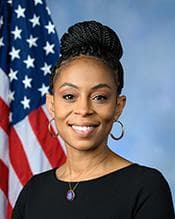
Shontel M. Brown
Democrat · OH · Representative
Votes with party: 98.7% (672 recorded votes)
Full profile: /officials/B001313
Source: Congress.gov · FEC
Cosponsors (30)
Members who have signed on to support this bill since introduction. Source: Congress.gov.
- Adelita S. Grijalva (D-AZ-7)Original· 2026-10-19
- André Carson (D-IN-7)Original· 2026-10-19
- Angie Craig (D-MN-2)Original· 2026-10-19
- Ayanna Pressley (D-MA-7)Original· 2026-10-19
- Bonnie Watson Coleman (D-NJ-12)Original· 2026-10-19
- Christopher R. Deluzio (D-PA-17)Original· 2026-10-19
- Daniel S. Goldman (D-NY-10)Original· 2026-10-19
- Debbie Dingell (D-MI-6)Original· 2026-10-19
- Dwight Evans (D-PA-3)Original· 2026-10-19
- Ed Case (D-HI-1)Original· 2026-10-19
- Emilia Strong Sykes (D-OH-13)Original· 2026-10-19
- Frederica S. Wilson (D-FL-24)Original· 2026-10-19
- Hillary J. Scholten (D-MI-3)Original· 2026-10-19
- Jahana Hayes (D-CT-5)Original· 2026-10-19
- Jared Huffman (D-CA-2)Original· 2026-10-19
- Jasmine Crockett (D-TX-30)Original· 2026-10-19
- Josh Gottheimer (D-NJ-5)Original· 2026-10-19
- Marc A. Veasey (D-TX-33)Original· 2026-10-19
- Marilyn Strickland (D-WA-10)Original· 2026-10-19
- Melanie A. Stansbury (D-NM-1)Original· 2026-10-19
- Morgan McGarvey (D-KY-3)Original· 2026-10-19
- Nikema Williams (D-GA-5)Original· 2026-10-19
- Paul Tonko (D-NY-20)Original· 2026-10-19
- Raja Krishnamoorthi (D-IL-8)Original· 2026-10-19
- Robert Garcia (D-CA-42)Original· 2026-10-19
- Sanford D. Bishop, Jr. (D-GA-2)Original· 2026-10-19
- Seth Magaziner (D-RI-2)Original· 2026-10-19
- Summer L. Lee (D-PA-12)Original· 2026-10-19
- Valerie P. Foushee (D-NC-4)Original· 2026-10-19
- Yassamin Ansari (D-AZ-3)Original· 2026-10-19
Latest Action
The most recent step in the bill's legislative path. Committee Activity below shows referrals and reports; the full action-by-action history including floor proceedings lives at Congress.gov →
Committee Activity
Currently in
- House Committee on Energy and CommerceReferred To · 2026-10-19
Plain-English Summary
Plain-English summary pending. Introduced on 2026-10-19. Check back soon — summaries are generated as bills progress through Congress.
Full Bill Text
Verbatim text published on Congress.gov via GovInfo. Use Cmd+F / Ctrl+F to search within this excerpt.
[Congressional Bills 119th Congress] [From the U.S. Government Publishing Office] [H.R. 10841 Introduced in House (IH)] <DOC> 119th CONGRESS 2d Session H. R. 10841 To prohibit the use of artificial intelligence to deprive or defraud individuals of the right to vote in elections for public office, and for other purposes. _______________________________________________________________________ IN THE HOUSE OF REPRESENTATIVES October 19, 2026 Ms. Brown (for herself, Ms. Strickland, Mr. Magaziner, Mr. Veasey, Ms. Crockett, Ms. Lee of Pennsylvania, Mr. Evans of Pennsylvania, Mr. Garcia of California, Mr. Krishnamoorthi, Mr. Carson, Mrs. Hayes, Ms. Scholten, Ms. Ansari, Ms. Craig, Ms. Williams of Georgia, Mrs. Foushee, Mrs. Watson Coleman, Mr. Bishop, Mr. Tonko, Mrs. Dingell, Mr. McGarvey, Mrs. Sykes, Mr. Goldman of New York, Mr. Deluzio, Mr. Case, Mr. Gottheimer, Mrs. Grijalva, Ms. Wilson of Florida, Ms. Pressley, Ms. Stansbury, and Mr. Huffman) introduced the following bill; which was referred to the Committee on Energy and Commerce _______________________________________________________________________ A BILL To prohibit the use of artificial intelligence to deprive or defraud individuals of the right to vote in elections for public office, and for other purposes. Be it enacted by the Senate and House of Representatives of the United States of America in Congress assembled, SECTION 1. SHORT TITLE. This Act may be cited as the ``Securing Elections From AI Deception Act''. SEC. 2. DEFINITIONS. In this Act, the following definitions apply: (1) Commission.--The term ``Commission'' means the Federal Trade Commission. (2) Covered algorithm.-- (A) In general.--The term ``covered algorithm'' means a computational process described in subparagraph (B) that-- (i) creates or facilitates the creation of a product or information; (ii) promotes, recommends, ranks, or otherwise affects the display or delivery of material information; (iii) makes a decision; or (iv) facilitates human decision making. (B) Computational process described.--A computational process described in this subparagraph is-- (i) a computational process that uses machine learning, natural language processing, artificial intelligence techniques, or other computational processing techniques of similar or greater complexity; or (ii) a deterministic computational process derived from a process described in clause (i). (3) Deployer.--The term ``deployer'' means any person, other than an individual acting in a non-commercial context, that uses a covered algorithm. Nothing in this paragraph may be construed to prohibit a person who is a deployer under this paragraph from treatment as a developer under this Act. (4) Developer.--The term ``developer'' means any person that designs, codes, customizes, or produces a covered algorithm, or substantially modifies a covered algorithm, whether for its own use or for use by a third party. Nothing in this paragraph may be construed to prohibit a person who is a developer under this paragraph from treatment as a deployer under this Act. (5) Election worker.--The term ``election worker'' means an individual who is an election official, poll worker, or an election volunteer in connection with the administration of an election for a Federal, state, or local office. SEC. 3. PROHIBITING USE OF ARTIFICIAL INTELLIGENCE TO DEPRIVE OR DEFRAUD INDIVIDUALS OF THE RIGHT TO VOTE IN ELECTIONS FOR PUBLIC OFFICE. (a) Prohibition.--A developer or deployer shall not use a covered algorithm in a manner that intentionally deprives or defrauds, or intentionally attempts to deprive or defraud, an individual of the right to vote in an election for Federal, State, or local office, including the following: (1) Providing deceptive information regarding-- (A) the time, place, or method of voting or registering to vote; (B) the eligibility requirements to vote or register to vote; (C) the counting and canvassing of ballots; (D) the adjudication of elections; (E) endorsements by any person or candidate; or (F) any other material information pertaining…
Show the remaining 1,173 wordsHide the remaining 1,173 words
to the procedures or requirements for voting or registering to vote in an election for Federal, State, or local office. (2) Using deception, threats, intimidation, fraud, or coercion to prevent, interfere with, retaliate against, or deter, or to attempt to prevent, interfere with, retaliate against, or deter, an individual from-- (A) registering to vote; (B) voting; (C) supporting or advocating for a candidate in the election; or (D) serving as, executing the responsibilities of, or assisting an election worker, including processing or scanning ballots, or tabulating, canvassing, or certifying voting results. (b) Penalty.--Whoever commits a violation of subsection (a) shall be fined under title 18, United States Code, imprisoned for not more than 1 year, or both. (c) Effective Date.--This section shall take effect upon the expiration of the 60-day period which begins on the date of the enactment of this Act. SEC. 4. REQUIRING DISCLAIMERS ON ELECTION-RELATED CONTENT GENERATED BY ARTIFICIAL INTELLIGENCE. (a) Requirement for Persons Deploying Content.-- (1) In general.--A deployer who uses a covered algorithm to generate, in whole or in part, an image, text, video, audio, or other media, and intentionally publishes such content, shall include the disclaimer described in paragraph (2) if-- (A) the content includes a simulation, alteration, or distortion of an image or video of a candidate for Federal, State, or local office; (B) the content includes audio simulating, altering, or distorting the voice of a candidate for Federal, State, or local office; or (C) the content depicts information about the time, place, manner, or requirements for voting or registering to vote in election for Federal, State, or local office. (2) Disclaimer described.--The disclaimer described in this paragraph is either of the following: (A) The following statement: ``AI Disclaimer: This output was generated by artificial intelligence''. (B) A symbol, similar in size and design to the copyright symbol, consisting of the letters ``AI'' in a circle. (b) Requirements for Developers.--A developer who offers the ability to use a covered algorithm to generate or publish any content described in subparagraphs (A), (B), or (C) of subsection (a)(1) shall-- (1) provide deployers of the covered algorithm a mechanism to comply with subsection (a); and (2) to the extent technically feasible, make the disclaimers required to be included by the deployer under subsection (a) permanent or unable to be easily removed. (c) Administration and Enforcement by Federal Trade Commission.-- (1) Regulations required.--Not later than 2 years after the date of the enactment of this Act, the Commission shall issue regulations under section 553 of title 5, United States Code, that detail the time, place, manner, and other appropriate requirements for the use of the disclaimer required by subsection (a), including accessibility for persons with disabilities and measures to ensure that the disclaimer is appropriate to the medium in which it is published. (2) Additional authority.--The Commission may issue regulations under section 553 of title 5, United States Code, that provide exceptions to subsection (a) in specific circumstances in which it would be obvious to a reasonable person that the media is a synthetic depiction of an actual item, place, person, or event. (3) Enforcement.-- (A) Unfair or deceptive acts or practices.--A violation of this section or a regulation issued under this section shall be treated as a violation of a regulation under section 18(a)(1)(B) of the Federal Trade Commission Act (15 U.S.C. 57a(a)(1)(B)) regarding unfair or deceptive acts or practices. (B) Powers of commission.--The Commission shall enforce this section and any regulation issued under this section in the same manner, by the same means, and with the same jurisdiction, powers, and duties as though all applicable terms and provisions of the Federal Trade Commission Act (15 U.S.C. 41 et seq.) were incorporated into and made a part of this section, and any person who violates this section or a regulation issued under this section shall be subject to the penalties and entitled to the privileges and immunities provided in the Federal Trade Commission Act. (4) Reporting requirement.-- (A) Public education.--During the 5-year period which begins on the date of the enactment of this Act, the Commission shall undertake reasonable efforts to educate the public about the meaning and use of the disclaimer required by subsection (a). (B) Report.--At the conclusion of the period described in subparagraph (A), the Commission shall submit a report to Congress on the adoption and effectiveness of the disclaimer required by subsection (a). (d) Effective Date.--This section shall take effect upon the expiration of the 60-day period which begins on the date on which the Commission issues the regulations required under subsection (c)(1). SEC. 5. DUTY OF CARE. (a) In General.--A developer or deployer shall not offer, license, or use a covered algorithm in a manner that is not safe and effective. (b) Safe.--For purposes of subsection (a), a covered algorithm is safe if-- (1) the developer or deployer has taken reasonable measures to prevent or mitigate harms identified by a pre-deployment evaluation or impact assessment; (2) use of the covered algorithm as intended is not likely to result in a violation of this Act; and (3) the developer or deployer evaluates the possibility of not offering, licensing, or using the covered algorithm, or removing a covered algorithm from use, and reasonably concludes that-- (A) use of the covered algorithm is not likely to result in substantial harm to individuals; (B) the benefits to individuals affected by the covered algorithm likely outweigh the costs to such individuals; (C) individuals can reasonably avoid being affected by the covered algorithm; and (D) use of the covered algorithm is not likely to result in deceptive practices. (c) Effective.--For purposes of subsection (a), a covered algorithm is effective if the developer or deployer has taken reasonable steps to ensure that-- (1) the covered algorithm functions at a level that would be considered reasonable performance by a person with ordinary skill in the art; (2) the covered algorithm functions in a manner that is consistent with the expected performance and publicly advertised performance of the covered algorithm; (3) the covered algorithm functions in a manner that is consistent with any publicly advertised purpose or use; and (4) any data used in the design, development, deployment, or use of the covered algorithm is relevant and appropriate to the deployment context and the publicly advertised purpose. (d) Enforcement by Federal Trade Commission.-- (1) Unfair or deceptive acts or practices.--A violation of this section shall be treated as a violation of a regulation under section 18(a)(1)(B) of the Federal Trade Commission Act (15 U.S.C. 57a(a)(1)(B)) regarding unfair or deceptive acts or practices. (2) Powers of commission.--The Commission shall enforce this section in the same manner, by the same means, and with the same jurisdiction, powers, and duties as though all applicable terms and provisions of the Federal Trade Commission Act (15 U.S.C. 41 et seq.) were incorporated into and made a part of this section, and any person who violates this section shall be subject to the penalties and entitled to the privileges and immunities provided in the Federal Trade Commission Act. <all>
Related legislation
Bills by the same sponsor or covering overlapping subjects.
- HR10617VET CARE ActReferred to Committee · 2026-09-28
- HR10534Affordable Housing Preservation and Protection Act of 2026Referred to Committee · 2026-09-24
- HR4635To designate the facility of the United States Postal Service located at 890 East 152nd Street in Cleveland, Ohio, as the "Technical Sergeant Alma Gladys Minter Post Office Building".Passed House · 2026-09-14
- HR9836REPLACE ActReferred to Committee · 2026-07-22