Safety in Shared Skies Act of 2026
Sponsor
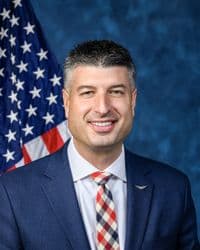
- Veterans$5,099k
- Progressive Groups$100k
Full profile: /officials/B001321
Source: Congress.gov · FEC
Cosponsors (1)
Members who have signed on to support this bill since introduction. Source: Congress.gov.
Latest Action
The most recent step in the bill's legislative path. Committee Activity below shows referrals and reports; the full action-by-action history including floor proceedings lives at Congress.gov →
Committee Activity
Currently in
- House Committee on Armed ServicesReferred To · 2026-03-25
Previously
- Armed Services CommitteeReferred To · 2026-03-25
Plain-English Summary
This bill would establish rules and safety standards for military and civilian aircraft operating in the same airspace, aiming to prevent collisions and accidents between military jets, helicopters, and commercial planes. The legislation likely requires the military and Federal Aviation Administration to coordinate better on flight paths, communication systems, and emergency procedures to protect both military personnel and civilian passengers and crews. It affects military pilots, commercial airlines, air traffic controllers, and anyone who flies in U.S. airspace.
AI-assisted summary generated from the official bill metadata (title, subjects, actions) sourced from Congress.gov. Cached and reviewed. Always verify against the official text linked below.
Subjects
Full Bill Text
Verbatim text published on Congress.gov via GovInfo. Use Cmd+F / Ctrl+F to search within this excerpt.
[Congressional Bills 119th Congress] [From the U.S. Government Publishing Office] [H.R. 8072 Introduced in House (IH)] <DOC> 119th CONGRESS 2d Session H. R. 8072 To direct the Secretary of Defense to test and certify each automatic dependent surveillance-broadcast out transponder system on a Department of Defense aircraft that is operated in United States airspace, and for other purposes. _______________________________________________________________________ IN THE HOUSE OF REPRESENTATIVES March 25, 2026 Mr. Barrett introduced the following bill; which was referred to the Committee on Armed Services _______________________________________________________________________ A BILL To direct the Secretary of Defense to test and certify each automatic dependent surveillance-broadcast out transponder system on a Department of Defense aircraft that is operated in United States airspace, and for other purposes. Be it enacted by the Senate and House of Representatives of the United States of America in Congress assembled, SECTION 1. SHORT TITLE. This Act may be cited as the ``Safety in Shared Skies Act of 2026''. SEC. 2. TESTING AND CERTIFICATION OF AUTOMATIC DEPENDENT SURVEILLANCE- BROADCAST OUT TRANSPONDER SYSTEMS ON DEPARTMENT OF DEFENSE AIRCRAFT. (a) Uniform Standards.--The Secretary of Defense shall establish uniform standards under which the Secretary shall test and certify, at least once every 90 days, each automatic dependent surveillance- broadcast out transponder system installed on a Department of Defense aircraft if the aircraft is operated in United States airspace. (b) Reporting Requirements.--Not later than 180 days after the date of the enactment of this Act, and every 180 days thereafter until the date that is two years after the date of the enactment of this Act, the Secretary shall submit to Congress a report that includes, for the period covered by the report, a detailed description of the testing and certification conducted pursuant to the uniform standards established under subsection (a), including a description of any failures of an automatic dependent surveillance-broadcast out transponder system. (c) Inspector General Audits.--Not later than one year after the date of the enactment of this Act, and not later than the date that is two years after the date of the enactment of this Act, the Inspector General of the Department of Defense shall-- (1) conduct an audit to ensure the Secretary is in compliance with the testing and certification requirements under subsection (a); and (2) submit to Congress a report that includes-- (A) the results of the audit; and (B) the recommendation of the Inspector General as to whether the reporting requirement under subsection (b) and the audit requirement under this subsection should be extended. <all>
Related legislation
Bills by the same sponsor or covering overlapping subjects.
- HR10768To establish the Office of Artificial Intelligence and Emerging Technology Threats within the Executive Office of the President, and for other purposes.Referred to Committee · 2026-10-09
- HR9570To designate the facility of the United States Postal Service located at 117 West Lovett Street in Charlotte, Michigan, as the "Francis C. Flaherty Post Office Building".Passed House · 2026-09-17
- HR10418VA Claims AI Accountability ActReferred to Committee · 2026-09-16
- HR10417VA AI Transparency Act of 2026Referred to Committee · 2026-09-16