HR9189Referred to Committee
Right to Record Act of 2026
Introduced
In Committee
3
Passed One Chamber4
Passed Both5
Signed into Law119th
Congress
2026-06-08
Introduced
2
Cosponsors
HR
ⓘType
Sponsor
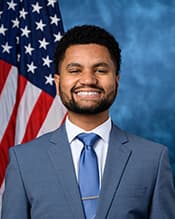
Maxwell Frost
Democrat · FL · Representative
Votes with party: 97.0% (670 recorded votes)
Full profile: /officials/F000476
Source: Congress.gov · FEC
Cosponsors (2)
Members who have signed on to support this bill since introduction. Source: Congress.gov.
2 cosponsors on record at Congress.gov. The named list is syncing into Govwatch and will appear here shortly — view on Congress.gov in the meantime.
Latest Action
The most recent step in the bill's legislative path. Committee Activity below shows referrals and reports; the full action-by-action history including floor proceedings lives at Congress.gov →
Committee Activity
Currently in
- House Committee on the JudiciaryReferred To · 2026-06-08
Plain-English Summary
The proposal would create a legal right for people to sue if their ability to record, watch, or peacefully protest police activities is violated, giving them a direct way to seek damages in court. This would apply to situations where law enforcement prevents someone from filming or observing police actions in public spaces or interferes with lawful protest activities. The measure would affect both individual citizens and police departments by establishing clearer legal standards around First Amendment protections during police encounters.
AI-assisted summary generated from the official bill metadata (title, subjects, actions) sourced from Congress.gov. Cached and reviewed. Always verify against the official text linked below.
Subjects
Crime and Law Enforcement
Full Bill Text
Verbatim text published on Congress.gov via GovInfo. Use Cmd+F / Ctrl+F to search within this excerpt.
[Congressional Bills 119th Congress] [From the U.S. Government Publishing Office] [H.R. 9189 Introduced in House (IH)] <DOC> 119th CONGRESS 2d Session H. R. 9189 To establish an express cause of action for violations of the right to record, observe, or peacefully protest law enforcement activities, and for other purposes. _______________________________________________________________________ IN THE HOUSE OF REPRESENTATIVES June 8, 2026 Mr. Frost introduced the following bill; which was referred to the Committee on the Judiciary _______________________________________________________________________ A BILL To establish an express cause of action for violations of the right to record, observe, or peacefully protest law enforcement activities, and for other purposes. Be it enacted by the Senate and House of Representatives of the United States of America in Congress assembled, SECTION 1. SHORT TITLE. This Act may be cited as the ``Right to Record Act of 2026''. SEC. 2. SENSE OF CONGRESS REGARDING FIRST AMENDMENT AND RIGHT TO RECORD, OBSERVE, OR PEACEFULLY PROTEST. (a) Sense of Congress.--It is the sense of Congress that-- (1) the First Amendment to the Constitution of the United States protects, among other things, the right to record law enforcement officers and other public officials in public view, observe the actions of law enforcement officers and other public officials in public view, protest peacefully, and engage in other expressive activities; and (2) while the First Amendment already protects the right to record, observe, or peacefully protest law enforcement, Congress can enhance the remedies available to individuals who are deprived of this right by establishing an express statutory cause of action for such rights violations. SEC. 3. RIGHT TO RECORD, OBSERVE, OR PEACEFULLY PROTEST LAW ENFORCEMENT ACTIVITIES. (a) Right to Record, Observe, or Peacefully Protest Law Enforcement Activities.--A person has the right to record, observe, or peacefully protest law enforcement activities, except in cases described under subsection (c). (b) Cause of Action.-- (1) Liability of officers.--Any Federal law enforcement officer who, while acting under color of law, violates a person's right to record, observe, or peacefully protest law enforcement activities shall be liable to the party injured in a civil action with respect to such violation in the appropriate district court for redress, including an award of the greater of actual damages or statutory damages in the amount of $25,000 for each violation, and punitive damages up to $100,000 for each violation engaged in with malice or reckless disregard for the federally protected rights of the party injured. (2) Liability of the united states.--If, while acting under color of law, any Federal law enforcement officer violates a person's right to record, observe, or peacefully protest law enforcement activities, the United States shall be liable to the party injured for the conduct of the officer in a civil action with respect to such violation in the appropriate district court for redress, including the greater of an award of actual damages or statutory damages in the amount of $25,000 for each violation, and punitive damages up to $100,000 for each violation engaged in with malice or reckless disregard for the federally protected rights of the party injured, regardless of whether a policy or custom of the Federal law enforcement agency that employs or contracts with the officer caused the violation, and regardless of whether the officer has any defense or immunity from suit or liability. This paragraph shall constitute a waiver of sovereign immunity with respect to Federal law enforcement agencies for any claim brought under this Act. Nothing in this paragraph shall be construed to limit or preclude any legal, equitable, or other remedy that is available, under this section or under any other source of law, against…
Show the remaining 877 wordsHide the remaining 877 words
an individual officer. (3) Violations.--A violation of the right to record, observe, or peacefully protest law enforcement activities includes the following: (A) Preventing or attempting to prevent a person from recording, observing, or peacefully protesting law enforcement activities. (B) Threatening, intimidating, or coercing a person with any negative consequences, including the addition of the personal information or biometric characteristics of the person into any database, in response to the person's recording, observing, or peacefully protesting law enforcement activities. (C) Pursuing a person to a different location because the person recorded, observed, or peacefully protested law enforcement activities. (D) Attempting to surveil or use surveillance powers to attempt to identify a person in order to intimidate or take other retaliatory action against that person because the person recorded, observed, or peacefully protested law enforcement activities. (E) Commanding that a person cease recording, observing, or peacefully protesting law enforcement activities when the person was not prohibited by law or court order to engage in such activities. (F) Stopping, seizing, searching, ticketing, or arresting a person because the person recorded, observed, or peacefully protested law enforcement activities. (G) Demanding to see the identification of a person or interrogating or otherwise harassing a person because the person recorded, observed, or peacefully protested law enforcement activities. (H) Unlawfully seizing property or instruments used by a person to record, observe, or peacefully protest law enforcement activities. (I) Unlawfully destroying or seizing a recorded image or recorded images of law enforcement activities, or copying such a recording of law enforcement activities, without the consent of the person who recorded it or without approval from an appropriate court. (J) Otherwise retaliating against a person because the person recorded, observed, or peacefully protested law enforcement activities. (c) Limitation.-- (1) In general.--Except as provided in paragraph (2), a person has no right to record, observe, or peacefully protest law enforcement activities pursuant to subsection (a) if the person physically restricts or restrains an officer taking official actions while acting under color of law. (2) Exception.--Paragraph (1) shall not apply to the mere act of recording, observing, or peacefully protesting law enforcement activities, or positioning oneself to record, observe, or peacefully protest law enforcement activities, even if such action is taken close to, in front of, or near the expected path of an officer acting under color of law. (d) Attorney's Fees and Costs.--The court shall award reasonable attorney's fees and costs to a prevailing plaintiff. (e) Training.--Not later than 1 year after the date of enactment of this Act, and annually thereafter, the head of each Federal law enforcement agency shall provide to every Federal law enforcement officer training on how to enforce the law while respecting the right to record, observe, or peacefully protest law enforcement activities. (f) Definitions.--In this section: (1) Federal law enforcement agency.--The term ``Federal law enforcement agency'' means any agency of the United States authorized to enforce Federal criminal law or Federal immigration law. (2) Federal law enforcement officer.--The term ``Federal law enforcement officer''-- (A) has the meaning given the term in section 115 of title 18, United States Code; and (B) includes an immigration officer. (3) Immigration officer.--The term ``immigration officer'' has the meaning given the term ``immigration officer'' in section 101 of the Immigration and Nationality Act (8 U.S.C. 1101). (4) Law enforcement activities.--The term ``law enforcement activities'' means the official actions taken in public view by an officer acting under color of law. (5) Observe.--The term ``observe'' means to watch or otherwise perceive. (6) Peacefully protest.--The term ``peacefully protest'' means to engage in constitutionally protected expression or assembly. (7) Public view.--The term ``public view'' means anything that can be seen from any place where an individual cannot be deemed to be trespassing, including parks, sidewalks, and roads, or a privately owned place where the individual is lawfully present. (8) Record.--The term ``record'' means creating a written, visual, or audio record. SEC. 4. RULES OF CONSTRUCTION. (a) Broad Construction.--This Act shall be construed in favor of a broad protection of the right to record, observe, or peacefully protest law enforcement activities and the right to access and document information about matters of public interest, to the maximum extent permitted by the terms of this Act and the Constitution of the United States. (b) No Diminishment of Other First Amendment Rights and Remedies.-- Nothing in this Act shall be construed to-- (1) diminish constitutional and statutory protections for any activity outside the scope of this Act that is otherwise covered by the First Amendment to the Constitution of the United States; (2) preclude any cause of action that may arise under the laws of the United States, a State, or a unit of local government for any violation of such First Amendment rights; or (3) limit or preclude any legal, equitable, or other remedy that is available in any action for any violation of such First Amendment rights. (c) No Preclusion of Other Causes of Action.--Nothing in this Act shall be construed to preclude any other cause of action that may arise under the laws of the United States, a State, or a unit of local government for any violation by an officer acting under color of law of the right to record, observe, or peacefully protest law enforcement activities. <all>
Related legislation
Bills by the same sponsor or covering overlapping subjects.
- HR8409Post-Disaster Protection ActReported by Committee · 2026-09-15
- HR10231No Homeless Detention Centers ActReferred to Committee · 2026-09-02
- HR8749SAFE through Medicare ActReferred to Committee · 2026-05-12
- HR8727No Illegal Captivity and Extensions Act of 2026Referred to Committee · 2026-05-11