End EPA Abuse Act of 2026
Sponsor
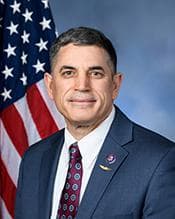
- Conservative Groups$1,001k
Full profile: /officials/C001116
Source: Congress.gov · FEC
Cosponsors (25)
Members who have signed on to support this bill since introduction. Source: Congress.gov.
- Barry Moore (R-AL-1)Original· 2026-06-25
- Ben Cline (R-VA-6)Original· 2026-06-25
- Brian Jack (R-GA-3)Original· 2026-06-25
- Chip Roy (R-TX-21)Original· 2026-06-25
- Clay Fuller (R-GA-14)Original· 2026-06-25
- Clay Higgins (R-LA-3)Original· 2026-06-25
- David Schweikert (R-AZ-1)Original· 2026-06-25
- Derrick Van Orden (R-WI-3)Original· 2026-06-25
- Gary J. Palmer (R-AL-6)Original· 2026-06-25
- John W. Rose (R-TN-6)Original· 2026-06-25
- Mary E. Miller (R-IL-15)Original· 2026-06-25
- Michael Cloud (R-TX-27)Original· 2026-06-25
- Mike Bost (R-IL-12)Original· 2026-06-25
- Mike Collins (R-GA-10)Original· 2026-06-25
- Mike Ezell (R-MS-4)Original· 2026-06-25
- Pat Harrigan (R-NC-10)Original· 2026-06-25
- Randy Fine (R-FL-6)Original· 2026-06-25
- Richard McCormick (R-GA-7)Original· 2026-06-25
- Rick W. Allen (R-GA-12)Original· 2026-06-25
- Russ Fulcher (R-ID-1)Original· 2026-06-25
- Scott Perry (R-PA-10)Original· 2026-06-25
- W. Gregory Steube (R-FL-17)Original· 2026-06-25
- Paul A. Gosar (R-AZ-9)· 2026-06-29
- Mark Harris (R-NC-8)· 2026-07-13
- Michael A. Rulli (R-OH-6)· 2026-07-14
Latest Action
The most recent step in the bill's legislative path. Committee Activity below shows referrals and reports; the full action-by-action history including floor proceedings lives at Congress.gov →
Committee Activity
Currently in
- House Committee on Energy and CommerceReferred To · 2026-06-25
Plain-English Summary
The proposal would restrict the federal government's ability to regulate air pollution and vehicle emissions under the Clean Air Act, while also limiting rules that could affect the electric grid's capacity. It would preserve consumer options in vehicle types, potentially slowing the transition toward electric vehicles by preventing stricter emission standards. The changes would affect automakers, power companies, and consumers who buy vehicles.
AI-assisted summary generated from the official bill metadata (title, subjects, actions) sourced from Congress.gov. Cached and reviewed. Always verify against the official text linked below.
Subjects
Full Bill Text
Verbatim text published on Congress.gov via GovInfo. Use Cmd+F / Ctrl+F to search within this excerpt.
[Congressional Bills 119th Congress] [From the U.S. Government Publishing Office] [H.R. 9453 Introduced in House (IH)] <DOC> 119th CONGRESS 2d Session H. R. 9453 To amend the Clean Air Act to preserve consumer vehicle choice, protect the electric grid, and impose limits on regulations under that Act, and for other purposes. _______________________________________________________________________ IN THE HOUSE OF REPRESENTATIVES June 25, 2026 Mr. Clyde (for himself, Mr. Palmer, Mr. Steube, Mr. Rose, Mr. Perry, Mr. Bost, Mr. Higgins of Louisiana, Mr. Schweikert, Mr. Fulcher, Mr. Moore of Alabama, Mr. Cloud, Mrs. Miller of Illinois, Mr. Van Orden, Mr. Harrigan, Mr. Fine, Mr. Jack, Mr. Allen, Mr. Collins, Mr. Fuller, Mr. McCormick, Mr. Ezell, Mr. Cline, and Mr. Roy) introduced the following bill; which was referred to the Committee on Energy and Commerce _______________________________________________________________________ A BILL To amend the Clean Air Act to preserve consumer vehicle choice, protect the electric grid, and impose limits on regulations under that Act, and for other purposes. Be it enacted by the Senate and House of Representatives of the United States of America in Congress assembled, SECTION 1. SHORT TITLE. This Act may be cited as the ``End EPA Abuse Act of 2026''. SEC. 2. ADMINISTRATION. Section 301 of the Clean Air Act (42 U.S.C. 7601) is amended-- (1) by striking the section designation and heading and all that follows through ``The Administrator'' in the first sentence of subsection (a)(1) and inserting the following: ``SEC. 301. ADMINISTRATION. ``(a) Regulatory Authority.-- ``(1) In general.--Subject to paragraph (3), the Administrator''; and (2) in subsection (a)-- (A) in paragraph (2)-- (i) by striking ``(2) Not later than'' and inserting the following: ``(2) Regional offices.--Not later than''; and (ii) by indenting subparagraphs (A) through (C) appropriately; and (B) by adding at the end the following: ``(3) Limitations on regulations.--Nothing in this Act authorizes the Administrator to prescribe any regulations, including the granting of a waiver or authorization otherwise authorized under this Act, if the regulation can reasonably be determined to-- ``(A) restrict or in effect restrict the sale or use of any type of vehicle or engine, including a new motor vehicle with an internal combustion engine (as defined in section 63.9375 of title 40, Code of Federal Regulations (as in effect on January 1, 2026)); ``(B) require or necessitate fuel-switching at a power plant; ``(C) reduce the reliability of the electric grid; ``(D) require or necessitate the use of a technology that is-- ``(i) commercially unavailable; ``(ii) cost-prohibitive or unachievable independent of any subsidies, including any subsidies provided directly or indirectly to cover the cost of the technology or to demonstrate the feasibility of the technology; ``(iii) infeasible due to factors beyond the control of the entity to which the regulation would apply, including but not limited to geographic, geologic, or climatic factors, or the lack of critical enabling infrastructure; or ``(iv) otherwise technically, economically, or practically infeasible; or ``(E) otherwise significantly expand the authority of the Administrator beyond the intent of Congress.''. <all>
Related legislation
Bills by the same sponsor or covering overlapping subjects.
- HR10377MAGA ActReferred to Committee · 2026-09-15
- HRES1351Impeaching Eleanor Louise Ross, Judge of the United States District Court for the Northern District of Georgia, for high crimes and misdemeanors.Referred to Committee · 2026-06-09
- HR8460Territorial Protection and Sovereignty ActReferred to Committee · 2026-04-23
- HR5107Common-Sense Law Enforcement and Accountability Now in DC Act of 2025Passed House · 2025-11-20