S1395Referred to Committee
NO TIME TO Waste Act);
Introduced
In Committee
3
Passed One Chamber4
Passed Both5
Signed into Law119th
Congress
2025-04-09
Introduced
3
Cosponsors
S
ⓘType
Sponsor
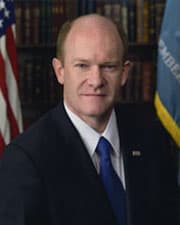
Christopher A. Coons
Democrat · DE · Senator
Votes with party: 80.6% (815 recorded votes)
Full profile: /officials/C001088
Source: Congress.gov · FEC
Cosponsors (3)
Members who have signed on to support this bill since introduction. Source: Congress.gov.
Latest Action
The most recent step in the bill's legislative path. Committee Activity below shows referrals and reports; the full action-by-action history including floor proceedings lives at Congress.gov →
Read twice and referred to the Committee on Agriculture, Nutrition, and Forestry.
2025-04-09
Source: Congress.gov
Plain-English Summary
New Opportunities for Technological Innovation, Mitigation, and Education To Overcome Waste Act or the NO TIME TO Waste Act This bill directs the Department of Agriculture (USDA) to reduce U.S. food loss and waste (FLW) through federal coordination, grants, and education. Under the bill, food loss means the food that does not reach a consumer as a result of an issue in the production, storage, processing, or distribution phase. Food waste means that food intended for human consumption is unconsumed for any reason at the retail or consumption phase. The bill requires USDA to collaborate with the Food and Drug Administration and the Environmental Protection Agency to carry out a December, 17, 2020, agreement to coordinate federal efforts to cut FLW. Further, USDA must establish an Office of Food Loss and Waste to support the existing role of the Food Loss and Waste Liaison. The office must also, among other things, establish a grant program to support collecting data on existing state and local FLW policies (and the office must use the data to establish model policies for state and local governments); a block grant program for states and Indian tribes to develop and support food recovery infrastructure and innovative food distribution models; and a grant program to incentivize state, municipal, local, and tribal governments to establish public-private partnerships that commit to reducing FLW by 50% by 2030. The Office of Food Loss and Waste must also initiate a national FLW education and public awareness campaign.
Plain-English rewrite of the Congressional Research Service summary published on Congress.gov. Cached and reviewed.
Subjects
Agriculture and Food
Full bill text is not yet cached locally.
Related legislation
Bills by the same sponsor or covering overlapping subjects.
- S5010NO BOSS ActReferred to Committee · 2026-07-16
- S4591NO FAKES Act of 2026Reported by Committee · 2026-06-24
- S4392Energy Security Pacts ActReferred to Committee · 2026-06-17
- S4707Responsible Artificial Intelligence Defense Act of 2026Referred to Committee · 2026-06-08