S2549Referred to Committee
Time Off to Vote Act
Introduced
In Committee
3
Passed One Chamber4
Passed Both5
Signed into Law119th
Congress
2025-07-30
Introduced
17
Cosponsors
S
ⓘType
Sponsor
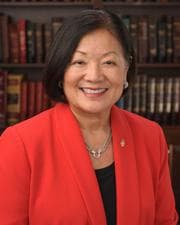
Mazie K. Hirono
Democrat · HI · Senator
Votes with party: 85.4% (911 recorded votes)
Full profile: /officials/H001042
Source: Congress.gov · FEC
Cosponsors (17)
Members who have signed on to support this bill since introduction. Source: Congress.gov.
- Adam B. Schiff (D-CA)Original· 2025-07-30
- Alex Padilla (D-CA)Original· 2025-07-30
- Chris Van Hollen (D-MD)Original· 2025-07-30
- Christopher A. Coons (D-DE)Original· 2025-07-30
- Cory A. Booker (D-NJ)Original· 2025-07-30
- Elizabeth Warren (D-MA)Original· 2025-07-30
- Jack Reed (D-RI)Original· 2025-07-30
- Jeff Merkley (D-OR)Original· 2025-07-30
- Kirsten E. Gillibrand (D-NY)Original· 2025-07-30
- Lisa Blunt Rochester (D-DE)Original· 2025-07-30
- Peter Welch (D-VT)Original· 2025-07-30
- Richard Blumenthal (D-CT)Original· 2025-07-30
- Richard J. Durbin (D-IL)Original· 2025-07-30
- Ron Wyden (D-OR)Original· 2025-07-30
- Ruben Gallego (D-AZ)Original· 2025-07-30
- Sheldon Whitehouse (D-RI)Original· 2025-07-30
- Tim Kaine (D-VA)Original· 2025-07-30
Latest Action
The most recent step in the bill's legislative path. Committee Activity below shows referrals and reports; the full action-by-action history including floor proceedings lives at Congress.gov →
Read twice and referred to the Committee on Health, Education, Labor, and Pensions.
2025-07-30
Source: Congress.gov
Committee Activity
Currently in
- Senate Committee on Health, Education, Labor, and PensionsReferred To · 2025-07-30
Previously
- Health, Education, Labor, and Pensions CommitteeReferred To · 2025-07-30
Plain-English Summary
Time Off to Vote Act This bill requires an employer, upon the request of an employee, to provide the employee with a minimum of two consecutive hours of paid leave while polls or sites that facilitate voting-related activity are open on the day of a federal election. This allotted time may be used to vote, return a mail-in ballot, or perform other voting-related activities. The employer may determine the two-hour period, excluding any lunch break or other break. Taking such leave shall not result in the employee losing accrued employment benefits. The bill makes it unlawful for an employer to interfere with the right to take such leave or for an employer to discriminate against an employee for taking such leave. Further, the bill makes it unlawful for any employer to retaliate against an employee for (1) opposing any practice made unlawful by this bill; (2) filing a charge, or instituting or causing to be instituted any proceeding, under or related to this bill; or (3) testifying or preparing to testify in an inquiry or proceeding relating to such leave. The bill specifies penalties for employers who violate these provisions.
Plain-English rewrite of the Congressional Research Service summary published on Congress.gov. Cached and reviewed.
Subjects
Government Operations and Politics
Full bill text is not yet cached locally.
Related legislation
Bills by the same sponsor or covering overlapping subjects.
- SRES931A resolution recognizing the month of October 2026 as Filipino American History Month and celebrating the history and culture of Filipino Americans and their immense contributions to the United States.Referred to Committee · 2026-09-30
- S5577A bill to amend the Federal Water Pollution Control Act to provide grants to upgrade or convert small-capacity cesspools for households in the State of Hawaii.Referred to Committee · 2026-09-29
- S5578A bill to amend the Federal Water Pollution Control Act to establish the Hawaiian Islands Program, and for other purposes.Referred to Committee · 2026-09-29
- SRES911A resolution expressing support for the recognition of September 27, 2026, to October 3, 2026, as "Asian American and Native American Pacific Islander-Serving Institutions Week".Referred to Committee · 2026-09-28