SRES654Referred to Committee
A resolution expressing the sense of the Senate that the United States should reduce and maintain the Federal unified budget deficit at or below 3 percent of gross domestic product.
Introduced
In Committee
3
Passed One Chamber4
Passed Both5
Signed into Law119th
Congress
2026-03-20
Introduced
3
Cosponsors
SRES
ⓘType
Sponsor
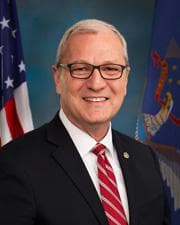
Kevin Cramer
Republican · ND · Senator
Votes with party: 76.6% (883 recorded votes)
Full profile: /officials/C001096
Source: Congress.gov · FEC
Cosponsors (3)
Members who have signed on to support this bill since introduction. Source: Congress.gov.
Latest Action
The most recent step in the bill's legislative path. Committee Activity below shows referrals and reports; the full action-by-action history including floor proceedings lives at Congress.gov →
Committee Activity
Currently in
- Senate Committee on the BudgetReferred To · 2026-03-20
Previously
- Budget CommitteeReferred To · 2026-03-20
Plain-English Summary
This resolution expresses the sense of the Senate that (1) Congress should adopt a fiscal target to reduce the federal budget deficit to 3% of gross domestic product or less as soon as possible and no later than the end of FY2030; and (2) after the target is achieved, Congress should continue to pursue further deficit reduction with the goal of achieving a balanced federal budget.
Plain-English rewrite of the Congressional Research Service summary published on Congress.gov. Cached and reviewed.
Subjects
Economics and Public Finance
Full Bill Text
Verbatim text published on Congress.gov via GovInfo. Use Cmd+F / Ctrl+F to search within this excerpt.
[Congressional Bills 119th Congress] [From the U.S. Government Publishing Office] [S. Res. 654 Introduced in Senate (IS)] <DOC> 119th CONGRESS 2d Session S. RES. 654 Expressing the sense of the Senate that the United States should reduce and maintain the Federal unified budget deficit at or below 3 percent of gross domestic product. _______________________________________________________________________ IN THE SENATE OF THE UNITED STATES March 20, 2026 Mr. Cramer (for himself, Mr. King, Mr. Peters, and Mr. McCormick) submitted the following resolution; which was referred to the Committee on the Budget _______________________________________________________________________ RESOLUTION Expressing the sense of the Senate that the United States should reduce and maintain the Federal unified budget deficit at or below 3 percent of gross domestic product. Whereas reducing annual deficits to 3 percent of gross domestic product has attracted bipartisan support as a target to stabilize the national debt; Whereas the budget deficit was $1,800,000,000,000 for fiscal year 2025, or roughly 6 percent of gross domestic product (referred to in this preamble as ``GDP''), even in the absence of major new emergency spending; Whereas the national debt held by the public now stands at nearly $31,000,000,000,000; Whereas interest payments on the national debt are now projected to total more than $1,000,000,000,000, the highest level in American history and more than total defense spending; Whereas the rising deficits and debt represent a threat to national security, economic growth, and future generations; Whereas rising deficits also threaten to increase interest rates and the cost of living, reduce the government's flexibility to respond to fiscal emergencies, and create risks of a fiscal crisis; Whereas the Federal budget ran a sub-3 percent deficit-to-GDP in 1989, 1994, 1995, 1996, 1997, 2002, 2005, 2006, 2007, 2014, and 2015; Whereas the Federal Government ran a surplus in 1998, 1999, 2000, and 2001; Whereas deficit reduction is best achieved when aiming toward a manageable, meaningful target; and Whereas Congress has a bipartisan responsibility to enact fiscal policies that promote long-term economic growth and to safeguard future generations, and to be ready for future emergencies: Now, therefore, be it Resolved, That it is the sense of the Senate that-- (1) Congress should adopt a fiscal target to reduce the Federal budget deficit to 3 percent of gross domestic product (in this resolution referred to as ``the target'') or less as soon as possible and no later than the end of fiscal year 2030; (2) following the achievement of the target, Congress should continue to pursue further deficit reduction with the goal of achieving a balanced Federal budget; (3) the President should submit budgets designed to create a path to meet and sustain the target; (4) the congressional budget resolution should set allocations consistent with meeting the target on schedule; (5) the Committee on the Budget of the Senate should, within 180 days, recommend enforcement options for consideration, which may include points of order and a backstop mechanism for when the target is not projected to be met; (6) the Committee on Rules and Administration of the Senate should, within 180 days, recommend changes to the rules of the Senate to ensure that the target can be met, including ensuring that rules of the Senate for budget enforcement are difficult to waive, and that enforcement of the Statutory Pay-As-You-Go Act of 2010 (Public Law 111-139) is difficult to waive; (7) the Congressional Budget Office should include statements within its cost estimates for major legislation that demonstrate how the legislation affects consistency toward the target under a current law baseline; (8) the Joint Committee on Taxation is encouraged to provide supplemental analysis of whether major legislation advances or impedes…
Show the remaining 50 wordsHide the remaining 50 words
progress toward the target; and (9) efforts to meet the target should examine changes to address current levels and the growth of discretionary appropriations, direct spending, and revenues and the gap between current revenues and expenditures of the Federal Government that avoid timing shifts, reclassifications, or other budgetary gimmicks. <all>
Related legislation
Bills by the same sponsor or covering overlapping subjects.
- S829A bill to designate the facility of the United States Postal Service located at 840 Front Street in Casselton, North Dakota, as the "Commander Delbert Austin Olson Post Office".Reported by Committee · 2026-09-14
- S5049CLAIM ActReferred to Committee · 2026-07-21
- S4835Bureau of Industry and Security License Administration Enhancement ActReferred to Committee · 2026-06-18
- S4637Conrad 30 Physician Workforce Optimization ActReferred to Committee · 2026-05-21