Save Our Shrimpers Act
Sponsor
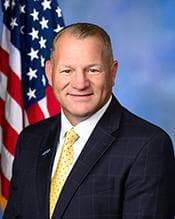
Full profile: /officials/N000026
Source: Congress.gov · FEC
Cosponsors (20)
Members who have signed on to support this bill since introduction. Source: Congress.gov.
- Anna Paulina Luna (R-FL-13)Original· 2025-03-11
- Barry Moore (R-AL-1)Original· 2025-03-11
- Brian Babin (R-TX-36)Original· 2025-03-11
- Byron Donalds (R-FL-19)Original· 2025-03-11
- Clay Higgins (R-LA-3)Original· 2025-03-11
- Earl L. "Buddy" Carter (R-GA-1)Original· 2025-03-11
- Gregory F. Murphy (R-NC-3)Original· 2025-03-11
- Gus M. Bilirakis (R-FL-12)Original· 2025-03-11
- John H. Rutherford (R-FL-5)Original· 2025-03-11
- Julia Letlow (R-LA-5)Original· 2025-03-11
- Michael Cloud (R-TX-27)Original· 2025-03-11
- Mike Ezell (R-MS-4)Original· 2025-03-11
- Nancy Mace (R-SC-1)Original· 2025-03-11
- Randy K. Weber, Sr. (R-TX-14)Original· 2025-03-11
- Russell Fry (R-SC-7)Original· 2025-03-11
- Troy A. Carter (D-LA-2)Original· 2025-03-11
- Vicente Gonzalez (D-TX-34)Original· 2025-03-11
- Mike Haridopolos (R-FL-8)· 2025-03-24
- David Rouzer (R-NC-7)· 2025-12-03
- Donald G. Davis (D-NC-1)· 2026-02-24
Latest Action
The most recent step in the bill's legislative path. Committee Activity below shows referrals and reports; the full action-by-action history including floor proceedings lives at Congress.gov →
Received in the Senate and Read twice and referred to the Committee on Foreign Relations.
2026-05-13
Source: Congress.gov
Committee Activity
Currently in
- Senate Committee on Foreign RelationsReferred To · 2026-05-13
- House Committee on Financial ServicesReported By · 2026-03-25
Previously
- Financial Services CommitteeReported By · 2026-03-25
- Financial Services CommitteeMarkup By · 2026-03-04
- House Committee on Financial ServicesMarkup By · 2026-03-04
- Financial Services CommitteeReferred To · 2025-03-11
- House Committee on Financial ServicesReferred To · 2025-03-11
Plain-English Summary
Save Our Shrimpers Act This bill prohibits federal funds from being made available to international financial institutions (e.g., the International Monetary Fund) for financing activities related to foreign shrimp farms. The bill also requires an annual report on compliance by U.S. leadership of international financial institutions with policies to oppose financing for certain commodities or minerals. Specifically, the bill requires the Department of the Treasury to condition any provision of federal funds to an international financial institution on the requirement that the funds not be used to finance any activity related to shrimp farming, shrimp processing, or the export of shrimp in any foreign country. Under current law, Treasury must instruct U.S. leadership of international financial institutions to oppose providing financial assistance for the production or extraction of any commodity or mineral for export if (1) the commodity or mineral is in surplus on world markets, and (2) the export of such commodity or mineral will cause substantial injury to U.S. producers of a competing commodity or mineral (or of the same or a similar commodity or mineral). This bill requires the Government Accountability Office to investigate and annually report to Congress on the extent to which U.S. leadership at these institutions have carried out Treasury's instructions.
Plain-English rewrite of the Congressional Research Service summary published on Congress.gov. Cached and reviewed.
Subjects
Full Bill Text
Verbatim text published on Congress.gov via GovInfo. Use Cmd+F / Ctrl+F to search within this excerpt.
[Congressional Bills 119th Congress] [From the U.S. Government Publishing Office] [H.R. 2071 Engrossed in House (EH)] <DOC> 119th CONGRESS 2d Session H. R. 2071 _______________________________________________________________________ AN ACT To require the United States Executive Directors at the international financial institutions to oppose certain projects involving shrimp production. Be it enacted by the Senate and House of Representatives of the United States of America in Congress assembled, SECTION 1. SHORT TITLE. This Act may be cited as the ``Save Our Shrimpers Act''. SEC. 2. VOICE AND VOTE REQUIREMENT. (a) In General.--The Secretary of the Treasury shall instruct the United States Executive Director at each international financial institution (as defined in section 1701(c)(2) of the International Financial Institutions Act) to use the voice and vote of the United States to oppose any financial assistance by such institution for any project to support shrimp farming, shrimp processing, or the export of shrimp in a borrowing country. (b) Waiver Authority.--The Secretary of the Treasury may waive subsection (a) with respect to a project upon notifying the Congress that the waiver is in the national interest of the United States. (c) Expiration.--Subsection (a) shall have no force or effect after the end of the 7-year period beginning on the date of enactment of this Act. Passed the House of Representatives May 12, 2026. Attest: Clerk. 119th CONGRESS 2d Session H. R. 2071 _______________________________________________________________________ AN ACT To require the United States Executive Directors at the international financial institutions to oppose certain projects involving shrimp production.
Related legislation
Bills by the same sponsor or covering overlapping subjects.
- HR7553Aviation Innovation and Global Competitiveness ActReferred to Committee · 2026-09-15
- HR309National Law Enforcement Officers Remembrance, Support, and Community Outreach ActPassed House · 2026-09-15
- HR9071Preventing Trafficking of Minors Act of 2026Referred to Committee · 2026-05-29
- HR9037To direct the Administrator of the Federal Aviation Administration to improve and expand electronic filing capabilities for Federal Aviation Administration Form 337, and for other purposes.Referred to Committee · 2026-05-26