HR7968Referred to Committee
Small AI Innovators Empowerment Act
Introduced
In Committee
3
Passed One Chamber4
Passed Both5
Signed into Law119th
Congress
2026-03-17
Introduced
7
Cosponsors
HR
ⓘType
Sponsor
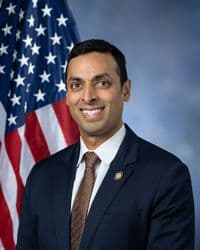
Suhas Subramanyam
Democrat · VA · Representative
Votes with party: 96.2% (666 recorded votes)
Top industries funding sponsor:
- Climate & Environment$106k
Full profile: /officials/S001230
Source: Congress.gov · FEC
Cosponsors (7)
Members who have signed on to support this bill since introduction. Source: Congress.gov.
Latest Action
The most recent step in the bill's legislative path. Committee Activity below shows referrals and reports; the full action-by-action history including floor proceedings lives at Congress.gov →
Committee Activity
Currently in
- House Committee on Science, Space, and TechnologyReferred To · 2026-03-17
Previously
- Science, Space, and Technology CommitteeReferred To · 2026-03-17
Plain-English Summary
This bill would likely provide support and resources to small companies and startups working on artificial intelligence technology, possibly through funding, regulatory relief, or access to government data and computing resources. The goal appears to be helping smaller AI businesses compete with large tech companies and grow their innovations. It would primarily affect startup founders, small tech companies, and potentially the broader AI industry landscape.
AI-assisted summary generated from the official bill metadata (title, subjects, actions) sourced from Congress.gov. Cached and reviewed. Always verify against the official text linked below.
Subjects
Commerce
Full Bill Text
Verbatim text published on Congress.gov via GovInfo. Use Cmd+F / Ctrl+F to search within this excerpt.
[Congressional Bills 119th Congress] [From the U.S. Government Publishing Office] [H.R. 7968 Introduced in House (IH)] <DOC> 119th CONGRESS 2d Session H. R. 7968 To authorize the Department of Commerce to carry out a study on challenges faced by United States small artificial intelligence businesses, and for other purposes. _______________________________________________________________________ IN THE HOUSE OF REPRESENTATIVES March 17, 2026 Mr. Subramanyam (for himself, Mr. Obernolte, and Mr. Gottheimer) introduced the following bill; which was referred to the Committee on Science, Space, and Technology _______________________________________________________________________ A BILL To authorize the Department of Commerce to carry out a study on challenges faced by United States small artificial intelligence businesses, and for other purposes. Be it enacted by the Senate and House of Representatives of the United States of America in Congress assembled, SECTION 1. SHORT TITLE. This Act may be cited as the ``Small AI Innovators Empowerment Act''. SEC. 2. STUDY ON CHALLENGES FACED BY SMALL ARTIFICIAL INTELLIGENCE BUSINESSES. (a) In General.--Subject to the availability of appropriations, the Secretary of Commerce, acting through the Director of the National Institute of Standards and Technology, and in consultation with the Administrator of the Small Business Administration, shall seek to enter into an agreement with an appropriate entity with relevant expertise, as determined by the Director of the National Institute of Standards and Technology, which may include a federally funded research and development center, to conduct a study on challenges faced by United States small artificial intelligence businesses located across the United States. (b) Elements.--The study under subsection (a) shall include the following: (1) An analysis of Federal and non-Federal resource funding opportunities for United States small artificial intelligence businesses, including relating to the following: (A) Data on early and seed funding sources. (B) Accessibility of Federal funding opportunities, timeline of receiving such funding, and the impact of physical asset collateral and other loan requirements on United States small artificial intelligence businesses. (C) Availability and use of non-Federal funding opportunities. (2) Usage of research and development tax credits, and the impact of tax credit restrictions or changes on United States small artificial intelligence businesses. (3) Usage of accelerators and incubators in the process of establishing United States small artificial intelligence businesses. (4) An analysis of downstream impacts of Federal policy on United States small artificial intelligence businesses, including an assessment of technology stacks, with consideration of the following: (A) Differences in usage of artificial intelligence tools between United States small artificial intelligence businesses and other businesses across the infrastructure, model, and application layers of the artificial intelligence ecosystem, and the role of access to computing resources, cloud services, and data. (B) Impact of regulatory uncertainty on exit strategies and acquisition opportunities for United States small artificial intelligence businesses. (C) Impact of partnerships with larger firms and competition policy frameworks on opportunities for growth of United States small artificial intelligence businesses. (5) An analysis of talent recruitment and retainment challenges faced by United States small artificial intelligence businesses. (6) An analysis of any other potential challenges faced by United States small artificial intelligence businesses the Secretary determines appropriate. (7) Proposals and recommendations to address any such challenges. (c) Definitions.--In this section: (1) Artificial intelligence.--The term ``artificial intelligence'' has the meaning given such term in section 5002 of the National Artificial Intelligence Initiative Act of 2020 (15 U.S.C. 9401). (2) United states small artificial intelligence business.-- The term ``United States small artificial intelligence business'' means a business that creates, develops, or customizes artificial intelligence products or services as its primary business activity and that-- (A) is headquartered in the United States; (B) is organized for profit; (C) operates…
Show the remaining 74 wordsHide the remaining 74 words
primarily within the United States or makes a significant contribution to the United States economy through payment of taxes or use of American products, materials, or labor; (D) is independently owned and operated, including a business that is backed by private funding, equity financing, or an institutional investor; and (E) employs 250 or fewer people. (3) Technology stacks.--The term ``technology stacks'' means the collection of technologies, tools, and infrastructure utilized by such businesses. <all>
Related legislation
Bills by the same sponsor or covering overlapping subjects.
- HR10712First Responder Behavioral Health Access ActReferred to Committee · 2026-10-01
- HR10713Federal Telework Protection ActReferred to Committee · 2026-10-01
- HR10715Domestic Visa Renewal Modernization ActReferred to Committee · 2026-10-01
- HR10711Reducing Visa Delays ActReferred to Committee · 2026-10-01