HR8492Referred to Committee
Public Safety UAS Readiness Act
Introduced
In Committee
3
Passed One Chamber4
Passed Both5
Signed into Law119th
Congress
2026-04-23
Introduced
2
Cosponsors
HR
ⓘType
Sponsor
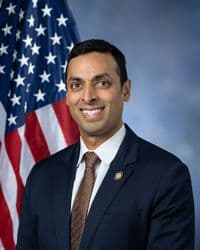
Suhas Subramanyam
Democrat · VA · Representative
Votes with party: 96.2% (666 recorded votes)
Top industries funding sponsor:
- Climate & Environment$106k
Full profile: /officials/S001230
Source: Congress.gov · FEC
Cosponsors (2)
Members who have signed on to support this bill since introduction. Source: Congress.gov.
Latest Action
The most recent step in the bill's legislative path. Committee Activity below shows referrals and reports; the full action-by-action history including floor proceedings lives at Congress.gov →
Committee Activity
Currently in
- House Committee on Transportation and InfrastructureReferred To · 2026-04-23
Previously
- Transportation and Infrastructure CommitteeReferred To · 2026-04-23
Plain-English Summary
The federal government would create a new grant program to help fund training for people who want to operate drones professionally. This would make it easier and more affordable for workers, businesses, and organizations to learn how to safely pilot unmanned aircraft for various purposes like delivery, inspection, or surveying. The Transportation Department would oversee the program and distribute the grants to training providers.
AI-assisted summary generated from the official bill metadata (title, subjects, actions) sourced from Congress.gov. Cached and reviewed. Always verify against the official text linked below.
Subjects
Transportation and Public Works
Full Bill Text
Verbatim text published on Congress.gov via GovInfo. Use Cmd+F / Ctrl+F to search within this excerpt.
[Congressional Bills 119th Congress] [From the U.S. Government Publishing Office] [H.R. 8492 Introduced in House (IH)] <DOC> 119th CONGRESS 2d Session H. R. 8492 To require the Secretary of Transportation to establish a grant program for unmanned aircraft system pilot training, and for other purposes. _______________________________________________________________________ IN THE HOUSE OF REPRESENTATIVES April 23, 2026 Mr. Subramanyam (for himself and Mr. Bresnahan) introduced the following bill; which was referred to the Committee on Transportation and Infrastructure _______________________________________________________________________ A BILL To require the Secretary of Transportation to establish a grant program for unmanned aircraft system pilot training, and for other purposes. Be it enacted by the Senate and House of Representatives of the United States of America in Congress assembled, SECTION 1. SHORT TITLE. This Act may be cited as the ``Public Safety UAS Readiness Act''. SEC. 2. UNMANNED AIRCRAFT SYSTEM PILOT TRAINING GRANT PROGRAM. (a) Establishment.--The Secretary of Transportation, acting through the Administrator of the Federal Aviation Administration, shall establish a program to award grants to covered entities to carry out activities to support training of unmanned aircraft system pilots. (b) Eligible Activities.--A covered entity in receipt of a grant awarded under this section may use such grant-- (1) to establish and develop an unmanned aircraft system training program, including curriculum design, instructional materials, and related resources necessary to carry out-- (A) training of public safety personnel on aviation safety, Federal Aviation Administration regulations, basic airspace principles, and public safety mission profiles relating to the operation of unmanned aircraft systems; (B) training of certified remote pilots on risk management, flight execution, data collection for unmanned aircraft systems; (C) specialized instruction for certified remote pilots leading unmanned aircraft system missions in complex, multi-agency environments; and (D) the development and validation of public safety UAS instructors to serve as instructors in certain regions throughout the United States upon completion of such certification; (2) to purchase an unmanned aircraft system that meets all Federal safety standards and regulatory requirements for the purpose of carrying out the training described in this paragraph; and (3) for reasonable administrative costs directly associated with the delivery of training and program implementation under this section, including support services necessary to ensure student participation and program completion, expenses incurred due to staff attendance, including travel coordination, and local facility use. (c) Comprehensive Plan.--To be eligible to receive a grant under this section, a covered entity shall demonstrate the ability to manage Federal funds and submit to the Secretary a comprehensive plan describing how such entity will use such funds to develop and sustain unmanned aircraft system training and operations. Such entity shall include in the comprehensive plan information on-- (1) administration and oversight for any program proposed to be established using such grant; (2) risk management procedures; (3) airspace coordination and safety protocols; (4) certified personnel rosters; (5) equipment maintenance schedules; (6) data and privacy protections; and (7) legal compliance documentation. (d) Requirements.--With respect to a training program established with a grant awarded under this section, a covered entity shall-- (1) operate or administer such program in accordance with applicable Federal law and regulations, which may include section 44807 of title 49, United States Code, or parts 91 or 107 of title 14, Code of Federal Regulations, as applicable, and-- (A) National Wildfire Coordinating Group Standard A-450 or S-373; (B) ASTM International Standard F3266, F3330, or F3370; or (C) National Fire Protection Association Standard 2400; and (2) ensure-- (A) that the curriculum for such program is maintained by, or licensed through, a national nonprofit public safety organization or a nonprofit emergency response training entity; (B) that such curriculum remains consistent…
Show the remaining 661 wordsHide the remaining 661 words
with operational standards and reflects mission specific public safety training needs; and (C) that any modification to such curriculum is subject to the approval of the organization through which the curriculum is maintained or licensed. (e) Prioritization.--In awarding grants under this section, the Secretary shall prioritize selecting covered entities who-- (1) engage in high risk operations or operate in underserved regions; (2) demonstrate multi-agency or regional coordination; (3) propose to carry out training that is consistent with Federal Aviation Administration, National Wildfire Coordinating Group, and National Fire Protection Association standards; and (4) lack the capacity for unmanned aircraft systems training. (f) Reports.-- (1) Report by recipient.--Each recipient of a grant awarded under this section shall, not less frequently than annually, submit to the Secretary a report containing the following information: (A) The number and type of personnel trained using such grant. (B) The number of certifications of public safety UAS instructors under subsection (b)(4). (C) The number of instructors participating in any training provided using such grant. (D) The number of unmanned aircraft system deployments carried out by such recipient after completion of training carried out with such grant. (E) Challenges or recommendations related to a program established using such grant. (2) Report by secretary.--Not less frequently than annually, the Secretary shall submit to Congress a report on the grant program carried out under this section that contains the following information: (A) A description of grant recipients, disaggregated by region and type of entity receiving such grant. (B) A summary of progress made in building unmanned aircraft system training capacity across the United States. (C) Any recommendations for improvements to training standards and the grant program established under this section. (g) Definitions.--In this section: (1) Certified remote pilot.--The term ``certified remote pilot'' means a pilot certified to operate an unmanned aircraft system under part 107 of title 14, Code of Federal Regulations, or under a valid public aircraft operation or Federal Aviation Administration authorization. (2) Covered entity.--The term ``covered entity'' means-- (A) a governmental or nonprofit fire department, emergency medical service, or law enforcement agency; (B) a State or regional public safety training academy; (C) an interagency unmanned aircraft system collaborative; or (D) a nonprofit public safety training organization that-- (i) has demonstrated a national presence in public safety education; (ii) maintains a primary mission focused on emergency response readiness; and (iii) has a documented history of partnerships with Federal, State, Tribal, territorial, or local public safety agencies. (3) Emergency medical service.--The term ``emergency medical service'' has the meaning given the term ``emergency medical services'' under section 553(e) of the Public Health Service Act (42 U.S.C. 290ee-10(e)). (4) High risk operation.--The term ``high risk operation'' means an unmanned aircraft mission conducted in an environment, condition, or for purposes where a loss of control, system, failure, or operational error could reasonably be expected to result in serious injury or death, substantial property damage, or disruption to public safety or critical infrastructure. (5) Interagency unmanned aircraft system collaborative.-- The term ``interagency unmanned aircraft system collaborative'' means a formal partnership, task force, or mutual aid framework involving 2 or more governmental or nonprofit public safety or emergency response agencies that jointly develop, operate, or coordinate unmanned aircraft system training and deployment to support all-hazards response. (6) Nonprofit.--The term ``nonprofit'', with respect to a covered entity, means an entity that is described in section 501(c) of the Internal Revenue Code of 1986 and is exempt from taxation under section 501(a) of such code. (7) Public safety uas instructor.--The term ``public safety UAS instructor'' means an instructor providing training for unmanned aircraft system operations conducted for the purpose of emergency response at or on behalf of a covered entity. (8) Unmanned aircraft system.--The term ``unmanned aircraft system'' has the meaning given such term in section 44801 of title 49, United States Code. (h) Authorization of Appropriations.--There is authorized to be appropriated to carry out this section $10,000,000 for each of fiscal years 2026 through 2029. <all>
Related legislation
Bills by the same sponsor or covering overlapping subjects.
- HR10712First Responder Behavioral Health Access ActReferred to Committee · 2026-10-01
- HR10713Federal Telework Protection ActReferred to Committee · 2026-10-01
- HR10715Domestic Visa Renewal Modernization ActReferred to Committee · 2026-10-01
- HR10711Reducing Visa Delays ActReferred to Committee · 2026-10-01