HR10032Referred to Committee
No Payoffs for Pardons Act
Introduced
In Committee
3
Passed One Chamber4
Passed Both5
Signed into Law119th
Congress
2026-08-03
Introduced
9
Cosponsors
HR
ⓘType
Sponsor
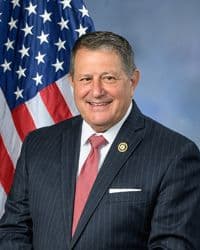
Joseph D. Morelle
Democrat · NY · Representative
Votes with party: 97.3% (658 recorded votes)
Top industries funding sponsor:
- Progressive Groups$100k
Full profile: /officials/M001206
Source: Congress.gov · FEC
Cosponsors (9)
Members who have signed on to support this bill since introduction. Source: Congress.gov.
9 cosponsors on record at Congress.gov. The named list is syncing into Govwatch and will appear here shortly — view on Congress.gov in the meantime.
Latest Action
The most recent step in the bill's legislative path. Committee Activity below shows referrals and reports; the full action-by-action history including floor proceedings lives at Congress.gov →
Committee Activity
Currently in
- House Committee on the JudiciaryReferred To · 2026-08-03
Plain-English Summary
The proposal would change how presidents can grant pardons and commutations by establishing new rules and procedures for the clemency process. It would likely affect people seeking forgiveness for federal crimes, as well as the staff who review clemency requests, by creating clearer standards for how these decisions are made. The changes aim to make the clemency system more transparent and consistent.
AI-assisted summary generated from the official bill metadata (title, subjects, actions) sourced from Congress.gov. Cached and reviewed. Always verify against the official text linked below.
Subjects
Crime and Law Enforcement
Full Bill Text
Verbatim text published on Congress.gov via GovInfo. Use Cmd+F / Ctrl+F to search within this excerpt.
[Congressional Bills 119th Congress] [From the U.S. Government Publishing Office] [H.R. 10032 Introduced in House (IH)] <DOC> 119th CONGRESS 2d Session H. R. 10032 To amend title 18, United States Code, to reform executive clemency. _______________________________________________________________________ IN THE HOUSE OF REPRESENTATIVES August 3, 2026 Mr. Morelle introduced the following bill; which was referred to the Committee on the Judiciary _______________________________________________________________________ A BILL To amend title 18, United States Code, to reform executive clemency. Be it enacted by the Senate and House of Representatives of the United States of America in Congress assembled, SECTION 1. SHORT TITLE. This Act may be cited as the ``No Payoffs for Pardons Act''. SEC. 2. FINDINGS. Congress finds the following: (1) The Constitution of the United States grants the President broad authority to issue reprieves and pardons for offenses against the United States. This power is meant to serve the interests of justice and offer a pathway to remedy unfair outcomes within the criminal legal system. (2) The breadth of the pardon power demands it be used judiciously. At times, Presidents have made questionable clemency decisions throughout American history, creating legitimate concerns about potential misuse across the political spectrum. (3) Alarmingly, President Donald Trump has gone further than any of his predecessors and fundamentally transformed the Presidential pardon from an instrument of mercy into a currency for insiders, repeatedly using clemency to reward political donors, loyalists, cronies, and individuals with direct access to him, while ordinary petitioners languish for years in the Department of Justice process. (4) In his current term, President Trump has granted only a tiny handful of pardons and commutations to the roughly 10,000 people who followed the formal Department of Justice review process in 2026, while showering clemency on high-profile allies, business associates, and well-connected offenders whose chief qualification was deep pockets or proximity to the President, not the merits of their cases. (5) President Trump has exploited clemency to erase the crimes and consequences of some of the most notorious white- collar offenders in United States history, including the longest-sentenced Medicare fraudster in the country. All told, President Trump's pardons have wiped out nearly $2,000,000,000 in victim repayments and taxpayer recovery. (6) President Trump has used the pardon power to undercut ongoing law enforcement investigations, including commuting the sentence of a predatory lender whose cooperation Federal prosecutors were actively seeking, instantly stripping prosecutors of leverage and signaling that well-connected criminals can buy or lobby their way out of accountability. (7) President Trump has leveraged clemency for convicted narcotraffickers and enablers of the international drug trade, such as the former Honduran President who turned his government into a cocaine pipeline to the United States and the creator of the Silk Road dark web drug market, even while demanding the death penalty for traffickers and campaigning on a promise to wage ``war'' on cartels. (8) On the first day of his second term, President Donald Trump issued a sweeping clemency proclamation granting blanket pardons and commutations to nearly all offenders charged or convicted for crimes arising from the January 6, 2021, attack on the United States Capitol, instantly wiping away the criminal records and prison time of roughly 1,600 rioters who assaulted law enforcement and violently disrupted the peaceful transfer of power. (9) President Trump's Department of Justice is now actively seeking to vacate and dismiss the seditious conspiracy convictions of multiple top Proud Boys and Oath Keepers leaders, including Stewart Rhodes and other organizers who helped plan and direct the assault, moving to erase the last remaining jury verdicts against the extremist ringleaders of the insurrection and to nullify years of…
Show the remaining 1,799 wordsHide the remaining 1,799 words
painstaking prosecutions by career Federal law enforcement. (10) President Trump's pattern of clemency for wealthy benefactors, the politically connected, and corrupt officials paired with his deliberate neglect of ordinary, meritorious petitioners, has weaponized the pardon power against the rule of law, turning a constitutional safety valve into a commodity to be purchased or bartered for through political allegiance. (11) Although the Supreme Court of the United States erroneously held in Trump v. United States, 603 U.S. 593 (2024), that the President has absolute immunity for the exercise of core constitutional powers, that immunity only attaches to the President and does not extend to private individuals who corruptly offer things of value to obtain clemency, or act as intermediaries in such corrupt arrangements. Congress has authority and responsibility to address corruption by clemency seekers and intermediaries, even if the conduct of the President may be beyond the reach of Federal criminal prosecution. SEC. 3. DISCLOSURE REQUIREMENTS FOR PARDON RECIPIENTS. (a) In General.--Chapter 11 of title 18, United States Code, is amended by adding at the end the following: ``Sec. 227A. Financial disclosure reports by recipients of executive clemency ``(a) Definitions.--In this section: ``(1) Clemency recipient.--The term `clemency recipient' means any individual who has received a pardon, commutation of sentence, reprieve, or any other form of executive clemency pursuant to section 2 of article II of the Constitution of the United States. ``(2) Covered benefit.--The term `covered benefit' means anything of value, including any contribution, donation, gift, service, payment, transfer, contract, investment, goods, or other benefit, whether direct or indirect, provided by the clemency recipient, at the direction of the clemency recipient, or on behalf of the clemency recipient, with an aggregate value at any point during any 12-month period during the disclosure period of not less than $10,000, as adjusted for inflation pursuant to subsection (f). ``(3) Covered recipient.--The term `covered recipient'-- ``(A) means-- ``(i) the President or an immediate family member of the President; ``(ii) any entity directly or indirectly established, financed, maintained, or controlled by, or operating with the explicit or implicit purpose of advancing a financial, political, electoral, or reputational benefit of, the President or an immediate family member of the President, including any commercial entity, any presidential library or foundation, any organization exempt from taxation under section 501(a) of the Internal Revenue Code of 1986, any Inaugural Committee, as defined in section 501 of title 36, any authorized committee, as defined in section 301 of the Federal Election Campaign Act of 1971 (52 U.S.C. 30101), and any political committee (including an independent expenditure-only committee), as defined in that section; ``(iii) any entity in which the clemency recipient knows, or reasonably should know, that the President or an immediate family member of the President holds a direct or indirect financial interest, including any ownership interest, partnership interest, or interest through a trust, limited liability company, or other intermediary; or ``(iv) any person who receives a covered benefit for the purpose of seeking or advocating for executive clemency for the clemency recipient; and ``(B) does not include any class of securities registered under section 12 of the Securities Exchange Act of 1934 (15 U.S.C. 78l) if-- ``(i) the President and no immediate family member of the President serve as a director or officer of the issuer; or ``(ii) the President and all immediate family members of the President are not, in the aggregate, beneficial owners of more than 10 percent of such class of securities within the meaning of section 16(a) of the Securities Exchange Act of 1934 (15 U.S.C. 78p(a)). ``(4) Disclosure period.--The term `disclosure period' means the period beginning on the date that is 1 year before the date on which the President who granted the executive clemency was first sworn into office and ending on the last day of the fourth calendar year after the calendar year during which the clemency recipient received the executive clemency. ``(5) Immediate family member.--The term `immediate family member' means, with respect to an individual, the spouse, child, stepchild, parent, stepparent, or sibling. ``(6) Willfully.--The term `willfully'-- ``(A) means intentionally undertaking an act that one knows to be wrongful; and ``(B) does not require that the actor know specifically that the conduct was unlawful. ``(b) Disclosure Requirement.-- ``(1) Pre-clemency disclosure.--Not later than 90 days after receiving executive clemency for an offense against the United States, each clemency recipient that has provided a covered benefit to a covered recipient during the disclosure period shall file with the Attorney General a disclosure report identifying each covered benefit provided to any covered recipient during the disclosure period. ``(2) Annual post-clemency disclosure.--For each of the 4 calendar years following the calendar year in which executive clemency was granted, a clemency recipient who has provided a covered benefit to a covered recipient during the disclosure period shall file with the Attorney General an annual disclosure report identifying each covered benefit provided to any covered recipient during that calendar year. ``(3) Content of disclosure.--Each disclosure report required under this subsection shall include-- ``(A) the identity of the covered recipient; ``(B) a description of the covered benefit, including its form, nature, and purpose; ``(C) the approximate date or dates on which the covered benefit was provided; and ``(D) the value of the covered benefit, or, where the exact value cannot reasonably be ascertained, a good-faith estimate of such value with an explanation of the basis for the estimate. ``(c) Exception for Bona Fide Legal Services.-- ``(1) In general.--This section shall not apply to payments made exclusively for bona fide legal services rendered in connection with representation before a court of law. ``(2) Allocation.-- ``(A) In general.--If a payment is made in part for legal services described in paragraph (1) and in part for lobbying, advocacy, advice, or other services related to seeking or obtaining executive clemency, only the portion of such payment reasonably attributable to clemency-related services shall be subject to disclosure under this section. ``(B) Good faith.--The clemency recipient shall-- ``(i) make the allocation required under subparagraph (A) in good faith; and ``(ii) shall document the basis for the allocation in the disclosure report filed pursuant to subsection (b). ``(d) Publication by the Attorney General.-- ``(1) In general.--The Attorney General shall make all disclosure reports filed under this section publicly available on a searchable, machine-readable website maintained by the Department of Justice not later than 30 days after the filing deadline applicable to each report. If a disclosure report is received after the filing deadline, the Attorney General shall make the report available as soon as practicable, but not later than 30 days after the date on which the report is received. ``(2) Forms and procedures.-- ``(A) In general.--The Attorney General shall prescribe forms and procedures for the filing of disclosure reports under this section and may promulgate regulations as the Attorney General determines are necessary to carry out the purposes of this section. ``(B) Contents.--The procedures described in subparagraph (A) shall include a process by which the Attorney General regularly contacts clemency recipients, through as many methods of communication as possible, to notify them of their obligations to file disclosure reports. ``(3) Online submission.--Not later than 90 days after the date of enactment of this section, the Attorney General shall establish an online portal through which clemency recipients shall submit the disclosure reports required under subsection (b). ``(e) Enforcement.-- ``(1) Civil penalty.--Any clemency recipient who knowingly fails to file a required disclosure report, files a materially false or incomplete report, or otherwise violates this section shall be subject to a civil penalty of not more than $50,000 per violation, as adjusted for inflation pursuant to subsection (f). ``(2) Criminal penalty.--Any clemency recipient who willfully fails to file a required disclosure report or who willfully files a materially false disclosure report shall be fined under this title, imprisoned for not more than 5 years, or both. ``(3) Investigations.--The Attorney General shall have authority to investigate potential violations of this section and to bring civil or criminal enforcement actions in any appropriate court. ``(f) Inflation Adjustment.--Not less frequently than once every 5 years, the Attorney General shall adjust the dollar threshold established in subsection (a)(2), and the civil penalty established in subsection (e)(1), based on the Consumer Price Index for All Urban Consumers (CPI-U): U.S. city average, all items, published monthly by the Bureau of Labor Statistics, rounded to the nearest $500. ``(g) Statute of Limitations.--No civil or criminal action may be brought under this section more than 10 years after the date on which the violation occurred. ``(h) Severability.--If any provision of this section, or the application thereof to any person or circumstances, is held invalid, the remainder of the section, and the application of such provision to other persons or circumstances, shall not be affected thereby.''. (b) Technical and Conforming Amendment.--The table of sections for chapter 11 of title 18, United States Code, is amended by adding at the end the following: ``227A. Financial disclosure reports by recipients of executive clemency.''. SEC. 4. UPDATING THE FEDERAL BRIBERY STATUTE. (a) In General.--Section 201 of title 18, United States Code, is amended-- (1) in subsection (a)-- (A) in paragraph (1), by inserting ``, including the President and the Vice President of the United States,'' after ``or an officer or employee or person''; (B) in paragraph (2)-- (i) by striking ``means any person'' and inserting the following: ``means-- ``(A) any person''; (ii) by striking ``and'' at the end; and (iii) by adding at the end the following: ``(B) any candidate, as defined in section 301 of the Federal Election Campaign Act of 1971 (52 U.S.C. 30101), with respect to any official act the candidate would have authority to perform upon taking office;''; (C) in paragraph (3), by striking the period at the end and inserting ``, including any pardon, commutation, reprieve, or other form of executive clemency pursuant to section 2 of article II of the Constitution of the United States; and''; and (D) by adding at the end the following: ``(4) the term `anything of value' includes any pardon, commutation of sentence, remission of fine or restitution, reprieve, or other form of executive clemency pursuant to section 2 of article II of the Constitution of the United States.''. (b) Limitations.--Section 3282 of title 18, United States Code, is amended by adding at the end the following: ``(c) Extended Limitations Period for Bribery Offenses Involving Executive Clemency.--Notwithstanding subsection (a), no person shall be prosecuted, tried, or punished for any offense under section 201 of this title arising from or related to the granting, denying, withholding, promising, or offering of any pardon, commutation, remission, or reprieve pursuant to section 2 of article II of the Constitution of the United States, unless the indictment is found or the information is instituted within 10 years after the offense was committed.''. <all>
Related legislation
Bills by the same sponsor or covering overlapping subjects.
- HR10451Emergency Grant Aid for College Students ActReferred to Committee · 2026-09-16
- HR10171Improving Health Through Integrated Food and Nutrition Services at Federally Qualified Health Centers ActReferred to Committee · 2026-08-27
- HR10058Summer Meals and Learning Act of 2026Referred to Committee · 2026-08-06
- HR9922AI Transparency in Elections Act of 2026Referred to Committee · 2026-07-23