HR3644Referred to Committee
Menstrual Equity For All Act of 2025
Introduced
In Committee
3
Passed One Chamber4
Passed Both5
Signed into Law119th
Congress
2025-05-29
Introduced
76
Cosponsors
HR
ⓘType
Sponsor
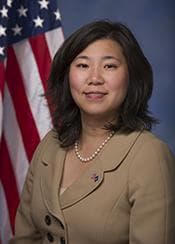
Grace Meng
Democrat · NY · Representative
Votes with party: 97.4% (625 recorded votes)
Full profile: /officials/M001188
Source: Congress.gov · FEC
Cosponsors (76)
Members who have signed on to support this bill since introduction. Source: Congress.gov.
- Al Green (D-TX-9)Original· 2025-05-29
- Alexandria Ocasio-Cortez (D-NY-14)Original· 2025-05-29
- André Carson (D-IN-7)Original· 2025-05-29
- Becca Balint (D-VT)Original· 2025-05-29
- Bonnie Watson Coleman (D-NJ-12)Original· 2025-05-29
- Chellie Pingree (D-ME-1)Original· 2025-05-29
- Daniel S. Goldman (D-NY-10)Original· 2025-05-29
- Debbie Dingell (D-MI-6)Original· 2025-05-29
- Debbie Wasserman Schultz (D-FL-25)Original· 2025-05-29
- Delia C. Ramirez (D-IL-3)Original· 2025-05-29
- Dwight Evans (D-PA-3)Original· 2025-05-29
- Eleanor Holmes Norton (D-DC)Original· 2025-05-29
- Frank J. Mrvan (D-IN-1)Original· 2025-05-29
- George Latimer (D-NY-16)Original· 2025-05-29
- Gregory W. Meeks (D-NY-5)Original· 2025-05-29
- Henry C. "Hank" Johnson, Jr. (D-GA-4)Original· 2025-05-29
- Jahana Hayes (D-CT-5)Original· 2025-05-29
- James P. McGovern (D-MA-2)Original· 2025-05-29
- Jasmine Crockett (D-TX-30)Original· 2025-05-29
- Jerrold Nadler (D-NY-12)Original· 2025-05-29
- Jesús G. "Chuy" García (D-IL-4)Original· 2025-05-29
- Jill N. Tokuda (D-HI-2)Original· 2025-05-29
- Jimmy Gomez (D-CA-34)Original· 2025-05-29
- Joseph D. Morelle (D-NY-25)Original· 2025-05-29
- Josh Gottheimer (D-NJ-5)Original· 2025-05-29
- Joyce Beatty (D-OH-3)Original· 2025-05-29
- Juan Vargas (D-CA-52)Original· 2025-05-29
- Judy Chu (D-CA-28)Original· 2025-05-29
- Julia Brownley (D-CA-26)Original· 2025-05-29
- Kevin Mullin (D-CA-15)Original· 2025-05-29
- Kim Schrier (D-WA-8)Original· 2025-05-29
- LaMonica McIver (D-NJ-10)Original· 2025-05-29
- Lateefah Simon (D-CA-12)Original· 2025-05-29
- Lloyd Doggett (D-TX-37)Original· 2025-05-29
- Marilyn Strickland (D-WA-10)Original· 2025-05-29
- Mark Pocan (D-WI-2)Original· 2025-05-29
- Mary Gay Scanlon (D-PA-5)Original· 2025-05-29
- Melanie A. Stansbury (D-NM-1)Original· 2025-05-29
- Mike Quigley (D-IL-5)Original· 2025-05-29
- Morgan McGarvey (D-KY-3)Original· 2025-05-29
- Nanette Diaz Barragán (D-CA-44)Original· 2025-05-29
- Nikki Budzinski (D-IL-13)Original· 2025-05-29
- Paul Tonko (D-NY-20)Original· 2025-05-29
- Pramila Jayapal (D-WA-7)Original· 2025-05-29
- Ritchie Torres (D-NY-15)Original· 2025-05-29
- Robert Menendez (D-NJ-8)Original· 2025-05-29
- Robin L. Kelly (D-IL-2)Original· 2025-05-29
- Sara Jacobs (D-CA-51)Original· 2025-05-29
- Sean Casten (D-IL-6)Original· 2025-05-29
- Seth Moulton (D-MA-6)Original· 2025-05-29
- Sheila Cherfilus-McCormick (D-FL-20)Original· 2025-05-29
- Shontel M. Brown (D-OH-11)Original· 2025-05-29
- Stephen F. Lynch (D-MA-8)Original· 2025-05-29
- Steve Cohen (D-TN-9)Original· 2025-05-29
- Summer L. Lee (D-PA-12)Original· 2025-05-29
- Suzan K. DelBene (D-WA-1)Original· 2025-05-29
- Sylvia R. Garcia (D-TX-29)Original· 2025-05-29
- Ted Lieu (D-CA-36)Original· 2025-05-29
- Terri A. Sewell (D-AL-7)Original· 2025-05-29
- Valerie P. Foushee (D-NC-4)Original· 2025-05-29
- Veronica Escobar (D-TX-16)Original· 2025-05-29
- Yvette D. Clarke (D-NY-9)· 2025-06-06
- Nydia M. Velázquez (D-NY-7)· 2025-06-25
- Rashida Tlaib (D-MI-12)· 2025-06-25
- Doris O. Matsui (D-CA-7)· 2025-07-10
- Jennifer L. McClellan (D-VA-4)· 2025-07-10
- Lois Frankel (D-FL-22)· 2025-07-10
- Christopher R. Deluzio (D-PA-17)· 2025-07-23
- Wesley Bell (D-MO-1)· 2025-09-11
- William R. Keating (D-MA-9)· 2025-09-11
- Nikema Williams (D-GA-5)· 2025-12-02
- Lori Trahan (D-MA-3)· 2026-01-13
- Emily Randall (D-WA-6)· 2026-04-23
Latest Action
The most recent step in the bill's legislative path. Committee Activity below shows referrals and reports; the full action-by-action history including floor proceedings lives at Congress.gov →
Referred to the Committee on Education and Workforce, and in addition to the Committees on the Judiciary, Financial Services, Energy and Commerce, Transportation and Infrastructure, Ways and Means, and the Budget, for a period to be subsequently determined by the Speaker, in each case for consideration of such provisions as fall within the jurisdiction of the committee concerned.
2025-05-29
Source: Congress.gov
Committee Activity
Currently in
- House Committee on Education and WorkforceReferred To · 2025-05-29
- House Committee on Energy and CommerceReferred To · 2025-05-29
- House Committee on Ways and MeansReferred To · 2025-05-29
- House Committee on Transportation and InfrastructureReferred To · 2025-05-29
- House Committee on Financial ServicesReferred To · 2025-05-29
- House Committee on the BudgetReferred To · 2025-05-29
- House Committee on the JudiciaryReferred To · 2025-05-29
Previously
- Judiciary CommitteeReferred To · 2025-05-29
- Budget CommitteeReferred To · 2025-05-29
- Financial Services CommitteeReferred To · 2025-05-29
- Transportation and Infrastructure CommitteeReferred To · 2025-05-29
- Energy and Commerce CommitteeReferred To · 2025-05-29
Plain-English Summary
Menstrual Equity For All Act of 2025 This bill expands access to menstrual products (e.g., tampons) in certain locations and for particular groups, such as in schools and for low-income individuals, through federal programs and requirements. It also prohibits state or local sales taxes for these products. The bill expands access to menstrual products through federal programs by requiring Medicaid to cover such products, establishing grants within the Temporary Assistance for Needy Families (TANF) program to provide benefits to ensure access to such products, authorizing the Emergency Food and Shelter Program to provide menstrual products to homeless individuals, and increasing Social Services Block Grant funding to provide such products to low-income individuals. Also, the bill sets out requirements to make free menstrual products available in federal and state correctional facilities (including Department of Homeland Security detention facilities) and restrooms in federal buildings that are open to the public. Further, the bill (1) establishes grants to provide free menstrual products to students at institutions of higher education, and (2) permits elementary and secondary schools to use certain grant funds to provide menstrual products to students. In addition, the bill requires employers with at least 100 employees to provide free menstrual products for employees. Finally, the bill prohibits states and local governments from taxing retail sales of menstrual products.
Plain-English rewrite of the Congressional Research Service summary published on Congress.gov. Cached and reviewed.
Subjects
Health
Full bill text is not yet cached locally.
Related legislation
Bills by the same sponsor or covering overlapping subjects.
- HRES1582Recognizing that the United States needs to support and strengthen mothers in the workforce by investing in the Mom Economy.Referred to Committee · 2026-09-24
- HRES1565Expressing the sense of the House of Representatives that the United States Postal Service should issue a commemorative postage stamp honoring Lewis Howard Latimer, in recognition of his distinctive life, scientific achievements, and his civic contributions to technological advancement, to commemorate the 178th year anniversary of his birth and that the Citizens Stamp Advisory Committee should recommend to the Postmaster General that such a stamp be issued.Referred to Committee · 2026-09-17
- HR5645Pray Safe Act of 2025Referred to Committee · 2026-09-15
- HR10129Stamps for Staying Connected Act of 2026Referred to Committee · 2026-08-20