No WAR Act
Sponsor
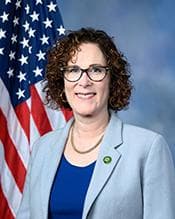
Full profile: /officials/H001094
Source: Congress.gov · FEC
Cosponsors (60)
Members who have signed on to support this bill since introduction. Source: Congress.gov.
- Brendan F. Boyle (D-PA-2)Original· 2026-04-30
- Dina Titus (D-NV-1)· 2026-05-04
- Jesús G. "Chuy" García (D-IL-4)· 2026-05-04
- Melanie A. Stansbury (D-NM-1)· 2026-05-04
- Teresa Leger Fernandez (D-NM-3)· 2026-05-04
- Andrea Salinas (D-OR-6)· 2026-05-12
- Becca Balint (D-VT)· 2026-05-12
- Maxine Dexter (D-OR-3)· 2026-05-12
- Ilhan Omar (D-MN-5)· 2026-05-13
- Jill N. Tokuda (D-HI-2)· 2026-05-13
- Joe Courtney (D-CT-2)· 2026-05-13
- John B. Larson (D-CT-1)· 2026-05-13
- Pablo José Hernández (D-PR)· 2026-05-13
- Richard E. Neal (D-MA-1)· 2026-05-13
- Stephen F. Lynch (D-MA-8)· 2026-05-13
- Sydney Kamlager-Dove (D-CA-37)· 2026-05-13
- Mike Thompson (D-CA-4)· 2026-05-14
- Rashida Tlaib (D-MI-12)· 2026-05-14
- Sean Casten (D-IL-6)· 2026-05-14
Latest Action
The most recent step in the bill's legislative path. Committee Activity below shows referrals and reports; the full action-by-action history including floor proceedings lives at Congress.gov →
Referred to the Committee on Rules, and in addition to the Committee on the Budget, for a period to be subsequently determined by the Speaker, in each case for consideration of such provisions as fall within the jurisdiction of the committee concerned.
2026-04-30
Source: Congress.gov
Committee Activity
Currently in
- House Committee on RulesReferred To · 2026-04-30
- House Committee on the BudgetReferred To · 2026-04-30
Previously
- Budget CommitteeReferred To · 2026-04-30
- Rules CommitteeReferred To · 2026-04-30
Plain-English Summary
No War Appropriations through Reconciliation Act or the No WAR Act This bill establishes a budget point of order that prohibits considering reconciliation legislation that provides funding for unauthorized military force against Iran. (Reconciliation is an expedited method by which Congress may adopt changes in spending and revenue laws to achieve the budgetary goals reflected in a congressional budget resolution. Reconciliation bills are considered by Congress using expedited legislative procedures that prevent a filibuster and restrict amendments in the Senate.) Specifically, the point of order may be raised to prohibit the consideration of reconciliation legislation that provides budget authority for hostilities, including hostilities conducted by a proxy force, against Iran unless Congress has authorized such hostilities through a declaration of war or a specific authorization for use of military force. Under the bill, hostilities includes any offensive military operation, strike, covert action, or sustained engagement involving armed conflict against Iranian military forces, territory, or government institutions. The point of order may be waived by a vote of at least three-fifths of all Senators duly chosen and sworn (60 votes if there are no vacancies).
Plain-English rewrite of the Congressional Research Service summary published on Congress.gov. Cached and reviewed.
Subjects
Full Bill Text
Verbatim text published on Congress.gov via GovInfo. Use Cmd+F / Ctrl+F to search within this excerpt.
[Congressional Bills 119th Congress] [From the U.S. Government Publishing Office] [H.R. 8592 Introduced in House (IH)] <DOC> 119th CONGRESS 2d Session H. R. 8592 To amend the Congressional Budget and Impoundment Control Act of 1974 to provide for a point of order against reconciliation measures that provide budget authority for unauthorized military operations against Iran, and for other purposes. _______________________________________________________________________ IN THE HOUSE OF REPRESENTATIVES April 30, 2026 Ms. Hoyle of Oregon (for herself and Mr. Boyle of Pennsylvania) introduced the following bill; which was referred to the Committee on Rules, and in addition to the Committee on the Budget, for a period to be subsequently determined by the Speaker, in each case for consideration of such provisions as fall within the jurisdiction of the committee concerned _______________________________________________________________________ A BILL To amend the Congressional Budget and Impoundment Control Act of 1974 to provide for a point of order against reconciliation measures that provide budget authority for unauthorized military operations against Iran, and for other purposes. Be it enacted by the Senate and House of Representatives of the United States of America in Congress assembled, SECTION 1. SHORT TITLE. This Act may be cited as the ``No War Appropriations through Reconciliation Act'' or the ``No WAR Act''. SEC. 2. POINT OF ORDER AGAINST RECONCILIATION MEASURE PROVIDING BUDGET AUTHORITY FOR UNAUTHORIZED MILITARY FORCE AGAINST IRAN. The Congressional Budget and Impoundment Control Act of 1974 is amended-- (1) in section 310, by adding at the end the following: ``(h) Limitation on Providing Funds for Unauthorized Military Force Against Iran.-- ``(1) In general.--Notwithstanding any other provision of law, it shall not be in order in the Senate or the House of Representatives to consider any reconciliation bill or reconciliation resolution reported pursuant to a concurrent resolution on the budget agreed to under section 301 or 304, or a joint resolution pursuant to section 258C of the Balanced Budget and Emergency Deficit Control Act of 1985, or any amendment thereto or conference report thereon, that appropriates or otherwise provides budget authority for hostilities, including hostilities conducted by a proxy force, against the Islamic Republic of Iran unless Congress has authorized such hostilities through a declaration of war or specific authorization for use of military force. ``(2) Definitions.--For purposes of this subsection: ``(A) Hostilities.--The term `hostilities' includes any offensive military operation, strike, covert action, or sustained engagement involving armed conflict against Iranian military forces, territory, or government institutions. ``(B) Proxy forces.--The term `proxy force' means any foreign military, paramilitary, or irregular force operating at the direction, request, or with the material support of the United States.''; and (2) in section 904, by inserting ``310(h),'' after ``310(g),'' each place it appears. <all>
Related legislation
Bills by the same sponsor or covering overlapping subjects.
- HR10823Northwest Wetlands Voluntary Incentives Program ActReferred to Committee · 2026-10-15
- HR10444Stop Corporate Takeovers of Physicians Act of 2026Referred to Committee · 2026-09-16
- HR10094Affordable Pricing for Taxpayer-Funded Prescription Drugs Act of 2026Referred to Committee · 2026-08-13
- HR9281DASH ActReferred to Committee · 2026-06-11