RESTORE Third Spaces Act of 2026
Sponsor
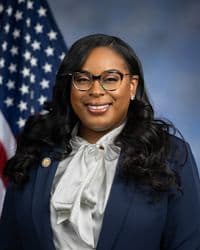
Full profile: /officials/M001229
Source: Congress.gov · FEC
Cosponsors (14)
Members who have signed on to support this bill since introduction. Source: Congress.gov.
- André Carson (D-IN-7)Original· 2026-05-26
- Bennie G. Thompson (D-MS-2)Original· 2026-05-26
- Cleo Fields (D-LA-6)Original· 2026-05-26
- Eleanor Holmes Norton (D-DC)Original· 2026-05-26
- Jesús G. "Chuy" García (D-IL-4)Original· 2026-05-26
- Rashida Tlaib (D-MI-12)Original· 2026-05-26
- Seth Moulton (D-MA-6)Original· 2026-05-26
- Shomari Figures (D-AL-2)· 2026-06-22
Latest Action
The most recent step in the bill's legislative path. Committee Activity below shows referrals and reports; the full action-by-action history including floor proceedings lives at Congress.gov →
Referred to the Committee on Transportation and Infrastructure, and in addition to the Committee on Financial Services, for a period to be subsequently determined by the Speaker, in each case for consideration of such provisions as fall within the jurisdiction of the committee concerned.
2026-05-26
Source: Congress.gov
Committee Activity
Currently in
- House Committee on Financial ServicesReferred To · 2026-05-26
- House Committee on Transportation and InfrastructureReferred To · 2026-05-26
Plain-English Summary
The federal government would create a pilot program that gives grants to communities to renovate and build "third spaces"—public gathering places like libraries, parks, community centers, and cafes where people can socialize outside of home and work. Local governments and organizations would apply for these grants to improve existing community spaces or develop new ones in their areas. The program aims to strengthen neighborhood connections and give people more places to gather together.
AI-assisted summary generated from the official bill metadata (title, subjects, actions) sourced from Congress.gov. Cached and reviewed. Always verify against the official text linked below.
Subjects
Full Bill Text
Verbatim text published on Congress.gov via GovInfo. Use Cmd+F / Ctrl+F to search within this excerpt.
[Congressional Bills 119th Congress] [From the U.S. Government Publishing Office] [H.R. 9032 Introduced in House (IH)] <DOC> 119th CONGRESS 2d Session H. R. 9032 To direct the Secretary of Commerce to establish a pilot program to award grants to renovate and develop third spaces, and for other purposes. _______________________________________________________________________ IN THE HOUSE OF REPRESENTATIVES May 26, 2026 Mrs. McIver (for herself, Mr. Carson, Mr. Moulton, Ms. Tlaib, Ms. Norton, Mr. Garcia of Illinois, Mr. Thompson of Mississippi, and Mr. Fields) introduced the following bill; which was referred to the Committee on Transportation and Infrastructure, and in addition to the Committee on Financial Services, for a period to be subsequently determined by the Speaker, in each case for consideration of such provisions as fall within the jurisdiction of the committee concerned _______________________________________________________________________ A BILL To direct the Secretary of Commerce to establish a pilot program to award grants to renovate and develop third spaces, and for other purposes. Be it enacted by the Senate and House of Representatives of the United States of America in Congress assembled, SECTION 1. SHORT TITLE. This Act may be cited as the ``Revitalizing Equitable Spaces to Transform Our Regional Environments and Third Spaces Act of 2026'' or the ``RESTORE Third Spaces Act of 2026''. SEC. 2. FINDINGS. Congress finds the following: (1) Third spaces--social environments distinct from home and work--are essential for democratic participation, mental health, social trust, and cultural vitality. They provide opportunities for residents to connect across lines of difference; reduce social isolation; and foster emotional well- being, civic engagement, and mutual aid. (2) Third spaces serve as engines for local economic resilience and community wealth-building. They act as vital incubators for local entrepreneurship and innovation by providing low-barrier environments for networking and collaboration. In urban and rural settings, vibrant social hubs drive foot traffic to surrounding businesses, increase property values, and foster a distinct sense of place that attracts sustainable long-term investment. By providing shared-use infrastructure, third spaces lower the cost of entry for small businesses and cooperative enterprises, turning social capital into tangible economic opportunity. (3) Decades of public disinvestment, segregation, urban renewal, and gentrification have disproportionately dismantled shared civic spaces in underserved and marginalized communities. The closure of community centers, parks, libraries, and gathering places has weakened social infrastructure that once supported local organizing, intergenerational relationships, and cultural continuity. (4) The widespread loss of accessible third spaces in urban and rural areas has reduced opportunities for collective problem-solving, mutual aid, and civic participation, thereby deepening loneliness, disconnection, and mistrust. (5) Social isolation and the decline of communal life have created conditions conducive to online radicalization and misinformation. When residents lack shared public spaces for dialogue, creativity, and belonging, they are more vulnerable to divisive and extremist influences online. (6) Third spaces also contribute to local economic resilience. By fostering collaboration, creativity, and shared- use infrastructure, these spaces can generate small business growth, cooperative enterprise, workforce development, and community wealth-building while remaining open and accessible to all. (7) The Federal Government has a vital role in seeding and studying innovative third space models that promote equity, inclusion, and sustainability. A national pilot program can catalyze local leadership, restore social cohesion, and demonstrate how inclusive, low- or no-cost shared public life can flourish in the twenty-first century. SEC. 3. PILOT GRANT PROGRAM TO RENOVATE AND DEVELOP THIRD SPACES. (a) Establishment.--The Secretary of Commerce, in consultation with the Secretary of Housing and Urban Development and the Secretary of Health and Human Services, shall establish a pilot program to award grants to eligible entities to renovate and develop third spaces. (b) Grant Priorities.--In awarding…
Show the remaining 929 wordsHide the remaining 929 words
grants under subsection (a), the Secretary shall prioritize any eligible entity that seeks to renovate or develop a third space that-- (1) strengthens the local economy; and (2) mitigates social isolation and the decline of communal life. (c) Application Requirements.--An application submitted by an eligible entity for a grant under subsection (a) shall-- (1) include documentation of the history of the community in which the third space to be renovated or developed is located, including documentation of historical inequities-- (A) within such community; and (B) between such community and other communities; and (2) describe how such eligible entity, in renovating or developing a third space pursuant to such grant, plans to-- (A) engage members of such community in the design of such third space; (B) ensure that such renovation or development-- (i) benefits members of such community; and (ii) does not exacerbate such historical inequities; and (C) preserve local-- (i) culture; (ii) history; and (iii) identity. (d) Use of Funds.--An eligible entity may use a grant under subsection (a) to-- (1) plan the renovation or development of a third space, including through-- (A) community engagement initiatives; (B) feasibility studies; and (C) other pre-development activities; and (2) pay construction costs associated with the renovation or development of such third space. (e) Equity and Historical Justice Requirements.-- (1) Federal requirements.--Not less than 60 percent of any amounts awarded under subsection (a) for a fiscal year shall be awarded to eligible entities serving low-income and underserved communities. (2) Accessibility policies.--Each eligible entity renovating or developing a third space pursuant to a grant under subsection (a) shall establish a policy to ensure that such third space remains free or low-cost to members of the public, except that an eligible entity may charge a reasonable rent to a business for the use of such third space. (f) Expiration of Pilot.-- (1) In general.--Except as provided in paragraph (2), the pilot program shall expire on the date that is 3 years after the date of enactment of this Act. (2) Optional extension of pilot.--Not later than 30 days before the expiration of the 3-year period following the date of the enactment of this Act, the Secretary may extend the pilot program for an additional period of 2 years. (g) Reports.-- (1) Eligible entity reports.--Not later than 30 days after the date of enactment of this Act, the Secretary shall establish reporting requirements for an eligible entity renovating or developing a third space pursuant to a grant under subsection (a), which shall-- (A) be responsive to the resources available to such eligible entity to engage in such reporting; and (B) include required reporting regarding-- (i) attendance rates at such third spaces; (ii) programs offered at such third spaces; and (iii) social, cultural, and direct and indirect economic impacts of such third spaces. (2) Reports to congress.--Not later than 3 years after the expiration of the pilot program under subsection (f), the Secretary shall submit to Congress a report-- (A) summarizing metrics of success for third spaces renovated and developed pursuant to grants under subsection (a), including-- (i) attendance rates at such third spaces; (ii) the number of new businesses formed in the communities in which such third spaces are located; (iii) the affordability of such third spaces; and (iv) survey-based measures of belonging experienced by attendees at such third spaces; (B) assessing, based on the metrics established in paragraph (1), the outcomes of the pilot program, including, for third spaces renovated and developed pursuant to grants under subsection (a)-- (i) social, cultural, and direct and indirect economic impacts of such third spaces; and (ii) the effectiveness of such third spaces in-- (I) reducing social isolation; and (II) supporting community life; and (C) providing recommendations regarding the expansion of the pilot program. (h) Administrative Expense Cap.--Not more than 5 percent of any funds appropriated to carry out this section for a fiscal year may be expended for Federal administration of the pilot program. (i) Authorization of Appropriations.--There are authorized to be appropriated to carry out this section $200,000,000. (j) Definitions.--In this section: (1) The term ``eligible entity'' means-- (A) a local government; (B) a nonprofit corporation; (C) a Federally recognized Indian tribe; (D) a Native Hawaiian organization; (E) a public library; (F) a community college; or (G) a partnership including at least-- (i) one nonprofit corporation; and (ii) one local government or an agency thereof. (2) The term ``Secretary'' means the Secretary of Commerce. (3) The term ``third space''-- (A) means a space open to members of the public that-- (i) does not function primarily as a residence or a workplace; and (ii) supports social, cultural, and economic life; and (B) may include-- (i) a community athletic field; (ii) a community center; (iii) a library; (iv) a cultural center; (v) a makerspace; (vi) a nonprofit incubator; (vii) a park; (viii) a playground; (ix) a public market; (x) a schoolyard with a shared use agreement; (xi) a small business concern (as described in section 3 of the Small Business Act (15 U.S.C. 632)); and (xii) a combination of two or more spaces listed in clauses (i) through (xi). (4) The term ``underserved community'' means a community-- (A) that is subject to one or more of the economic distress criteria under section 301.3(a)(1) of title 13, Code of Federal Regulations (or any successor regulation); and (B) that-- (i) is located in a rural area; or (ii) has experienced-- (I) poverty; (II) disinvestment; (III) racial segregation; (IV) economic segregation; or (V) the loss of third spaces due to-- (aa) redevelopment; (bb) gentrification; or (cc) the construction of new infrastructure. <all>
Related legislation
Bills by the same sponsor or covering overlapping subjects.
- HR10371Ensuring SBA Implementation of GAO Recommendations Act of 2026Reported by Committee · 2026-10-09
- HR9810Small Business Development Centers Improvement Act of 2026Referred to Committee · 2026-07-21
- HR9587Summer Meals REACH Act of 2026Referred to Committee · 2026-07-02
- HR8939Closing the HPV Testing Gap ActReferred to Committee · 2026-05-20