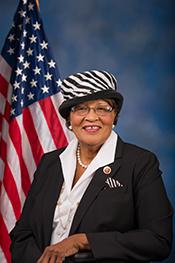
Alma S. Adams
DDemocratNC-12 · Representative
52
/ 100
Average
Attendance100
Avg: 96
Independence1
Avg: 4
Bipartisan Tone25
Avg: 15
Ethics Record100
Avg: 99
Transparency14
Avg: 53
Accountability Score — composite of attendance, independence, bipartisan tone, ethics record & transparency.
Methodology28
Bills Sponsored
0
Enacted into Law
0
Passed a Chamber
28
In Committee
All Sponsored Bills
HR10530In Committee
Quality Educator Partnership Act
HR10531In Committee
Sickle Cell Disease Treatment Centers Act of 2026
HR10513In Committee
Faith-Based Affordable Housing Predevelopment Fund Act
HR10414In Committee
Community Health Worker Access Act
Community Health Worker Access Act This bill provides for coverage of community health services under Medicare. Community health services are services provided by a community health agency in accordance with an individual needs assessment, including preventive services (e.g., screenings) and services to address social determinants of health (e.g., educational home visits). Community health agencies include nonprofits, federally qualified health centers, and other organizations that employ health workers (in accordance with certain labor standards) who have lived experience in the communities served. The bill also allows state Medicaid programs to cover these services and provides for an increased Medicaid federal matching rate, also known as the Federal Medical Assistance Percentage (FMAP), for these services.
HR10330In Committee
Higher Education Oversight for Nonprofits Ensuring Standards and Transparency Act
HRES1491In Committee
Expressing support for the designation of the week of August 25 through August 31, 2026, as "Black Breastfeeding Week".
HCONRES114In Committee
Recognizing the significance of equal pay and the disparity in wages paid to men and to Black women.
This resolution acknowledges the wage gap between men and Black women in the workplace, highlighting that Black women typically earn significantly less than men doing similar work. The measure recognizes this pay disparity as a significant issue affecting Black women workers across various industries and job sectors. By bringing attention to this inequality, the resolution aims to underscore the importance of addressing wage discrimination and promoting equal pay practices.
HR9669In Committee
FACT Pilot Program Act
The federal government would fund a five-year test program that gives grants to organizations providing intensive mental health and substance abuse treatment to people involved in the criminal justice system who have serious mental illnesses. These "forensic assertive community treatment" teams would work with individuals in their communities rather than institutions, aiming to reduce incarceration and improve outcomes for this vulnerable population. The program would help expand these specialized services to more areas across the country.
HR9591In Committee
Extreme Temperatures Injustice in Prisons Act of 2026
The bill would require federal prisons to improve how they handle extreme heat and cold, including better cooling and heating systems, emergency protocols, and staff training to protect inmates and workers from dangerous temperatures. It aims to prevent heat-related illnesses and deaths in federal correctional facilities by establishing standards for temperature control and emergency response procedures. The proposal affects incarcerated people, prison staff, and federal prison operations across the country.
HR9571In Committee
Living Wage for Federal Contractors Act
Companies that do business with the federal government would be required to pay their workers a higher minimum wage than the current federal minimum. This would affect millions of workers employed by federal contractors across industries like construction, defense, and services, potentially increasing their earnings but also potentially raising costs for government projects. The bill is currently being reviewed by congressional committees to determine whether it should move forward.
HR8211In Committee
Army Security Agency Monument Act
This bill would authorize the creation of a monument or memorial dedicated to the Army Security Agency, a military intelligence organization that operated during the Cold War. The monument would honor the service and contributions of military personnel and civilians who worked for the agency. Veterans' groups and military history advocates would likely support recognizing this part of American military history.
HR8399In Committee
STAR Act
The proposal would establish or modify federal programs and funding related to transportation infrastructure and public works projects. It would affect states, cities, construction companies, and workers involved in building and maintaining roads, bridges, transit systems, and other public infrastructure. The specific details of what projects would be funded or how the money would be distributed depend on the bill's full text, which is currently being reviewed by the House Committee on Transportation and Infrastructure.
HRES1183In Committee
Supporting the designation of the week of April 11 through April 17, 2026, as "Black Maternal Health Week", founded by Black Mamas Matter Alliance, Inc. (BMMA), to bring national attention to the maternal and reproductive health crisis in the United States and the importance of reducing maternal mortality and morbidity among Black women and birthing people.
This resolution designates April 11-17, 2026, as "Black Maternal Health Week" to raise awareness about the serious health challenges Black women and pregnant people face during pregnancy and childbirth, including higher rates of death and complications compared to other groups. The week aims to highlight the need for better healthcare and support to reduce these disparities. No new laws or funding are created; it's a symbolic designation meant to draw national attention to this public health issue.
HR8074In Committee
Kira Johnson Act
Without access to the specific legislative text, this bill appears to address a health-related issue and has been sent to the House committee responsible for healthcare policy. Based on the name "Kira Johnson Act," it likely honors or responds to a specific health situation or case, though the exact provisions—such as whether it funds research, changes medical regulations, or establishes new patient protections—cannot be determined from the title alone. To understand what this bill would actually do, you would need to review the full text or summary available through Congress.gov.
HR7522In Committee
Improving Access to Nutrition Act of 2026
Improving Access to Nutrition Act of 2026 This bill repeals certain work requirements for the Supplemental Nutrition Assistance Program (SNAP). The requirements apply to able-bodied adults who are ages 18-65 and have no dependent children under the age of 14. Individuals who do not meet certain work requirements are generally prohibited from receiving more than 3 months of SNAP benefits over a 36-month period.
HRES1040In Committee
Recognizing the significance of the Greensboro Four sit-in during Black History Month.
This resolution recognizes (1) the Greensboro Four for their contributions to the civil rights movement and the significant role they played as a catalyst for the formation of the Student Non-Violent Coordinating Committee, (2) the value of ethnic and racial diversity in the United States, and (3) the continued importance of sit-ins as an effective form of nonviolent resistance. The resolution also encourages states to include information about the Greensboro Four in their educational curriculums.
HR6706In Committee
EFFECTIVE Food Procurement Act
The proposal would change how the federal government buys food for programs like school lunches and military meals, likely requiring agencies to purchase more American-grown products and potentially adjusting nutrition standards or pricing rules. This would affect school districts, military bases, food suppliers, and farmers who sell to the government. The bill aims to support domestic agriculture while potentially improving the quality or cost-effectiveness of meals provided to students, service members, and other people served by federal food programs.
HR5129In Committee
Closing the Meal Gap Act of 2025
The legislation would expand federal food assistance programs to help more low-income Americans, particularly children and seniors, access adequate meals throughout the year. It aims to close gaps in existing programs like SNAP (food stamps) and school meal programs by increasing benefits or extending eligibility to people currently just above the income cutoff. The bill would primarily affect families struggling with food insecurity and the organizations that distribute food assistance.
HR6169In Committee
Fair Credit for Farmers Act
The proposal would make it easier for farmers to access credit and loans by adjusting how lenders evaluate their creditworthiness, potentially allowing agricultural operations with limited credit histories or non-traditional income patterns to qualify for financing. This could help small and mid-sized farms invest in equipment, land, and operations without being turned away by banks that rely on standard credit scoring methods. The changes would primarily benefit farmers and agricultural businesses seeking to grow or maintain their operations.
HRES691In Committee
Expressing the sense of Congress that August 30, 2025, be observed as the 135th anniversary of the 1890 Institutions.
This resolution (1) recognizes the 135 years of significant and meaningful contributions the 1890 Institutions (i.e., historically Black universities established under the Second Morrill Act of 1890) have made to the United States, (2) supports the efforts of the Department of Agriculture and other federal agencies to build stronger partnerships with such institutions, and (3) commits to working in a bipartisan way to address the past funding and program inequities of such institutions.
HRES662In Committee
Expressing support for the designation of the week of August 25 through August 31, 2025, as "Black Breastfeeding Week".
This resolution recognizes the negative effects of systemic and institutional racism on the ability of Black women to meet breastfeeding guidelines. It also recognizes that the barriers created by racism contribute to health disparities and identifies policies to mitigate these barriers.
HCONRES42In Committee
Recognizing the significance of equal pay and the disparity in wages paid to men and to Black women.
The resolution acknowledges the wage gap between men and Black women in the workplace, highlighting that Black women typically earn significantly less than their male counterparts for similar work. While this measure does not create new laws or requirements, it formally recognizes the problem and calls attention to the need for addressing pay inequality. The resolution has been sent to the House Committee on Education and Workforce for consideration.
HR3527In Committee
Real Education and Access for Healthy Youth Act of 2025
The bill would establish or expand health and wellness education programs in schools to help young people learn about physical health, mental health, and healthy lifestyle choices. It affects students, teachers, and school districts by potentially requiring curriculum changes and providing resources for health education. The bill is currently being reviewed by two congressional committees to determine which parts each committee should handle.
HR2357In Committee
Food Secure Strikers Act of 2025
Food Secure Strikers Act of 2025 This bill allows certain striking workers and their households to maintain their eligibility for the Supplemental Nutrition Assistance Program (SNAP). Specifically, the bill provides that a household that would otherwise be eligible to participate in SNAP is eligible for benefits if any member of the household is on strike because of a labor dispute. Current law generally prohibits a household from participating in SNAP if any member of the household is on strike unless the household was eligible for SNAP immediately prior to the strike. Also, under current law, households are not eligible for an increased SNAP allotment as a result of the decreased income of a striking member of the household. The bill expands SNAP eligibility for households with striking workers by repealing both of these restrictions. The bill also allows a government employee who is dismissed for striking and their household to maintain SNAP program eligibility. Specifically, current law prohibits certain individuals who voluntarily and without good cause quit a job from participating in SNAP. Further, a federal, state, or local government employee who participates in a strike against the government that results in their dismissal is considered to have voluntarily quit without good cause. The bill eliminates the provision that considers the dismissed government employee to have voluntarily quit without good cause, thereby allowing the employee and their household to maintain SNAP program eligibility if they are otherwise eligible for the program.
HRES332In Committee
Supporting the designation of the week of April 11 through April 17, 2025, as the eighth annual "Black Maternal Health Week", founded by Black Mamas Matter Alliance, Inc. (BMMA), to bring national attention to the maternal and reproductive health crisis in the United States and the importance of reducing maternal mortality and morbidity among Black women and birthing people.
The proposal designates April 11-17, 2025 as "Black Maternal Health Week" to raise awareness about the serious health challenges Black women and pregnant people face during pregnancy and childbirth, including higher rates of death and complications. The week-long recognition aims to draw national attention to these disparities and encourage efforts to reduce maternal mortality and health problems in Black communities. This designation does not create new programs or funding, but rather officially recognizes an existing awareness initiative started by the Black Mamas Matter Alliance.
HR2664In Committee
To amend the Higher Education Act of 1965 to provide for additional uses of funds for grants to strengthen historically Black colleges and universities, and for other purposes.
This bill would expand how historically Black colleges and universities can use federal grant money, likely allowing them to spend funds on a broader range of programs and initiatives beyond their current restrictions. The changes would give these institutions more flexibility to strengthen academics, student services, campus facilities, or other areas they determine are priorities. The bill affects students and faculty at historically Black colleges and universities, as well as the institutions themselves.
HRES95In Committee
Recognizing the significance of the Greensboro Four sit-in during Black History Month.
This resolution recognizes (1) the Greensboro Four for their contributions to the civil rights movement and the significant role they played as a catalyst for the formation of the Student Non-Violent Coordinating Committee, (2) the value of ethnic and racial diversity in the United States, and (3) the continued importance of sit-ins as an effective form of nonviolent resistance. The resolution also encourages states to include information about the Greensboro Four in their educational curriculums.
HRES45In Committee
Honoring Alpha Kappa Alpha Sorority, Inc.®, on reaching the historic milestone of 117 years of serving communities.
This resolution congratulates and commends Alpha Kappa Alpha Sorority Inc. for its 117 years of service.