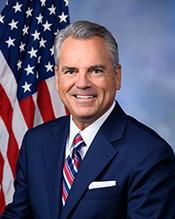
Mark Alford
RRepublicanMO-4 · Representative
62
/ 100
Average
Attendance98
Avg: 96
Independence3
Avg: 4
Bipartisan Tone26
Avg: 15
Ethics Record100
Avg: 99
Transparency75
Avg: 53
Accountability Score — composite of attendance, independence, bipartisan tone, ethics record & transparency.
Methodology20
Bills Sponsored
0
Enacted into Law
2
Passed a Chamber
18
In Committee
All Sponsored Bills
HR10644In Committee
Faith and Rural Small Business Act
HR9828In Committee
Federal Employee Financial Protection Act of 2026
During a government shutdown, federal employees who are furloughed or not paid would be protected from having late or missed payments reported to credit agencies and damaging their credit scores. This would prevent workers from facing long-term financial penalties for bills they couldn't pay through no fault of their own when the government stopped paying them. The change applies only to debts that become delinquent specifically because of a government shutdown.
HR915Passed House
Small Business Technological Advancement Act
Small Business Technological Act of 2025 This bill authorizes the Small Business Administration (SBA) to finance under the 7(a) loan program business software or cloud computing services that facilitate business operations, product or service delivery, payroll processing, human resources functions, sales and billing functions, or accounting or tracking of inventory. Such software or services include business tools that utilize artificial intelligence. The 7(a) loan program is the SBA's primary business loan program that provides loan guaranties for participating lenders to provide financing to small businesses that are otherwise unable obtain reasonable credit terms.
HRES1401In Committee
Honoring John Wathan on his induction into the Kansas City Royals Hall of Fame.
This resolution recognizes and honors John Wathan for his induction into the Kansas City Royals Hall of Fame, celebrating his contributions to the team and baseball. The measure serves as a formal congressional acknowledgment of Wathan's achievements as a player and his significance to Kansas City sports history.
HR9539In Committee
Online Accessibility Act
This bill would require private companies to make their websites and mobile apps accessible to people with disabilities, such as by providing text descriptions for images or keyboard navigation options. It would establish specific technical standards that companies must follow to ensure their digital platforms work for users who are blind, deaf, or have other disabilities. The requirement would apply to most consumer-facing websites and apps, affecting retailers, banks, social media platforms, and other businesses that serve the public online.
HR9212In Committee
VA Emergency Transportation Act
Veterans who use emergency medical transportation to reach a Veterans Affairs hospital or clinic would be reimbursed by the VA for those transportation costs, rather than having to pay out of pocket. This change would help reduce financial burdens on veterans who need urgent medical care at VA facilities. The bill is currently being reviewed by the House Committee on Veterans' Affairs.
HRES1367In Committee
Honoring the tremendous effort undertaken by the good people of Kansas City, Missouri, Kansas, and surrounding communities in getting the heartland ready for the World Cup.
This resolution recognizes the work done by residents and organizations in the Kansas City area to prepare the region for hosting World Cup soccer matches. The measure acknowledges the efforts of people across Missouri, Kansas, and nearby communities who contributed to infrastructure improvements, planning, and local preparations for the international tournament.
HR9118In Committee
Enhanced Alerts for Missing Loved Ones with Disabilities Act of 2026
The proposal would expand an emergency alert system (called the Ashanti Alert) that helps find missing people to also include alerts for individuals with developmental disabilities, Alzheimer's disease, and dementia. This would allow law enforcement and the public to be notified more quickly when someone with these conditions goes missing, potentially improving search and rescue outcomes. The change affects missing persons cases involving vulnerable populations who may need specialized help when lost.
HR8596In Committee
FAIR Labels Act of 2026
The bill would require clearer labeling rules so shoppers can easily tell the difference between traditional meat and poultry products and newer lab-grown protein products when they're shopping. This gives consumers better information to make their own choices about which type of protein they want to buy, while the meat and poultry industries would need to follow updated labeling standards to distinguish their products from cell-cultivated alternatives.
HR8258In Committee
Strategic Assets Protection Act
Without specific subjects listed, this bill likely aims to protect important U.S. assets—such as critical infrastructure, technology, or natural resources—from foreign control or interference, based on its referral to committees overseeing financial services, foreign affairs, and energy. The exact protections would depend on the bill's specific provisions, but such legislation typically restricts foreign investment in sensitive sectors or requires government review of certain business deals involving foreign buyers. Workers, companies, and consumers could be affected depending on which industries and transactions the bill targets.
HRES1132In Committee
Expressing support for the designation of March 24, 2026, as "National Agriculture Day" and celebrating the importance of agriculture as one of the most impactful industries in the United States.
This resolution supports the designation of National Agriculture Day.
HR7727In Committee
Sustaining Rural Healthcare Act
This bill aims to help keep hospitals and clinics open in rural areas by providing financial support and other assistance to healthcare providers serving small communities. Rural hospitals and clinics often struggle to stay in business because they serve fewer patients and have higher costs, so the bill would likely include funding, tax breaks, or other incentives to keep these facilities operating. The changes would affect rural residents who depend on local healthcare services, as well as the doctors, nurses, and hospital staff who work in these communities.
HR7680In Committee
Protect our Ballots Act of 2026
This bill would restrict voting access by requiring proof of citizenship to register and vote in federal elections, affecting all voters nationwide. The legislation targets immigration policy by preventing non-citizens from participating in elections, though it would also impact the voter registration process for all Americans who would need to provide citizenship documentation. The bill has been sent to two committees for review to determine which parts fall under their respective areas of responsibility.
HR5764Passed House
AI for Main Street Act
AI for Main Street Act This bill requires Small Business Development Centers to assist small businesses in evaluating artificial intelligence, including by providing best practices for using artificial intelligence and guidance about using artificial intelligence to plan for unexpected circumstances.
HR5993In Committee
MACV–SOG Congressional Gold Medal Act
This bill would award the Congressional Gold Medal, one of the nation's highest civilian honors, to members of MACV-SOG (Military Assistance Command, Vietnam – Studies and Observations Group), a special operations unit that conducted classified missions during the Vietnam War. The medal recognizes the extraordinary heroism and sacrifice of these soldiers who served in dangerous, covert operations that were largely unknown to the public for decades. Veterans and their families would receive official acknowledgment of their service through this prestigious award.
HR5387In Committee
Saving the American Dream Act
Based on the title and housing focus, this bill likely aims to make homeownership more affordable or accessible for American families by addressing barriers like down payments, lending requirements, or housing costs. The specific measures aren't yet clear since the bill is still in early stages, but it probably targets working and middle-class people struggling to buy homes or build wealth through property ownership. The bill has been sent to a subcommittee for review and discussion before any votes take place.
HR4153In Committee
Supporting Trade and Rebuilding Opportunity for National Growth Act
This bill aims to support American businesses and economic growth through trade policies and programs that help companies compete globally and expand domestically. It likely includes measures to assist small businesses in accessing new markets, reducing trade barriers, and creating jobs across different industries. The bill is currently being reviewed by the House Committee on Small Business to determine its specific provisions and potential impact on entrepreneurs and workers.
HR1648In Committee
A–PLUS Act
Amplifying Processing of Livestock in the United States Act or the A–PLUS Act This bill directs the Department of Agriculture (USDA) to revise its regulations to allow certain packers to hold an ownership interest in, finance, or participate in the management or operation of a market agency selling livestock on a commission basis. The bill applies to packers that have a cumulative slaughter capacity of (1) less than 2,000 animals per day or 700,000 animals per year with respect to cattle or sheep, and (2) less than 10,000 animals per day or 3 million animals per year with respect to hogs. In addition, USDA must revise its regulations to include a disclosure requirement for a market agency that has an ownership interest in, finances, or participates in the management or operation of a packer. Specifically, the market agency must disclose the existence of such ownership interest, financial relationship, or participation.
HRES227In Committee
Expressing support for the designation of March 18, 2025, as "National Agriculture Day" and celebrating the importance of agriculture as one of the most impactful industries in the United States.
This resolution supports the designation of National Agriculture Day.
HRES129In Committee
Expressing support for the designation of February 9, 2025, as the first ever "Gulf of America Day" and celebrating the importance of changing the Gulf of Mexico to the Gulf of America.
This resolution expresses support for the designation of the first Gulf of America Day and celebrates the changing of the Gulf of Mexico to the Gulf of America.