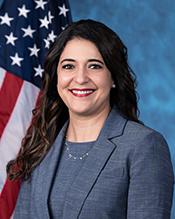
Stephanie I. Bice
RRepublicanOK-5 · Representative
55
/ 100
Average
Attendance99
Avg: 96
Independence2
Avg: 4
Bipartisan Tone10
Avg: 15
Ethics Record100
Avg: 99
Transparency53
Avg: 53
Accountability Score — composite of attendance, independence, bipartisan tone, ethics record & transparency.
Methodology23
Bills Sponsored
1
Enacted into Law
3
Passed a Chamber
19
In Committee
All Sponsored Bills
HR1555In Committee
Bureau of Land Management Mineral Spacing Act
Bureau of Land Management Mineral Spacing Act This bill exempts certain oil and gas exploration and production activities from permit and environmental review requirements. This exemption applies to activities conducted on nonfederal surface estates located on partially federally-held mineral rights. Specifically, the bill prohibits the Bureau of Land Management (BLM) from requiring an operator to obtain a federal drilling permit under the Mineral Leasing Act for oil and gas exploration and production activities conducted on a nonfederal surface estate if (1) less than 50% of the subsurface mineral estate to be accessed by the proposed action is federally owned, and (2) the operator submits to the BLM a state permit to conduct such activities on the nonfederal surface estate. Those activities are not considered to be a major federal action under the National Environmental Policy Act of 1969 (NEPA), and thus are exempt from environmental review requirements under NEPA. Further, those activities are exempt from requirements for federal actions under the National Historic Preservation Act of 1966 and the Endangered Species Act of 1973. The bill does not apply to Indian lands.
HR9342Passed House
GPO Modernization Act of 2026
GPO Modernization Act of 2026 This bill revises certain programs and operations of the Government Publishing Office (GPO). The bill also revises a Library of Congress (LOC) requirement related to the publication of the Constitution Annotated. Specifically, the bill revises the Federal Depository Library Program (FDLP) through which GPO provides long-term public access to federal publications. Among other changes to the FDLP, the bill (1) updates statutory references within the FDLP to include references to government public information in all formats, including digital; and (2) removes a requirement that a depository library must maintain a specified minimum number of books. Additionally, the bill requires GPO's Superintendent of Documents to (1) provide descriptive cataloguing records for government public information, which must include metadata; and (2) protect the privacy of individuals using the digital repository system. Among other changes to GPO operations, the bill redesignates the Joint Committee on Printing (which oversees GPO) as the Joint Committee on Publishing and updates the relevant statutory references, specifies that GPO may provide publishing services, allows GPO to accept gifts, increases the statutory simplified acquisition threshold for GPO purchases, and updates certain employee leave carryover and compensation rules. The bill also replaces the requirement for LOC to prepare hardbound versions of the Constitution Annotated and supplements with a requirement for LOC to instead prepare digital versions and publish them online. The new requirement applies to the supplement after the Supreme Court term beginning October 2026 and all subsequent editions.
HRES1512In Committee
Celebrating the 50th anniversary of the admission of women to the United States service academies and honoring the pioneering women of the Class of 1980.
HR10250In Committee
No Preference Act
HR7418In Committee
STEADFAST Act
Without access to the bill's specific text or detailed provisions, I cannot provide an accurate summary of what this legislation would do. The title "STEADFAST Act" and subject area of "Government Operations and Politics" are too general to determine the bill's concrete effects. To write a meaningful summary, I would need information about the bill's actual provisions, such as what government operations it would change or what political processes it would affect.
HR8675In Committee
Training Rural Law Enforcement Officers Act of 2026
The legislation would provide funding and training programs to help law enforcement agencies in rural areas improve their capabilities and prepare officers for the unique challenges they face in less populated communities. Rural police departments would gain access to specialized training resources, equipment support, and technical assistance to better serve their communities. This would primarily benefit small-town police forces and the residents they protect by strengthening law enforcement capacity in areas that often have fewer resources than urban departments.
HR8295In Committee
Protecting Families from Fertility Fraud Act of 2026
This bill would make it a federal crime to abuse, harm, or exploit people undergoing fertility treatments or to misuse eggs, sperm, or embryos without consent. It would protect patients at fertility clinics and research facilities from unauthorized use of their reproductive materials and physical harm during medical procedures. The law would apply to doctors, clinic staff, researchers, and anyone else involved in assisted reproductive technology services.
HRES1164In Committee
Directing Members required to reimburse the Treasury for payments related to certain claims to appear before the Clerk for public disclosure of the reasons for the reimbursement.
Members of Congress who are required to pay back taxpayer money for certain claims would have to publicly explain to the House Clerk why they owe that reimbursement. The requirement would make these repayments and their reasons a matter of public record rather than allowing them to happen quietly behind the scenes. This would increase transparency about how congressional funds are being used and recovered.
HR8039In Committee
Workforce and Education Partnership Act of 2026
This bill would likely create or strengthen partnerships between schools and employers to help students gain job skills and work experience while still in school. It probably aims to connect educational programs with real workplace training so that graduates are better prepared for available jobs in their communities. The bill would affect students, schools, employers, and workforce development programs.
HR7308In Committee
Turn It Down Act
Based on the title and subject areas, this bill likely aims to regulate noise levels or reduce unnecessary sound emissions from technology and communications equipment. The measure would probably set standards for how loud devices like speakers, alarms, or industrial equipment can be, affecting manufacturers, businesses, and consumers who use these products. The specific requirements would depend on the bill's detailed provisions, which would be developed as it moves through the House Energy and Commerce Committee.
HR7153In Committee
Agriculture and National Security Act of 2026
This bill would likely strengthen U.S. agricultural production and food supply chains to reduce dependence on foreign sources and protect national security interests. It probably includes measures to support domestic farmers, invest in agricultural infrastructure, and ensure the country can feed itself during emergencies or international conflicts. The bill affects farmers, food producers, consumers, and government agencies responsible for agriculture and defense.
HR3486Passed House
Stop Illegal Entry Act of 2025
Stop Illegal Reentry Act This bill establishes or increases criminal penalties for certain non-U.S. nationals ( aliens under federal law) who illegally enter the United States and then commit a felony or illegally reenter the United States. The bill establishes a mandatory minimum prison term of 5 years and allows a life sentence for an individual who (1) improperly enters, or attempts to improperly enter, the United States; and (2) is subsequently convicted of a felony. The bill increases the maximum term of imprisonment from 2 years to 5 years for repeated improper entry. The bill also increases from 2 years to 10 years the maximum term of imprisonment for an individual who had been denied entry into or removed from the United States and who later enters or attempts to enter without prior approval. The bill increases the maximum term of imprisonment from 10 to 15 years if such an individual was convicted of three or more specified types of misdemeanors before removal. An individual who had been denied entry or removed three or more times and who later enters or attempts to enter the United States shall be fined, imprisoned for up to 10 years, or both. The bill establishes a mandatory minimum term of imprisonment of 10 years and allows a life sentence for an individual who was convicted of a felony before removal, or convicted of illegal reentry at least two times before removal, and who subsequently enters or tries to enter the United States.
HR4836In Committee
To designate the facility of the United States Postal Service located at 201 West Oklahoma Avenue in Guthrie, Oklahoma, as the "Oscar J. Upham Post Office".
This bill designates the facility of the United States Postal Service located at 201 West Oklahoma Avenue in Guthrie, Oklahoma, as the "Oscar J. Upham Post Office".
HJRES24Enacted
Providing for congressional disapproval under chapter 8 of title 5, United States Code, of the rule submitted by the Department of Energy relating to "Energy Conservation Program: Energy Conservation Standards for Walk-In Coolers and Walk-In Freezers".
This joint resolution eliminates new, more stringent energy conservation standards for certain walk-in coolers and freezers, including the new limits on maximum daily energy consumption for walk-in non-display doors. Under the joint resolution, walk-in non-display doors and walk-in refrigeration systems are no longer required to comply with the new standards. Specifically, the joint resolution nullifies the rule titled Energy Conservation Program: Energy Conservation Standards for Walk-In Coolers and Walk-In Freezers and submitted by the Department of Energy (DOE) on December 23, 2024. Under the rule, DOE adopted energy conservation standards for walk-in coolers and freezers to achieve the maximum improvement in energy efficiency that DOE determined was technologically feasible and economically justified. The rule required walk-in non-display doors to comply with those standards by December 23, 2027, and walk-in refrigeration systems to comply with them by December 31, 2028.
HR3089In Committee
More Paid Leave for More Americans Act
This bill would expand paid leave benefits for American workers, likely requiring employers to provide more paid time off for employees for reasons like illness, family care, or other personal needs. The proposal affects private sector workers and possibly federal employees, and would need to address how businesses would fund these expanded benefits and whether the government would help cover costs. The bill has been sent to multiple committees to review different aspects, including how it would impact federal workers, taxes, and military personnel.
HJRES90In Committee
Providing for congressional disapproval under chapter 8 of title 5, United States Code, of the rule submitted by the Commodity Futures Trading Commission relating to "Commission Guidance Regarding the Listing of Voluntary Carbon Credit Derivative Contracts".
This joint resolution nullifies the final guidance issued by the Commodity Futures Trading Commission (CFTC) titled Commission Guidance Regarding the Listing of Voluntary Carbon Credit Derivative Contracts and published on October 15, 2024. The guidance provides factors for designated contract markets (i.e., CFTC-regulated derivatives exchanges) to consider when listing voluntary carbon credit derivative contracts, including characteristics of transparency and permanence.
HR2756In Committee
National Biotechnology Initiative Act of 2025
This bill would establish a coordinated national program to advance biotechnology research and development across multiple federal agencies, likely including funding, research priorities, and coordination between government, universities, and private companies. It would affect researchers, biotech companies, healthcare providers, and agricultural businesses that rely on biotechnology innovations. The bill has been referred to multiple committees because biotechnology touches on science, international trade, farming, energy, healthcare, and education.
HR1234Passed House
To direct the Librarian of Congress to promote the more cost-effective, efficient, and expanded availability of the Annotated Constitution and pocket-part supplements by replacing the hardbound versions with digital versions.
This bill replaces the requirement for the Library of Congress to prepare hardbound versions of the Constitution Annotated and supplements with a requirement for the Library to instead prepare digital versions and publish them online. The new requirement applies to the supplement after the Supreme Court term beginning October 2025 and all subsequent editions.
HR1824In Committee
Supporting Disabled National Guardsmen Act
Supporting Disabled National Guardsmen Act This bill provides disability pay and medical care for members of the National Guard who were physically disabled as a result of state active duty. State active duty includes training or other duty in service to the governor of a state for which the member is not entitled to federal pay, but excludes required drills and field exercises. The bill expands eligibility for Department of Defense retired pay to such members who are physically disabled as a result of state active duty after September 23, 1996. Such pay must be reduced if it is determined to duplicate any other federal or state benefit to such members based on disability. The bill also makes such members eligible for hospital care and medical services from the Department of Veterans Affairs (VA) to treat the disability and any illness or condition arising from the disability. The VA may provide reimbursement for hospital care or medical services provided to such members only after a member or the provider of care has exhausted (without success) all claims and remedies reasonably available against a third party.
HR1281In Committee
Natural GAS Act of 2025
Natural Gas Appliances Standards Act of 2025 or the Natural GAS Act of 2025 This bill limits what the Department of Energy (DOE) may include in future energy conservation rules related to water heaters, furnaces, boilers, and kitchen cooktops, ranges, and ovens. Energy conservation rules establish standards that set minimum energy efficiency levels or maximum energy usage for certain consumer products, such as appliances. Specifically, the bill requires DOE to certify that the rules are not likely to result in a significant shift from gas appliances to electric appliances. As part of the rulemaking process, DOE must require a full fuel cycle analysis for energy efficiency standards. In addition to measuring energy use at the site where the appliance is operated, a full fuel cycle analysis estimates the energy consumed in the extraction, processing, and transport of primary fuels; energy losses in thermal combustion in power-generation plants; and energy losses in transmission and distribution to homes and commercial buildings. Further, such rules must require energy efficiency labels to disclose the full-fuel-cycle efficiency. Currently, the labels only disclose point-of-use energy consumption, which is based on the amount of energy used at the site where the appliance is operated. In addition, the bill exempts certain small major household appliance manufacturers from future energy conservation rules for such appliances. The bill also prohibits any future energy conservation rule relating to kitchen cooktops, ranges, and ovens from limiting the features and functionality (e.g., quick-to-boil times) available on residential gas kitchen cooktops, ranges, and ovens.
HR1184In Committee
Stop CCP Land Act
Stop China’s Continuous Purchase of Land Act or the Stop CCP Land Act This bill requires states that receive certain federal program funds to restrict the purchase of agricultural land by a covered foreign country. Covered foreign country means a country included in Department of State regulations as subject to certain prohibitions (i.e., Belarus, Burma, China, Cuba, Iran, North Korea, Syria, and Venezuela), as well as Russia. Specifically, a state may not receive funds for certain programs funded by the Inflation Reduction Act of 2022 (e.g., certain energy efficiency and conservation programs) unless that state has a law prohibiting a covered foreign country (or persons acting on behalf of the country) from purchasing agricultural land in the state. Further, a state must require that a person from a covered foreign country that holds agricultural land in the state prior to the state law's enactment submit an annual report to the state on the agricultural holdings. The Department of Agriculture must submit a report to Congress on how the Agricultural Foreign Investment Disclosure Act of 1978 should be updated to ensure accurate documentation and monitoring of foreign investment in agricultural land. The Government Accountability Office must submit a report to Congress that includes (1) an assessment of this bill's impact on national security, and (2) any measures that can be taken to better secure U.S. real estate from foreign manipulation.
HR413In Committee
CHILD Act of 2025
Combating High Inflation Limiting Daycare Act of 2025 or the CHILD Act of 2025 This bill increases the maximum annual amount that may be contributed to a dependent care assistance program (generally known as a dependent care flexible spending account [FSA]). Under the bill, the maximum annual amount that may be contributed to a dependent care FSA increases from $5,000 ($2,500 for married taxpayers who file separate federal tax returns) to $10,000 ($5,000 for married taxpayers who file separate federal tax returns) and is adjusted annually for inflation.
HR377In Committee
Regulation Reduction Act of 2025
Regulation Reduction Act of 2025 This bill requires federal agencies to repeal certain existing rules prior to issuing a new rule. Specifically, the bill prohibits an agency from issuing a rule that imposes a cost or responsibility on a nongovernmental person or a state or local government unless it repeals three or more related rules. Additionally, an agency may not issue a major rule that imposes such a cost or responsibility unless (1) the agency has repealed three or more related rules, and (2) the cost of the new rule is less than or equal to the cost of the rules being repealed. A major rule is a rule that has resulted in or is likely to result in (1) an annual economic effect of at least $100 million; (2) a major increase in costs or prices for consumers, individual industries, government agencies, or geographic regions; or (3) significant adverse effects on competition, employment, investment, productivity, or innovation. Any such repealed rule must be published in the Federal Register. This bill does not apply to a rule or major rule that (1) relates to an internal agency policy or practice, (2) relates to procurement, or (3) is being revised to be less burdensome to decrease requirements imposed or compliance costs. Additionally, each federal agency must submit to Congress and the Office of Management and Budget a report that includes a review of each rule of the agency and that identifies whether each rule is costly, ineffective, duplicative, or outdated.