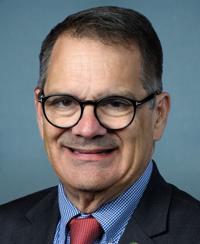
Gus M. Bilirakis
RRepublicanFL-12 · Representative
61
/ 100
Average
Attendance98
Avg: 96
Independence2
Avg: 4
Bipartisan Tone6
Avg: 15
Ethics Record100
Avg: 99
Transparency100
Avg: 53
Accountability Score — composite of attendance, independence, bipartisan tone, ethics record & transparency.
Methodology31
Bills Sponsored
0
Enacted into Law
2
Passed a Chamber
29
In Committee
All Sponsored Bills
HR10532In Committee
Beagle Liberation Act of 2026
HR979Passed House
AM Radio for Every Vehicle Act of 2025
AM Radio for Every Vehicle Act of 2025 This bill requires the Department of Transportation (DOT) to issue a rule requiring AM radio capabilities to be standard in all new passenger vehicles. (AM radio is often used to deliver emergency alerts and news and entertainment programming; some newer vehicles do not include AM equipment.) Specifically, this bill applies to passenger vehicles (1) manufactured in the United States for sale in the United States, imported into the United States, or shipped in interstate commerce; and (2) manufactured after the rule's effective date. The rule must require all such vehicles to have devices that can receive signals and play content transmitted by AM stations or digital audio AM stations installed as standard equipment and made easily accessible to drivers. Prior to the rule's effective date, manufacturers that do not include devices that can access AM radio as standard equipment (1) must inform purchasers of this fact through clear and conspicuous labeling, and (2) may not charge an additional or separate fee for AM radio access. DOT may assess civil penalties for any violation of the rule. The Department of Justice may also bring a civil action to enjoin a violation. The rule, including DOT’s authority to enforce it, must expire 10 years after the bill’s enactment. Further, the Government Accountability Office must study and report on the dissemination of emergency alerts to the public, including by conducting an assessment of AM radio relative to other Integrated Public Alert and Warning System communication technologies.
HR10359In Committee
Priority for Pediatric Cures Act
HR10185In Committee
Part D Premium Protection Act of 2026
HR10121In Committee
To obtain and direct the placement in the Capitol or on the Capitol Grounds of a statue to honor American humanitarian and star athlete Roberto Clemente of Puerto Rico.
HR9978In Committee
Homeowners Premium Tax Reduction Act of 2026
Homeowners Premium Tax Reduction Act of 2026 This bill establishes a new deduction of up to $10,000 claimed against gross income (above-the-line tax deduction) for annual policy premiums paid or incurred for homeowners insurance on an individual's principal residence.
HR9541In Committee
FIREWALL Act
The legislation would prevent federal funding from going to individuals and companies that buy fiber-optic cables from countries considered security risks, such as China. This would affect telecommunications companies, internet service providers, and other businesses that receive federal grants or contracts if they use cables from these restricted countries. The goal is to reduce dependence on foreign sources for critical communications infrastructure.
HR9422In Committee
Medicaid RAC Improvement Act of 2026
Medicaid RAC Improvement Act of 2026 This bill establishes additional requirements for and expands the scope of Medicaid Recovery Audit Contractors (RACs). RACs identify improper Medicaid payments to providers, collect overpayments, and reimburse underpayments. Current law requires state Medicaid programs to establish a RAC program; however, states may apply to the Centers for Medicare & Medicaid Services (CMS) for an exception. The bill prohibits the CMS from granting exceptions after December 31, 2028. The CMS must inform states that have an approved RAC exception that the exception will not be renewed after this date, and it must also inform these states of the current expiration date of their excepted status. The bill also expands the scope of RACs to include a review of payments to Medicaid managed care organizations, prepaid inpatient health plans, and prepaid ambulatory health plans. In addition, the bill expands the period of review for RACs to include the four-year period prior to the fiscal year at issue. Finally, the bill establishes reporting requirements relating to the effectiveness of RACs, including annual reports with state-specific data on collected overpayments. The CMS must also conduct a study and establish a related demonstration program to increase the number of states with a RAC program.
HR9089In Committee
Commission on Sustaining Medicare and Social Security Act of 2026
The bill would create a special commission to study how to keep Medicare and Social Security financially stable for the future. The commission would examine these two major programs that provide health insurance and retirement income to millions of seniors and disabled Americans, and recommend solutions to lawmakers. This affects retirees, people receiving disability benefits, and younger workers who pay into these systems.
HR7027In Committee
Restore Veterans’ Compensation Act of 2026
The proposal would adjust or restore compensation benefits for military veterans, likely addressing pay, healthcare, or other financial support that veterans receive from the government. The bill is currently being reviewed by committees in Congress that handle military and veterans' issues to determine what changes should be made and who would be affected by them.
HRES1203In Committee
Recognizing the 200th anniversary of the heroic Exodus of Missolonghi and commemorating its historical significance to the Greek War of Independence.
This resolution honors the 200th anniversary of the Exodus of Missolonghi, a significant event during Greece's war for independence from Ottoman rule in the 1820s, where Greek fighters and civilians attempted to break through an Ottoman siege. The measure recognizes the historical importance of this event to Greek independence and American-Greek relations. It does not create new laws or spending, but rather expresses Congress's acknowledgment of this important moment in history.
HRES1143In Committee
Recognizing the 205th anniversary of the War of Greek Independence.
This resolution congratulates the people of Greece as they celebrate the 205th anniversary of the War of Greek Independence. The resolution also expresses support for the principles of democracy, human rights, and the rule of law to which the people of the United States and Greece are committed.
HR8095In Committee
Ensuring Medicaid Continuity for Children in Foster Care Act of 2026
Ensuring Medicaid Continuity for Children in Foster Care Act of 2026 This bill allows states to receive federal Medicaid payment for services provided to foster care children in qualified residential treatment programs (i.e., programs with trauma-informed treatment models that address the needs of children with serious emotional or behavioral disorders or disturbances).
HR8000In Committee
END 7-OH Act
This bill would restrict or ban the production and sale of 7-hydroxymitragynine, a powerful opioid-like compound found in kratom, treating it similarly to other controlled substances under federal law. The measure would affect kratom vendors, supplement companies, and consumers who use kratom products, potentially making them illegal to distribute or possess. Law enforcement agencies would gain authority to enforce these restrictions, similar to how they handle other banned drugs.
HR7863In Committee
Promoting Fairness for Medicare Providers Act of 2026
This bill would adjust how Medicare pays doctors, hospitals, and other healthcare providers to ensure the payment rates are fair and competitive. The changes would likely affect healthcare providers' revenues and potentially influence how much care they can afford to provide to Medicare patients, who are primarily seniors and some disabled individuals. The bill is currently being reviewed by two congressional committees to determine what specific payment reforms should be included.
HR4837In Committee
Written Informed Consent Act
This bill would require military members to give written permission before participating in medical experiments or receiving certain medical treatments. The measure aims to protect service members by ensuring they fully understand and agree to any experimental procedures or medications before doctors can administer them.
HR6840In Committee
ARMENIA Security Partnership Act
This bill would strengthen military and security cooperation between the United States and Armenia, likely including provisions for defense assistance, training, and intelligence sharing. The measure aims to support Armenia's security interests and regional stability, potentially affecting U.S. foreign policy in the South Caucasus region where Armenia borders Azerbaijan and Turkey.
HR6484In Committee
Kids Online Safety Act
This legislation would require social media platforms and online services to take steps to protect children from harmful content, predators, and addictive design features, while giving parents more tools to monitor their kids' online activity. The bill would hold companies responsible if they knowingly allow illegal content targeting minors and would establish safety standards that tech companies must follow. It affects social media companies, online platforms, parents, and children by changing how these services operate and what protections they must provide.
HR4312In Committee
SCORE Act
Student Compensation and Opportunity through Rights and Endorsements Act or the SCORE Act This bill provides a framework for the compensation of student athletes for the use of their name, image, or likeness (NIL). This includes addressing certain elements of the court approved agreement to settle the In re College Athlete NIL Litigation (i.e., House settlement ). Specifically, the bill statutorily prohibits institutions, conferences, or interstate intercollegiate athletic associations (e.g., the National Collegiate Athletic Association (NCAA)) from restricting the ability of a student athlete to enter an NIL agreement. The bill also requires institutions of higher education that generate $20 million or more in annual revenue from the institution's intercollegiate athletics activities to (1) provide counseling and medical benefits to student athletes, and (2) establish and maintain at least 16 varsity sports teams. Further, the bill authorizes interstate intercollegiate athletic associations to establish rules with respect to athletic eligibility, transfers, recruitment, and the disclosure of NIL agreements. Under the bill, student athletes may not be considered employees of an institution, conference, or interstate intercollegiate athletic association. The bill also preempts state laws with respect to compensation, payments, benefits, employment status, eligibility, and academic standards applicable to student athletes. Compliance with the provisions of this bill is considered lawful under federal and state antitrust laws.
HR6128In Committee
VISIT USA Act
The VISIT USA Act aims to make it easier for international tourists to visit the United States by streamlining visa processes and removing travel barriers. The bill would likely affect travel companies, hotels, airlines, and the tourism industry by potentially increasing the number of foreign visitors, while also impacting how the government processes visa applications and manages entry requirements.
HR1402Passed House
TICKET Act
Transparency In Charges for Key Events Ticketing Act or the TICKET Act This bill requires ticket sellers (including sellers on the secondary market) for concerts, performances, sporting events, and similar activities to clearly and prominently disclose the total ticket price for the event at the time the ticket is first displayed to an individual (and anytime thereafter during the purchasing process). Prior to completing a purchase, ticket sellers also must provide an itemized list of the base ticket price and each fee (e.g., service fee, processing fee, or other charge). The total ticket price must also be disclosed in any advertisement, marketing, or price list. Additionally, a ticket seller, secondary market seller, or ticket exchange that does not have actual or constructive possession of an event ticket is prohibited from selling or advertising a ticket for the event. However, a secondary market seller or exchange may sell or advertise a service to obtain an event ticket for an individual if the seller or exchange (1) does not market the service as an event ticket, (2) maintains a clear separation between the provided service and the event tickets throughout the entire purchasing process, and (3) clearly discloses that the service is not an event ticket. The bill establishes additional disclosure requirements for ticket sellers, secondary market sellers, and ticket exchanges, and requires such entities to issue a refund for the total ticket price if an event is canceled or postponed. The Federal Trade Commission must enforce these requirements.
HR4056In Committee
RAMP Act
I don't have enough information to write an accurate summary. The bill's title "RAMP Act" is too vague without knowing what RAMP stands for or the specific policy details. To provide a meaningful explanation of what this health-related bill would actually do and who it affects, I would need access to the bill's text or a more detailed description of its provisions.
HR2757In Committee
Medicare Audiology Access Improvement Act of 2025
Medicare Audiology Access Improvement Act of 2025 This bill provides for Medicare coverage of certain audiology services. Specifically, the bill expands coverage to include diagnostic and treatment services that are furnished by audiologists and that would otherwise be covered if provided by a physician, including incidental services, regardless of whether such services are provided pursuant to a referral from, or under the supervision of, a physician or other health care practitioner.
HR2102In Committee
Major Richard Star Act
Major Richard Star Act This bill allows a veteran with a combat-related disability to receive retirement pay, without reduction, concurrently with their disability compensation. This includes veterans with a combat-related disability and fewer than 20 years of creditable service. (Currently, veterans who receive combat-related special compensation and retirement pay are subject to an offset in retirement pay for concurrent receipt of such benefits.)
HR2589In Committee
Consensual Donation and Research Integrity Act of 2025
Consensual Donation and Research Integrity Act of 2025 This bill requires certain entities that acquire human bodies and sell for profit a whole human body or human body part to register with the Department of Health and Human Services. Registered entities must comply with record-keeping, labeling, packaging, and disposition requirements. The registration and related requirements do not apply to the Organ Procurement and Transplantation Network (a public-private partnership that links the professionals involved in the U.S. donation and transplantation system) or its members; the preparation, transportation, and final disposition of human bodies or body parts by funeral service professionals; and schools of medicine, dentistry, and mortuary science and other research and training entities that do not sell whole human bodies or body parts for profit.
HRES249In Committee
Recognizing the 204th anniversary of the War of Greek Independence.
This resolution honors the 204th anniversary of Greece's war for independence from Ottoman rule in the early 1800s, recognizing a significant moment in European history. The measure is largely ceremonial and does not create new laws or policies, but instead expresses Congress's respect for Greek independence and the historical struggle that led to modern Greece.
HR1517In Committee
Prevent Interruptions in Physical Therapy Act of 2025
Prevent Interruptions in Physical Therapy Act of 2025 This bill allows a physical therapist to receive payment under Medicare for services provided to the physical therapist's patients by another physical therapist through a qualifying temporary arrangement, regardless of the geographic area or population served. Currently, physical therapists may only receive payment with respect to such arrangements for services provided in medically underserved, rural, or health professional shortage areas.
HR1518In Committee
New Era of Preventing End-Stage Kidney Disease Act
New Era of Preventing End-Stage Kidney Disease Act This bill establishes regional centers of excellence, postgraduate fellowships, and training for health professionals relating to the diagnosis and treatment of rare kidney disease. It also requires the Department of Health and Human Services (HHS) to conduct various studies on rare kidney disease. Specifically, it authorizes the National Institute of Diabetes and Digestive and Kidney Diseases to award funding to public and private nonprofit entities for establishing regional centers of excellence that will increase public awareness, conduct research, and develop resources for diagnosing and treating rare kidney diseases. A center may receive such funding for up to five years, unless extended by the institute. The bill also requires health professions schools receiving a grant from the Health Resources and Services Administration (HRSA) Centers of Excellence program to award fellowships for training on preventing, diagnosing, and treating rare kidney disease in disproportionately impacted populations. Also, the bill expands the priorities of HRSA’s Primary Care Training and Enhancement program to include training for health care workers to care for individuals with kidney disease. Additionally, HHS must conduct several studies and report to Congress on topics such as treating rare kidney disease in disproportionately affected populations, eliminating the need for dialysis or kidney transplants, and increasing public awareness of rare kidney disease.
HR1403In Committee
LIVE Beneficiaries Act
Leveraging Integrity and Verification of Eligibility for Beneficiaries Act or the LIVE Beneficiaries Act This bill requires state Medicaid programs to check the Social Security Administration's Death Master File on at least a quarterly basis to determine whether Medicaid enrollees are deceased.
HR1282In Committee
Eliminate DEI in Colleges Act
Eliminate DEI in Colleges Act This bill prohibits an institution of higher education (IHE) from receiving federal funds or participating in federal student aid programs if the IHE carries out diversity, equity, and inclusion (DEI) initiatives. Specifically, the bill requires an IHE to certify to the Department of Education (ED) that the IHE (1) does not and will not carry out any program, project, initiative, or other activity that advocates, promotes, or otherwise supports DEI; and (2) does not and will not maintain any office or other entity within the IHE that advocates, promotes, or otherwise supports DEI. Each IHE that provides the certification must, upon request, make available to ED any information necessary to verify the accuracy of the certification. ED must publish regulations to implement and enforce the bill's provisions. The bill establishes a process through which an IHE may appeal ED's decision to terminate the IHE's financial assistance for failure to comply with the bill's provisions.
HR414In Committee
Student Visa Security Improvement Act
Student Visa Security Improvement Act This bill establishes new requirements for foreign student visas and participating educational institutions. The Department of Homeland Security (DHS) must review the applications of student visa applicants and conduct in-person interviews when appropriate to determine whether they are inadmissible due to terrorist-related activities. DHS must also conduct on-site reviews of applications and supporting documents deemed appropriate prior to final adjudication. Institutions and exchange student visitor programs must ensure that student visa-holders are active participants in the program. Students must be regularly observed and must be reported on if they transfer or change majors. The bill also provides for enhanced access to the Student and Exchange Visitor Information System for institutions and programs that meet staffing and training requirements. The Government Accountability Office must review the fees for the Student and Exchange Visitor program.