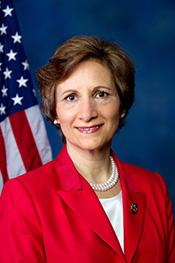
Suzanne Bonamici
DDemocratOR-1 · Representative
59
/ 100
Average
Attendance99
Avg: 96
Independence2
Avg: 4
Bipartisan Tone22
Avg: 15
Ethics Record100
Avg: 99
Transparency62
Avg: 53
Accountability Score — composite of attendance, independence, bipartisan tone, ethics record & transparency.
Methodology56
Bills Sponsored
0
Enacted into Law
1
Passed a Chamber
55
In Committee
All Sponsored Bills
HRES1625In Committee
Expressing support for a whole child approach to education and recognizing the role of parents, educators, and community members in providing a whole child approach to education for each student.
HRES1607In Committee
Expressing support for the designation of September 2026 as "National Workforce Development Month".
HR10649In Committee
Safe Disposal of Opioids Act of 2026
HR10515In Committee
Artificial Intelligence Education and Workforce Readiness Act of 2026
HR10421In Committee
Transforming Education for the Future Act
HRES1538In Committee
Supporting the designation of the week of September 14 through September 18, 2026, as "Malnutrition Awareness Week".
HR2406Passed House
National Oceanic and Atmospheric Administration Sexual Harassment and Assault Prevention Improvements Act of 2025
National Oceanic and Atmospheric Administration Sexual Harassment and Assault Prevention Improvements Act of 2025 This bill expands requirements for addressing sexual harassment and sexual assault involving personnel of the National Oceanic and Atmospheric Administration (NOAA). The bill specifies that NOAA's sexual harassment prevention and response policy applies to personnel such as observers, at-sea monitors, and voting members and staff of regional fishery management councils. The bill removes the requirement that certain acts, such as assault, intimidation, and sexual harassment of an observer or a data collector, be forcible in nature to be unlawful. The bill also requires NOAA's Office of Marine and Aviation Operations to establish a policy for reporting to the Coast Guard the names of NOAA personnel involved in a sexual harassment or sexual assault claim. Specifically, such reports must identify employees or contractors who are the subject of such claim, the time and date of the incident, and the location of the vessel when the incident occurred. The bill prohibits a person convicted of certain sexual offenses from enlisting with or being commissioned by NOAA. Additionally, the bill directs NOAA to update its policies to develop a restricted reporting system that allows employees and other personnel to confidentially report sexual harassment or assault and receive services without triggering an investigation. Finally, the bill also expands reporting requirements on sexual harassment, sexual assault, and equal employment.
HR10220In Committee
SIMPLE Act
HR9824In Committee
Daycare Not Detentions Act of 2026
Daycare Not Detentions Act of 2026 This bill rescinds funding that was provided to U.S. Immigration and Customs Enforcement (ICE) and U.S. Customs and Border Protection (CBP) and reallocates the funding to the Administration for Children and Families (ACF) for federal child care programs. Specifically, the bill rescinds $70 billion in funding that was provided to ICE and CBP by the Secure America Act. The bill also provides a total of $70 billion to ACF for federal child care programs, including $25.5 billion for the Child Care and Development Block Grant, $20 billion for the Child Care Entitlement to States, $24 billion for Head Start, and $500 million for Preschool Development Grants. The funds provided to ACF are available through FY2029.
HR9796In Committee
Supporting Grandfamilies Act of 2026
The proposal would restore a federal center that provides support and resources to grandparents and other relatives raising children who cannot live with their parents. This center would help these families navigate challenges like legal guardianship, accessing benefits, and finding community services. The bill affects millions of Americans in kinship care situations who need guidance and assistance managing their family responsibilities.
HR9647In Committee
To prohibit the National Science Foundation from obligating or expending Federal funds to descope or decommission the Ocean Observatories Initiative instruments, and for other purposes.
This bill prohibits the National Science Foundation (NSF) from using federal funds to decommission or descope Ocean Observatories Initiative (OOI) instruments until a thorough review of OOI is completed. OOI measures and observes ocean conditions using a series of in-water instruments that gather physical, chemical, geological, and biological data. On May 21, 2026, NSF announced that it would remove all in-water infrastructure from four of the five active OOI arrays. However, on June 18, 2026, NSF announced that it would not proceed with this decommissioning and would instead continue OOI operations and solicit input from stakeholders on the future of NSF's ocean observation efforts. NSF also indicated that it would redeploy one array that was removed from the water. Under the bill, NSF must conduct a thorough review of OOI with engagement from the scientific and coastal communities before decommissioning or descoping specified OOI instruments. This includes OOI instruments anchored off of Oregon, Washington, Alaska, and North Carolina, as well as instruments anchored in the Irminger Sea. NSF is required to maintain full and consistent OOI operations, including monitoring in states where instruments have already been decommissioned, until the review is complete.
HRES1391In Committee
Impeaching Linda M. McMahon, Secretary of Education, for high crimes and misdemeanors.
This resolution would remove Linda M. McMahon from her position as Secretary of Education by impeaching her, which is Congress's formal process for charging a federal official with serious wrongdoing. The House Judiciary Committee would need to investigate the allegations and determine whether there is sufficient evidence of "high crimes and misdemeanors" before the full House could vote on whether to impeach her. If the House votes to impeach, the case would then go to the Senate for a trial to decide whether she should be removed from office.
HJRES195In Committee
Providing for congressional disapproval under chapter 8 of title 5, United States Code, of the rule submitted by the Department of Health and Human Services relating to "Restoring Flexibility in the Child Care and Development Fund (CCDF)".
Congress would reject a new rule from the Department of Health and Human Services that changes how states can use federal child care funding, potentially allowing more flexibility in how child care programs operate and who they serve. The rule is currently under review by the House Committee on Education and Workforce, which will decide whether to move forward with blocking it. If approved, this would prevent the new rule from taking effect.
HRES1343In Committee
Recognizing World Oceans Day and celebrating the maritime heritage, ocean leadership, fisheries stewardship, and coastal communities of the United States.
The resolution designates June 8th as World Oceans Day in the United States to recognize the importance of ocean health, maritime traditions, and fishing industries to American communities. It celebrates the country's coastal heritage and commitment to responsible ocean stewardship while honoring the people and businesses that depend on healthy seas.
HR9116In Committee
Equal Remedies Act of 2026
This proposal would expand the types of compensation and legal remedies available to workers who win discrimination lawsuits based on race, color, religion, sex, or national origin, as well as those based on age discrimination. Currently, workers in age discrimination cases can recover less than workers in other discrimination cases, and this bill would make the remedies equal across all types of discrimination claims. The change would affect employees who pursue discrimination cases against their employers in federal court.
HR8952In Committee
Elder Pride Act of 2026
The proposal would create a new grant program to help rural communities provide services and support specifically for LGBTQI older adults, addressing gaps in care and social services in areas where such resources are often limited. The grants would fund organizations working to improve health care access, social engagement, and quality of life for LGBTQI seniors living in rural regions. This affects rural older adults, community organizations, and health care providers serving aging populations in less populated areas.
HJRES189In Committee
Providing for congressional disapproval under chapter 8 of title 5, United States Code, of the rule submitted by the Department of Education relating to "Reimagining and Improving Student Education-Federal Student Loan Program Final Regulations".
Congress would reject new federal student loan rules that the Department of Education created to change how the student loan program works. The rejection would prevent these regulations from taking effect, keeping the current student loan system in place instead of allowing the Education Department's changes to go forward. This would affect millions of student loan borrowers and the federal government's management of its lending programs.
HR7129In Committee
Water Power Research and Development Reauthorization Act
The bill would renew federal funding and support for research into water power technologies, including hydroelectric dams and newer systems that generate electricity from ocean waves and tidal currents. This funding would help scientists and engineers develop cleaner, more efficient ways to produce electricity from water sources, potentially benefiting energy companies, researchers, and communities looking for renewable energy options. The bill is currently being reviewed by committees in Congress to determine its details and feasibility.
HR6834In Committee
STORE Act of 2025
The proposal would establish or modify programs related to food storage, agricultural production, or food supply management to address potential shortages or improve food security. It would likely affect farmers, food producers, grocery stores, and consumers by changing how food is stored, distributed, or made available across the country. The bill is currently being reviewed by lawmakers who focus on nutrition and agricultural trade issues.
HR8916In Committee
CHIERS Act of 2026
The federal government would provide grants to help communities improve transportation services for people seeking treatment for substance use disorders or related support services. These grants would be awarded jointly by the health and housing departments to organizations that either develop new transportation programs or expand existing ones. The goal is to remove a major barrier that prevents people from accessing the addiction treatment and support services they need.
HR8256In Committee
Senior Hunger Prevention Act of 2026
Senior Hunger Prevention Act of 2026 This bill expands and modifies nutrition programs for older adults and adults with disabilities, including the Supplemental Nutrition Assistance Program (SNAP) and the Commodity Supplemental Food Program (CSFP). Under the bill, a household's eligibility for SNAP benefits may be certified for 36 months if all adult household members are elderly or disabled, an increase from 24 months. The bill also expands the SNAP medical expense deduction and increases the minimum allotment for households with one and two persons. The Department of Agriculture (USDA) must establish an elderly simplified application program that allows a state to implement a streamlined SNAP application and certification process for households where all adult household members are elderly or disabled and have no earned income. The bill also directs USDA to authorize public-private partnerships between USDA, retail food stores participating in SNAP, and community-based organizations to provide free or low-cost food delivery under SNAP, including through the use of private funds. Further, the bill reauthorizes CSFP, provides additional funding for the program, and expands eligibility to include low-income adults with disabilities. CSFP benefits may also be certified for 36 months. Currently, benefits may be certified for not less than one year, but not more than three years. The bill also expands eligibility for the Seniors Farmers Market Nutrition Program to include adults with disabilities, provide a 36-month certification period, and include minimum and maximum benefit amounts. Under the bill, USDA must also establish various related grant programs.
HR7670In Committee
Specialty CROP Act of 2026
Specialty Crops Reporting on Opportunities and Promotion Act of 2026 or the Specialty CROP Act of 2026 This bill expands the annual reporting requirements for the Technical Assistance for Specialty Crops program to require the Department of Agriculture (USDA) to provide specific information on the competitiveness of U.S. exports of specialty crops. Specifically, the bill modifies the requirements for a congressionally mandated annual report on U.S. specialty crop trade issues to require USDA to report specific information on acts, policies, and practices of foreign countries that constitute significant barriers to, or distortions of, U.S. exports of specialty crops. Further, USDA must consult with the Office of the United States Trade Representative (USTR) on the report. Before preparing the report, USDA, in coordination with the USTR, must seek comments from the public and the Agricultural Technical Advisory Committee for Trade in Fruits and Vegetables. Under the bill, USDA must submit the report to Congress in an unclassified form, but may include a classified annex. The unclassified portion of the report must be publicly available.
HRES1151In Committee
Expressing support for the designation of the weeks of March 29, 2026, through April 11, 2026, as National Young Audiences Arts for Learning Week.
This resolution would officially recognize a two-week period in late March and early April 2026 as National Young Audiences Arts for Learning Week to highlight the importance of arts education for students. The designation aims to raise awareness about how arts programs help young people learn and develop, though it does not create any new funding or requirements. Schools, arts organizations, and educators could use this official recognition to promote arts learning initiatives during that time.
HRES1118In Committee
Expressing support for the designation of the third week of March as "National CACFP Week".
This resolution recognizes the role of the Child and Adult Care Food Program (commonly referred to as CACFP) in improving the health of the country's most vulnerable children and adults in Head Start programs, child care programs, family day care homes, emergency shelters, adult day care programs, and after-school care by providing nutritious meals and snacks. It also supports the designation of National CACFP Week.
HR7671In Committee
Students and Young Consumers Empowerment Act
The bill aims to give students and young people better tools and knowledge to manage their money and understand financial products like credit cards and loans. It likely includes provisions for financial education in schools and protections for young consumers dealing with banks, lenders, and credit companies. The measure would help younger Americans avoid debt traps and make smarter financial decisions early in their lives.
HR7656In Committee
ReSCUE Oceans Act
The ReSCUE Oceans Act would establish new protections and restoration efforts for ocean ecosystems and marine habitats, likely including measures to reduce pollution, protect endangered marine species, and restore damaged coastal and ocean environments. The bill would affect fishing industries, coastal communities, environmental organizations, and federal agencies responsible for managing ocean resources. Congress is currently reviewing the specific provisions to determine which committees should handle different parts of the legislation.
HRES1002In Committee
Recognizing the value of the Older Americans Act of 1965 nutrition program in addressing hunger, malnutrition, and isolation, and improving the health and quality of life for millions of our Nations seniors each year.
This resolution recognizes the important role that local nutrition programs supported through the Older Americans Act of 1965 play in addressing senior hunger, malnutrition, and isolation.
HR7279In Committee
Nurse Faculty Shortage Reduction Act of 2026
This bill aims to address the shortage of nursing instructors by likely providing funding, loan forgiveness, or other incentives to encourage experienced nurses to teach in nursing schools and training programs. The shortage of nursing faculty has made it harder for nursing schools to admit and train new nurses, which ultimately affects how many qualified nurses are available to work in hospitals and other healthcare settings. The bill would help both current and future nurses by making it easier to fill teaching positions and expand nursing education programs.
HR6419In Committee
New Essential Education Discoveries Act of 2025
The bill aims to support educational research and development in areas considered critical to student learning and achievement, though the specific programs and funding mechanisms are not yet detailed in its current form. Based on its title and education focus, it likely directs resources toward discovering or implementing new teaching methods, curriculum approaches, or educational technologies that could improve student outcomes. The bill would primarily affect schools, educators, and potentially students by providing funding or support for these research and discovery initiatives.
HR6371In Committee
No Robot Bosses Act
The bill would restrict employers' use of automated decision-making systems—like AI algorithms—when making significant employment decisions such as hiring, firing, scheduling, or pay determinations, requiring human review and worker notification when such systems are used. It aims to protect workers from unfair or discriminatory outcomes that might result from automated systems making decisions about their jobs without human oversight. The proposal affects employers across industries and gives workers more transparency and control over how technology influences their employment.
HRES856In Committee
Expressing the sense of the House of Representatives that the United States Department of Agriculture should use its contingency funds and interchange authority to finance the supplemental nutrition assistance program.
This resolution expresses the sense of the House of Representatives that the Trump Administration is legally obligated to fund the Supplemental Nutrition Assistance Program (SNAP) through the use of the contingency fund, the Administration has the legal authority and the funds to finance SNAP through November 2025, exercising this power is extremely important for the health and wellness of families experiencing hunger, and the Administration should immediately exercise this authority.
HR6165In Committee
CREATIVE Act of 2025
The bill aims to support arts and cultural programs, likely through funding, grants, or tax incentives that help artists, museums, theaters, and cultural organizations operate and reach more people. It may also address how religious institutions and cultural heritage sites receive support or recognition. The measure would primarily affect creative professionals, cultural organizations, and communities that depend on arts and cultural activities.
HR6076In Committee
Save Our Seas 2.0 Marine Debris Infrastructure Programs Reauthorization Act
This bill would extend and reauthorize federal programs that help remove trash and other debris from oceans and coastal areas, as well as fund infrastructure projects to prevent marine pollution. The legislation would provide funding and support to states, local governments, and organizations working to clean up waterways and reduce the amount of plastic and waste entering the ocean. Coastal communities, environmental groups, and fishing industries would benefit from these cleanup and prevention efforts.
HR5373In Committee
Alan Reinstein Ban Asbestos Now Act of 2025
Alan Reinstein Ban Asbestos Now Act of 2025 This bill generally prohibits the manufacture, process, use, and distribution in commerce of commercial asbestos or any mixture or article containing commercial asbestos. The President may, on application, grant exemptions from the prohibition in situations where it is necessary to protect national security interests.
HR5297In Committee
PARTNERS Act
The bill's vague title makes its specific purpose unclear, but based on its referral to committees handling labor, education, and legal matters, it likely addresses workplace partnerships, employee rights, or labor-management relations. Without access to the bill's actual text, the exact provisions cannot be determined, though the dual committee referral suggests it involves both employment law and potentially judicial or regulatory oversight of workplace arrangements.
HR5296In Committee
BUILDS Act
HRES690In Committee
Expressing support for the designation of September 2025 as "National Workforce Development Month".
HR5104In Committee
Preventing HEAT Illness and Deaths Act of 2025
The legislation would establish federal standards and requirements to protect workers and vulnerable people from dangerous heat-related illnesses and deaths, likely including workplace safety rules, public health guidelines, and emergency response measures during extreme heat events. The bill would affect outdoor workers, elderly people, low-income communities, and others at high risk from heat exposure, while also potentially requiring employers and government agencies to implement heat safety protocols and monitoring systems.
HR4477In Committee
PRICE Act
The PRICE Act would likely address housing affordability and community development issues, though the specific provisions aren't clear from the title alone. Based on its referral to the Financial Services Committee, it probably involves policies related to housing costs, lending practices, or programs that help communities develop affordable housing. The bill would affect renters, homebuyers, real estate lenders, and local communities working on housing initiatives.
HR4151In Committee
Ruthie and Connie LGBTQI Elder Americans Act of 2025
Ruthie and Connie LGBTQI Elder Americans Act of 2025 This bill makes changes to federal programs serving older individuals to facilitate care for lesbian, gay, bisexual, transgender, queer, and intersex (LGBTQI) individuals. Under current law, certain services provided to older individuals must be targeted to populations with the greatest social need . The bill adds status as an LGBTQI individual and status as an individual living with HIV as factors contributing to greatest social need. The bill also explicitly allows grants that support the health, independence, and longevity of older individuals to be used for certain activities promoting services for individuals with the greatest social need. The bill establishes an Office of LGBTQI Inclusion within the Administration on Aging (AOA). The office must promote access to services for LGBTQI older individuals and coordinate related activities within the Department of Health and Human Services and among other federal entities. The bill also provides statutory authority for a national resource center on LGBTQI aging. The center must provide organizations that serve older individuals or LGBTQI individuals with information and technical assistance needed to effectively serve LGBTQI older individuals. Finally, the bill requires certain studies and reports on issues affecting LGBTQI older individuals. Specifically, state long-term care ombudsmen must collect and analyze data on discrimination against LGBTQI older individuals in long-term care settings. Further, the AOA must study the services needed by LGBTQI older individuals and collect data on the number of such individuals served by various services and activities.
HR4120In Committee
Supporting the Mental Health of Educators and Staff Act of 2025
This bill would provide funding and resources to help teachers and school staff address mental health challenges like stress, burnout, and depression. The legislation would likely support programs such as counseling services, mental health training, and wellness initiatives in schools to improve the wellbeing of educators who work directly with students.
HR4073In Committee
Tsunami Warning, Research, and Education Act of 2025
This bill would improve how the U.S. prepares for and responds to tsunamis by strengthening warning systems, funding research to better understand tsunami risks, and supporting education programs to help coastal communities know what to do in an emergency. It would affect coastal residents, emergency management agencies, and scientists working to predict and track these dangerous ocean waves. The goal is to give people more time to evacuate and reduce deaths and damage when tsunamis strike.
HR3943In Committee
Opportunity To Address College Hunger Act
HR3856In Committee
Runaway and Homeless Youth and Trafficking Prevention Act of 2025
This bill would expand federal support and services for runaway and homeless youth, including funding for shelters, counseling, and job training programs. It also aims to prevent human trafficking by helping young people in vulnerable situations access safe housing and resources. The legislation would affect homeless youth, social service organizations, and local governments that run youth assistance programs.
HR3700In Committee
MEALS Act of 2025
Mitigating Electronic Access Losses for Students Act of 2025 or the MEALS Act of 2025 This bill requires the Food and Nutrition Service (FNS) to prescribe fraud prevention measures for the Summer Electronic Benefits Transfer (or Summer EBT) program and provide for the replacement of the full amount of a student's stolen benefits. Summer EBT provides electronic benefits that can be redeemed for groceries to households with eligible children over the summer months. Specifically, using funds provided by FNS, a participating state agency must provide a household with replacement Summer EBT benefits if the state agency determines that the benefits were stolen, and the agency meets certain requirements. The benefits must be equal to the amount of benefits stolen through card skimming, card cloning, or similar fraudulent methods. Further, for state agencies and Indian tribal organizations that administer the Summer EBT program, FNS must issue guidance on security measures that are effective in detecting and preventing the theft of benefits (e.g., through card skimming or card cloning), and promulgate regulations to require them to take the appropriate security measures and implement procedures for the replacement of benefits. In addition, FNS must coordinate with the Department of Justice and the Department of Health and Human Services to establish (1) measures to prevent Summer EBT benefits from being stolen, and (2) standard reporting methods. Finally, the Government Accountability Office must submit a report to Congress that examines the risks related to Summer EBT benefit payment system security.
HR3265In Committee
Protecting our Students in Schools Act of 2025
HR3130In Committee
FACTS Act
Fentanyl Awareness for Children and Teens in Schools Act or the FACTS Act This bill establishes grant programs and requires strategies and studies to address the misuse of synthetic opioids (i.e., laboratory-derived substances such as fentanyl and its derivatives) among youth. The bill requires the Department of Health and Human Services (HHS) to award grants to partnerships between educational and health organizations for prevention, treatment, and recovery efforts related to the use of synthetic opioids by middle and high school-aged children. It also allows school-based health centers to use existing HHS grants to purchase naloxone to reverse the effects of opioid overdoses and to establish programs to address misuse of synthetic opioids. Also, the bill authorizes state educational agencies to use certain Department of Education (ED) grant funds to provide training to school personnel on addressing students’ misuse of synthetic opioids. State and local educational agencies must also address such misuse in their educational plans in order to qualify for certain ED grants. Finally, the bill (1) establishes an interagency taskforce to coordinate federal efforts to address synthetic opioid misuse among youth, (2) requires an evaluation of the State Unintentional Drug Overdose Reporting System’s effectiveness in identifying the specific synthetic opioids causing youth overdoses, (3) expands the data reported by the National Center for Education Statistics to include information about the use of synthetic opioids in schools, and (4) requires two recurring HHS surveys to include questions on youth exposure to synthetic opioids.
HR2818In Committee
Early Childhood Nutrition Improvement Act
The proposal would expand nutrition assistance programs for young children, likely increasing funding or eligibility for meal programs in schools and childcare settings. It aims to improve access to healthy food for low-income families with children under school age, helping ensure better nutrition during critical early development years. The changes would affect families receiving assistance, childcare providers, schools, and the Department of Agriculture.
HR2620In Committee
Save Our Seas 2.0 Amendments Act
The legislation would strengthen protections for ocean environments and marine life by updating rules for managing coastal areas and reducing ocean pollution from sources like plastic waste and abandoned fishing gear. It would affect fishing companies, shipping industries, coastal communities, and environmental organizations by establishing new standards for how they operate in ocean waters. The bill also aims to improve coordination between federal agencies responsible for protecting marine resources and enforcing environmental laws at sea.
HR2485In Committee
Arts Education for All Act
Arts Education for All Act This bill expands arts education and programming for children in early education, K-12 students, and juveniles and adults in the criminal justice system. Specifically, the bill allows Child Care and Development Block Grant funding to be used for additional activities, including arts programming. Additionally, the bill addresses arts programming in elementary and secondary schools by directing each state educational agency to include information on arts programming in its state plan, including how it will integrate arts education instruction into the curriculum and increase the number of arts teachers in schools; requiring state report cards to include information on arts courses; requiring local educational agency (LEA) plans to describe how the LEA will encourage the use of arts education to improve student achievement; and allowing certain funds to be used for professional development for arts teachers. The bill directs the National Center for Education Research to carry out research on the use of arts and arts education in elementary and secondary schools, including in low-performing schools. Further, the National Center for Education Statistics must compile data on arts education. The National Assessment of Educational Progress must include a specified arts assessment. The bill requires a state's juvenile justice and delinquency plan to describe how the state will coordinate services and activities for juvenile justice and delinquency prevention with arts agencies and arts organizations. Additionally, grants for adult offender reentry demonstration projects may be used for facilitating arts education.
HRES228In Committee
Expressing support for the designation of the third week of March 2025 as "National CACFP Week".
This resolution recognizes the role of the Child and Adult Care Food Program (commonly referred to as CACFP) in improving the health of the country's most vulnerable children and adults in Head Start programs, child care programs, family day care homes, emergency shelters, adult day care homes, and after-school care by providing nutritious meals and snacks. It also supports the designation of National CACFP Week.
HR1042In Committee
Project Turnkey Act
HRES94In Committee
Expressing support for the Nation's local public K-12 schools and condemning any actions that would defund public education or weaken or dismantle the Department of Education.
This resolution supports federal investment in public K-12 schools, affirms that the Department of Education (ED) plays a vital role in the public education system, and states that public education funding should not be diverted (e.g., through the use of vouchers) to privately run K-12 schools. The resolution also rejects any claim that the executive branch has the legal authority to (1) dismantle or relocate ED or any of its major offices; or (2) reduce federal funding for public education, block federal grants for education, or transfer funding burdens for education to state and local governments.
HR846In Committee
SAD Act
Stop Antiabortion Disinformation Act or the SAD Act This bill prohibits deceptive advertising for reproductive health services. Specifically, the bill makes it unlawful for a person (i.e., individual, partnership, corporation, association, or organization) to deceptively advertise the reproductive health services they offer, including by misrepresenting that the person (1) offers or provides contraception or abortion services (or referrals for such contraception or abortion services), or (2) employs or offers access to licensed medical personnel. The bill provides for enforcement by the Federal Trade Commission. In addition to any other penalty, violations are subject to a civil penalty that may not exceed the greater of $100,000 (adjusted annually for inflation) or 50% of the revenue earned during the preceding 12-month period by the ultimate parent entity of the person who violated the bill.
HR646In Committee
Build Housing with Care Act of 2025
HR644In Committee
Harmful Algal Bloom and Hypoxia Research and Control Amendments Act of 2025
Harmful Algal Bloom and Hypoxia Research and Control Amendments Act of 2025 This bill extends through FY2030 and modifies the Harmful Algal Bloom and Hypoxia Research and Control Act to address algal blooms and hypoxia (deficiency of oxygen) in U.S. marine, estuarine, and freshwater systems. Harmful algal blooms are high concentrations of algae that may create nuisance or toxic conditions that are harmful to humans, animals, aquatic ecosystems, and the economy. The bill directs the Inter-Agency Task Force on Harmful Algal Blooms and Hypoxia to submit to Congress an action strategy for harmful algal blooms at least once every five years. The bill also expands the task force's membership to include the Department of Energy. The bill also expands the duties of the National Oceanic and Atmospheric Administration (NOAA) under the National Harmful Algal Bloom and Hypoxia program. NOAA must also carry out a variety of activities related to monitoring, predicting, preventing, mitigating, and responding to marine, coastal, and Great Lakes harmful algal bloom and hypoxia events. For example, NOAA must establish (1) a national network of observing systems for monitoring, detecting, and forecasting harmful algal blooms; and (2) a national-level incubator program to increase the number of strategies, technologies, and measures available to prevent, mitigate, and control harmful algal blooms. Additionally, the Environmental Protection Agency must develop and enhance operational freshwater harmful algal bloom monitoring, observing, and forecasting programs in lakes, rivers, and reservoirs and carry out other activities related to researching freshwater harmful algal blooms and hypoxia events.