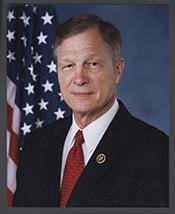
Brian Babin
RRepublicanTX-36 · Representative
57
/ 100
Average
Attendance98
Avg: 96
Independence2
Avg: 4
Bipartisan Tone29
Avg: 15
Ethics Record100
Avg: 99
Transparency41
Avg: 53
Accountability Score — composite of attendance, independence, bipartisan tone, ethics record & transparency.
Methodology12
Bills Sponsored
0
Enacted into Law
0
Passed a Chamber
11
In Committee
All Sponsored Bills
HR10241In Committee
I–47 Future Interstate Act of 2026
HR9829In Committee
ORTHO Act
I don't have enough information to write an accurate summary. The bill title "ORTHO Act" and its referral to the House Committee on Energy and Commerce suggest it relates to either orthopedic medicine or orthodontics, but without the bill's actual text or stated subjects, I cannot reliably explain what it would do or who it affects. Please provide the bill's summary, key provisions, or subject matter so I can write an accurate plain-English explanation.
HR9505In Committee
Bonnie Eloise Rush Milam Congressional Gold Medal Act of 2026
This legislation would award the Congressional Gold Medal to Bonnie Eloise Rush Milam in recognition of her contributions and achievements. The Congressional Gold Medal is one of the highest civilian honors Congress can bestow, typically given to individuals who have made extraordinary impacts in their fields or service to the nation. The medal would be presented to honor her legacy and accomplishments.
HR9341In Committee
AI-Ready Federal Data Guidelines Act
The federal government would establish new standards and guidelines to make its data more useful for artificial intelligence research and development. This would help companies, researchers, and government agencies more easily access and use government-held information to train and improve AI systems. The changes would affect federal agencies, tech companies, AI researchers, and potentially the public by making government data more accessible for AI applications.
HR9119In Committee
To provide a prohibition on certain reductions to MQ-9 aircraft units, and for other purposes.
The military would be prohibited from reducing the number of MQ-9 Reaper drone aircraft units below current levels, protecting jobs at defense contractors and maintaining surveillance and strike capabilities for the armed forces. This affects military personnel, defense workers, and the Department of Defense's ability to manage its fleet of unmanned aircraft.
HR7813In Committee
NOAA Weather Radio Modernization Act
The bill would upgrade the National Oceanic and Atmospheric Administration's (NOAA) weather radio system with modern technology to improve how emergency weather alerts reach the public. This affects everyone who relies on weather warnings during storms and emergencies, as well as the government agencies responsible for broadcasting those alerts. The upgrades would help ensure that critical information about severe weather reaches people faster and more reliably through their radios and mobile devices.
HR3706In Committee
SUSHI Act
The bill addresses management and conservation of public lands and natural resources, though the specific provisions are not detailed in the available information. Based on its status as an amended substitute ordered for reporting, it likely proposes changes to how federal agencies oversee public lands, protect wildlife habitats, or manage resource use on government-owned property. The measure would affect federal land managers, outdoor recreation users, conservation groups, and potentially industries that extract resources from public lands.
HR7273In Committee
NASA Reauthorization Act of 2026
NASA Reauthorization Act of 2026 This bill reauthorizes through FY2026 the programs and activities of the National Aeronautics and Space Administration (NASA). The bill also directs NASA to continue planning for the eventual deorbit of the International Space Station (ISS) and to continue lunar and Mars exploration missions. Specifically, the bill requires NASA to submit to Congress a strategy for research and operations in low-Earth orbit. ( Low-Earth orbit generally encompasses an altitude of up to 2,000 kilometers.) With respect to the ISS, which sits in low-Earth orbit, NASA must generally maintain a flight cadence necessary to support productive use of the station through its operational lifetime. The bill provides statutory authority for NASA's acquisition of ISS deorbit capabilities from a commercial entity and specifies that NASA must not, to the greatest extent practicable, reduce or deprioritize ISS activities. (In 2024, NASA contracted with SpaceX for the development of an ISS deorbit vehicle.) Further, NASA must report on the risk to science and technology research posed by lack of access to a low-Earth orbit platform (i.e., after retirement of the ISS). NASA may continue to enter into agreements with U.S. commercial entities for the development of one or more private, low-Earth orbit platforms. Separately, the bill directs NASA to continue efforts to support crewed lunar landings and Mars explorations, including through partnerships with the private sector (i.e., the Moon to Mars and Artemis programs). Finally, NASA must continue researching advanced air mobility, unmanned aircraft systems (i.e., drones), and hypersonic technologies.
HR3179Reported
To rename the Anahuac National Wildlife Refuge located in the State of Texas as the "Jocelyn Nungaray National Wildlife Refuge".
This bill renames the Anahuac National Wildlife Refuge located in Anahuac, Texas, as the Jocelyn Nungaray National Wildlife Refuge.
HR2028In Committee
REDI Act
Resident Education Deferred Interest Act or the REDI Act This bill allows borrowers in medical or dental internships or residency programs to defer student loan payments until the completion of their programs.
HRES96In Committee
Providing amounts for the expenses of the Committee on Science, Space, and Technology in the One Hundred Nineteenth Congress.
This resolution provides amounts for the expenses of the House Committee on Science, Space, and Technology for the 119th Congress.
HR569In Committee
Birthright Citizenship Act of 2025
Birthright Citizenship Act of 2025 This bill limits birthright citizenship by redefining what it means to be subject to the jurisdiction of the United States. Currently, a person born in the United States and subject to U.S. jurisdiction is entitled to citizenship. Under the bill, a person is subject to U.S. jurisdiction if he or she is born to a parent who is (1) a U.S. citizen or national, (2) a lawful permanent resident residing in the United States, or (3) a non-U.S. national ( alien under federal law) with a lawful immigration status who is performing active service in the Armed Forces. The bill does not affect the citizenship or nationality status of any person born before the bill's enactment date.