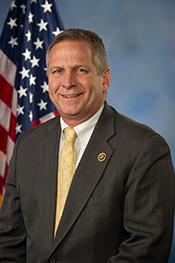
Mike Bost
RRepublicanIL-12 · Representative
57
/ 100
Average
Attendance98
Avg: 96
Independence2
Avg: 4
Bipartisan Tone14
Avg: 15
Ethics Record100
Avg: 99
Transparency62
Avg: 53
Accountability Score — composite of attendance, independence, bipartisan tone, ethics record & transparency.
Methodology21
Bills Sponsored
0
Enacted into Law
2
Passed a Chamber
19
In Committee
All Sponsored Bills
HR2283In Committee
Recognizing Community Organizations for Veteran Engagement and Recovery Act
Recognizing Community Organizations for Veteran Engagement and Recovery Act or the RECOVER Act This bill requires the Department of Veterans Affairs to implement a three-year pilot program to make grants to established non-profit mental health care providers to provide culturally competent, evidence-based mental health care for veterans.
HR9237In Committee
Take Care of America’s Veterans Act
Take Care of America's Veterans Act This bill addresses veterans’ benefits, health care, counseling, Department of Veterans Affairs (VA) personnel, VA infrastructure, and the Veterans Community Care Program (VCCP). The bill modifies various compensation programs for veterans, including by (1) allowing concurrent receipt of disability compensation and military retired pay for certain retirees with a combat-related disability, (2) extending entitlement for various benefits and services to remarried surviving spouses, (3) increasing the rate of dependency and indemnity compensation, and (4) establishing a supplemental monthly allowance for certain disabled veterans. The bill also addresses VA education and training benefits, including by (1) modifying which independent study programs are covered under veterans’ educational assistance benefits, (2) requiring Transition Assistance Program counseling to include a presentation about VA benefits, and (3) increasing the housing allowance rate for individuals pursuing apprenticeships. The bill revises health care provisions, including by (1) expanding support and assistance provided to family caregivers, (2) extending the Staff Sergeant Parker Gordon Fox Suicide Prevention Grant Program, and (3) expanding the scope of VA mental health research. Among other elements, the bill revises VA disability ratings for sleep apnea and tinnitus; expands eligibility for a memorial headstone or marker for the spouse, surviving spouse, child, or dependent of a veteran or member of the Armed Forces; addresses the administration of the VCCP and codifies the eligibility standards; establishes a standardized screening process for priority or routine admission to certain mental health care programs; and addresses VA personnel, hiring, and infrastructure matters.
HR9214In Committee
TSP Modernization Act
Federal employees and military members who participate in the Thrift Savings Fund (a retirement savings plan for government workers) would be allowed to electronically transfer their savings to other qualified retirement accounts like IRAs or 401(k)s. This change would give government workers more flexibility in managing their retirement savings and potentially allow them to consolidate their accounts in one place. The proposal is currently being reviewed by the House Committee on Oversight and Government Reform.
HR1041Passed House
Veterans 2nd Amendment Protection Act
Veterans 2nd Amendment Protection Act This bill prohibits the Department of Veterans Affairs (VA) from transmitting certain information to the National Instant Criminal Background Check System (NICS) utilized by licensed importers or dealers of firearms. Specifically, the bill prohibits the VA from transmitting personally identifying information of a veteran or a beneficiary to the NICS solely on the basis that such veteran or beneficiary has an appointed fiduciary to manage their benefits, unless there is an order or finding of a judicial authority that such veteran or beneficiary is a danger to themselves or others.
HR6779In Committee
USDA Loan Modernization Act
The proposal would update how the U.S. Department of Agriculture provides loans to farmers and rural businesses by modernizing the application process and loan terms to make it easier for agricultural operations to access funding. Farmers, ranchers, and rural entrepreneurs would benefit from streamlined paperwork and potentially more flexible borrowing options tailored to today's agricultural needs. The changes aim to help both established and beginning farmers compete more effectively while supporting rural economic development.
HR6733In Committee
VISN Reform Act of 2025
The bill would reorganize how the Department of Veterans Affairs manages its regional healthcare networks, known as VISNs (Veterans Integrated Service Networks), likely to improve efficiency and coordination of medical services for veterans. The changes would affect how VA hospitals and clinics operate across different regions and could impact both the veterans receiving care and the VA employees managing these facilities. Committee members are currently examining the proposal to determine whether the restructuring would actually improve healthcare delivery or create operational challenges.
HRES1301In Committee
Supporting the designation of May 29, 2026, as "Mental Health Awareness in Agriculture Day" to raise awareness around mental health in the agricultural industry and workforce and to continue to reduce stigma associated with mental illness.
This resolution supports the designation of Mental Health Awareness in Agriculture Day to raise awareness around mental health in the agricultural industry and reduce the stigma associated with mental illness.
HR988Passed House
To amend title 36, United States Code, to move the place of incorporation and domicile of the National Woman’s Relief Corps to Illinois, to move the principal office of such Corps to Murphysboro, Illinois, and for other purposes.
This bill moves the National Woman's Relief Corps' place of incorporation and domicile from the District of Columbia to Illinois and moves its principal office in Illinois from Springfield to Murphysboro. The National Woman's Relief Corps is a federally chartered corporation whose purposes include (1) perpetuating the memory of the Grand Army of the Republic and those who saved the Union during the Civil War; (2) preserving, and making available for research, documents and records pertaining to the Grand Army of the Republic and its members; and (3) honoring those who have patriotically served the United States in any war.
HR4217In Committee
VA COST SAVINGS Enhancements Act
Department of Veterans Affairs Creation of On-Site Treatment Systems Affording Veterans Improvements and Numerous General Safety Enhancements Act or the VA COST SAVINGS Enhancements Act This bill requires the Department of Veterans Affairs (VA) to install and operate an on-site regulated medical waste treatment system at each VA facility that would benefit from such a system's cost savings. In order to identify which VA facilities would benefit, the VA must develop a uniform regulated medical waste cost analysis model to determine the cost savings associated with the use of an on-site regulated medical waste treatment system.
HR6710In Committee
Fiscal Year 2025 Veterans Affairs Major Medical Facility Authorization Act
The Department of Veterans Affairs would receive authorization to construct or renovate major medical facilities across the country to improve healthcare services for veterans. This spending plan allows the VA to upgrade hospitals, clinics, and other healthcare buildings to better serve the millions of veterans who depend on these facilities for medical care. The bill is currently being reviewed by the House Committee on Veterans' Affairs to determine the specific projects and funding amounts.
HR4585In Committee
Agricultural and Rural Road Improvement Program Act
The proposal would create a federal program to fund improvements to roads in agricultural and rural areas, helping farmers and rural residents access markets, services, and jobs more easily. It would provide grants or other financial support to states and local governments for repairing and upgrading roads that are critical to agriculture and rural economies. Farmers, rural communities, and transportation officials would be the main groups affected by this initiative.
HR4633In Committee
USPS Act
The proposal would make changes to how the U.S. Postal Service operates and is managed, affecting mail delivery for millions of Americans and the thousands of postal workers who deliver it. The specific reforms would be determined by Congress as the bill moves through the legislative process. Currently, the measure is being reviewed by the House Committee on Oversight and Government Reform to evaluate what modifications might be needed.
HR740In Committee
Veterans’ ACCESS Act of 2025
Veterans' Assuring Critical Care Expansions to Support Servicemembers Act of 2025 or the Veterans' ACCESS Act of 2025 This bill addresses the administration of the Veterans Community Care Program (VCCP) and other Department of Veterans Affairs (VA) health care matters. Among other provisions regarding the VCCP, the bill establishes in statute access standards that determine when a veteran is eligible to receive non-VA care through the VCCP, requires the VA to notify veterans regarding their eligibility for care within two business days after the VA is aware the veteran is seeking care, and extends the deadline for the submittal of claims under the VCCP by health care entities and providers. The VA must address its mental health treatment programs by establishing a standardized screening process to determine whether a veteran satisfies criteria for priority or routine admission to a mental health residential rehabilitation treatment program or a program for residential care for mental health and substance abuse disorders, tracking the performance of medical facilities and Veterans Integrated Service Networks in meeting the requirements for mental health treatment screenings and timely admission to treatment programs under such screenings, and establishing an appeal process for when a veteran is denied admission to a covered treatment program or is accepted into a program but not offered bed placement in a timely manner. Additionally, the VA must establish an online self-service module for veterans to request and manage appointments, track referrals, and appeal and track decisions related to requests for care.
HR3835In Committee
Veterans Appeals Efficiency Act of 2025
The proposal would streamline the process veterans use to appeal decisions about their benefits, making it faster and easier for former service members to challenge denials or disputes over disability payments, healthcare, or other veteran services. It aims to reduce wait times and paperwork by modernizing how the Department of Veterans Affairs handles these appeals. Veterans who are currently stuck in lengthy appeal processes would likely see their cases resolved more quickly.
HR3862In Committee
Clean Water SRF Parity Act of 2025
This bill would adjust how federal money is distributed to states for water infrastructure projects, likely aiming to make funding more equitable across different regions or types of water systems. It would affect states, cities, and water utilities that rely on federal grants and loans to repair aging pipes, treat contaminated water, and build new water systems. The changes could shift which communities receive priority funding for their water infrastructure needs.
HR1592In Committee
SOLAR Act
Securing Our Lands and Resources Act or the SOLAR Act This bill prohibits the Department of Agriculture from providing financial assistance for certain projects that would result in the conversion of covered farmland for solar energy production. Under the bill, covered farmland generally refers to prime farmland, unique farmland, and farmland that is of statewide or local importance. Conversion means any activity that results in the covered farmland no longer meeting certain requirements for agricultural production, activity, or use. The bill includes an exception for certain smaller projects that result in the conversion of (1) less than 5 acres of covered farmland, or (2) less than 50 acres of covered farmland if the majority of the energy produced by the project is for on-farm use. The bill also includes an exception for projects that have the approval or support from the local county and municipality. For these projects, the applicant must (1) develop a farmland conservation plan for the project (e.g., implementing best practices to protect future soil health and productivity), and (2) ensure that sufficient funds are provided for the decommissioning of the solar energy production system and the remediation and restoration of the farmland.
HR1659In Committee
Truck Parking Safety Improvement Act
Truck Parking Safety Improvement Act This bill directs the Department of Transportation (DOT) to provide competitive grants for projects that provide public parking for commercial motor vehicles and improve the safety of commercial motor vehicle drivers. States, metropolitan planning organizations, tribal governments, and local governments are eligible for these grants. The grants must be used for projects on federal-aid highways or a facility with reasonable access to such a highway or a freight facility. A grant recipient may not charge a fee to a commercial motor vehicle driver to access a public parking facility that is constructed, opened, maintained, or improved with a grant under this program. In providing grants, DOT must determine that there is a shortage of commercial motor vehicle parking capacity in the project's corridor; the eligible entity has consulted motor carriers, commercial motor vehicle drivers, public safety officials, and private providers of commercial motor vehicle parking regarding the project; the project will likely increase the availability or utilization of commercial motor vehicle parking, facilitate the efficient movement of freight, or improve highway safety, traffic congestion, and air quality; and the eligible entity has demonstrated the ability to provide for the facility's maintenance and operation. To the maximum extent practicable, DOT must select grant projects that maximize the geographic dispersion of new commercial motor vehicle parking capacity across the United States.
HR1285In Committee
Water Infrastructure Subcontractor and Taxpayer Protection Act of 2025
This bill would protect subcontractors and taxpayers involved in water infrastructure projects by establishing clearer payment rules and accountability measures for construction work on dams, water systems, and related projects. It likely aims to ensure that smaller contractors and workers get paid fairly and on time when working on federally-funded water projects, while also preventing waste of taxpayer money. The bill affects construction companies, subcontractors, workers, and communities that depend on water infrastructure improvements.
HR1284In Committee
Fighting Trade Cheats Act of 2025
Fighting Trade Cheats Act of 2025 This bill increases penalties for, and establishes additional enforcement mechanisms related to, fraudulent and grossly negligent violations of U.S. customs laws. Specifically, the bill increases the maximum civil penalty for a fraudulent violation to three times the domestic value of the merchandise. (Currently, the maximum penalty is the domestic value of the merchandise.) It prohibits a person who commits a fraudulent violation from importing merchandise into the United States for a five-year period. Additionally, the bill increases the maximum civil penalty for a grossly negligent violation to the lesser of (1) 3 times the domestic value of the merchandise; or (2) 10 times the lawful duties, taxes, and fees. (Currently, the maximum penalty is the lesser of the domestic value of the merchandise or four times the lawful duties, taxes, and fees.) It prohibits a person who commits a grossly negligent violation from importing merchandise into the United States for a two-year period. Further, the bill applies these importation bans to an affiliated person (e.g., a family member or employee) of the person who committed the fraudulent or grossly negligent violation. The bill establishes a private right of action for an interested party (e.g., a manufacturer) affected by customs fraud or grossly negligent violations. The bill prohibits any person (or an affiliated person) who commits a fraudulent or grossly negligent violation from participating in the U.S. Customs and Border Protection's Importer of Record program, and further requires revocation of their importer of record numbers.
HR1237In Committee
PANELS Act
Protect Agriculture, Nutrients, and Essential Lands from Solar Act or the PANELS Act This bill excludes expenses for solar property placed in service on prime or unique farmland from the energy investment tax credit. The bill also excludes solar facilities placed on prime or unique farmland from the clean electricity production tax credit. Under current law, businesses may be able to claim an energy investment tax credit for qualified solar property placed into service before January 1, 2025. This bill excludes expenses for solar property placed into service on prime or unique farmland (e.g., land with the best combination of physical and chemical characteristics for the production of food and other related uses) from the energy investment tax credit. Further, under current law, a business may also be able to claim the clean electricity production tax credit for the production of electricity using a qualified facility that has no greenhouse gas emissions. The amount of the tax credit is based on the amount of electricity produced and sold by a qualified facility placed into service in 2025 or after. This bill modifies the definition of qualified facility to exclude solar facilities placed on prime or unique farmland.
HRES79In Committee
Providing amounts for the expenses of the Committee on Veterans' Affairs in the One Hundred Nineteenth Congress.
This resolution provides amounts for the expenses of the House Committee on Veterans' Affairs for the 119th Congress.