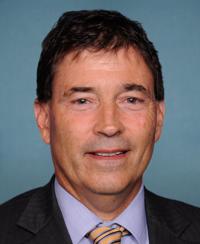
Troy Balderson
RRepublicanOH-12 · Representative
55
/ 100
Average
Attendance99
Avg: 96
Independence2
Avg: 4
Bipartisan Tone30
Avg: 15
Ethics Record100
Avg: 99
Transparency28
Avg: 53
Accountability Score — composite of attendance, independence, bipartisan tone, ethics record & transparency.
Methodology15
Bills Sponsored
0
Enacted into Law
6
Passed a Chamber
9
In Committee
All Sponsored Bills
HR10645In Committee
SMART Act
HR10615In Committee
Medicaid Integrity Improvement Act
HR9332Passed House
Load Forecasting Enhancement Act
Load Forecasting Enhancement Act This bill requires the Federal Energy Regulatory Commission (FERC) to establish regional boards to study and recommend best practices for electric load forecasting, which is the process of predicting the demand for electricity at a particular time. It also requires states to consider adopting the recommendations. Specifically, the bill directs FERC to establish regional boards to study electric load forecasting, chair the boards, and run them jointly with each state public utility commission in the regions. The boards must (1) study issues relevant to identifying best practices for electric load forecasting that enhance the reliability and affordability of electric service to customers, and (2) identify such best practices. FERC must make recommendations to Congress for the consistent use across states of such best practices by electric utilities. The bill also modifies provisions under the Public Utility Regulatory Policies Act to require state public utility commissions to consider adopting those recommendations. It also modifies the Energy Policy and Conservation Act to make federal assistance for state energy conservation plans contingent upon the plan including procedures and programs to improve the accuracy, oversight, and transparency to stakeholders of the forecasting of electric loads by electric utilities.
HR3747Passed House
Accelerating Access to Dementia and Alzheimer’s Provider Training Act
Accelerating Access to Dementia and Alzheimer’s Provider Training Act or the AADAPT Act This bill reauthorizes through FY2031 and revises the Technology-enabled Collaborative Learning Program, which is administered by the Health Resources and Services Administration. This program provides grants to support the use of technology that connects different health care professionals to improve access to health care, including specialty care, for certain rural and medically underserved populations. The bill explicitly adds dementia care to the types of specialty care that the program may address.
HRES1129In Committee
Recognizing and honoring the fallen members of the 121st Air Refueling Wing of the Ohio Air National Guard.
This resolution honors and recognizes members of the Ohio Air National Guard's 121st Air Refueling Wing who have died in service to the country. The measure is a ceremonial action by Congress to pay tribute to these fallen service members and their families, though it does not create new laws or programs.
HR7523In Committee
Spent Petroleum Catalyst Recycling and Critical Minerals and Metals Recovery Exemption Act
This bill would allow companies to recycle used catalysts from oil refineries without treating them as hazardous waste, making it easier and cheaper to recover valuable metals like platinum and palladium from these materials. The change would help reduce mining for new metals while keeping recycling costs down for refineries and chemical manufacturers. The bill aims to support both environmental goals and domestic supply of critical minerals needed for batteries, electronics, and other industries.
HR3616Passed House
Reliable Power Act
Reliable Power Act This bill directs the electric reliability organization (i.e., the North American Electric Reliability Corporation) to conduct annual long-term assessments of the reliability of electric power in the bulk-power system. It also establishes a process for the Federal Energy Regulatory Commission (FERC) to review federal regulations before they are finalized if the electric reliability organization finds that the system is at risk of not having sufficient electric generation to maintain reliability. If the electric reliability organization finds that the system does not have sufficient generation to maintain reliability, it must notify FERC that the bulk-power system is in a state of generation inadequacy. FERC must then notify the Department of Energy, the Environmental Protection Agency, and any other appropriate federal agencies of the generation inadequacy. Upon receiving the notice, the federal agency must provide proposed regulations that affect any generation resource in the bulk-power system to FERC for review and comment. If applicable, FERC must provide recommendations to modify the regulations. Federal agencies may not finalize such a regulation until FERC finds that it will not be likely to have a significant negative impact on the ability of the bulk-power system to supply sufficient electric energy necessary to maintain an adequate level of reliability.
HR1047Passed House
GRID Power Act
Guaranteeing Reliability through the Interconnection of Dispatchable Power Act or the GRID Power Act This bill requires the Federal Energy Regulatory Commission (FERC) to issue and periodically review a rule that revises the approval process for interconnection requests of generating units that produce electricity to prioritize dispatchable power projects (e.g., certain fossil fuel projects). Under the bill, dispatchable power generally refers to an electric energy generation resource, such as a generating unit that produces electricity from fossil fuels, capable of providing known and forecastable electric supply in time intervals necessary to ensure grid reliability. Currently, FERC receives interconnection requests from those projects and other generating units, such as units that produce electricity from renewable energy. Interconnection requests are requests from generating units to connect to the high voltage transmission lines of the electric grid. First, the rule must address the efficiency and effectiveness of the existing procedures for processing interconnection requests to ensure that new dispatchable power projects that improve grid reliability and resource adequacy can interconnect to the electric grid quickly, cost-effectively, and reliably. Second, the rule must revise the pro forma Large Generator Interconnection Procedures, and the pro forma Large Generator Interconnection Agreement as appropriate, to authorize transmission providers to submit proposals to FERC to prioritize new dispatchable power projects that will improve grid reliability and resource adequacy by assigning those projects higher positions in the interconnection queue of the provider. FERC must review and approve or deny such proposals within 60 days after the proposal is submitted.
HR4629In Committee
Protecting American Energy from State Overreach Codification Act
This bill would prevent states from imposing their own environmental or energy regulations on power plants and energy facilities that operate across state lines, limiting what individual states can require from energy companies. The legislation aims to give the federal government primary authority over energy regulation rather than allowing states to set stricter standards on their own, which supporters argue creates a more uniform national energy market but critics worry could weaken environmental protections. The bill would primarily affect energy companies, state governments, and consumers who depend on electricity from interstate power grids.
HR1767Passed House
Awning Safety Act of 2025
Awning Safety Act of 2025 This bill requires the Consumer Product Safety Commission (CPSC) to issue a consumer product safety standard for fixed and freestanding retractable awnings. Specifically, the CPSC must issue a standard to protect against the risk of death or serious injury associated with the awnings, including the risk of death or serious injury related to the awning unexpectedly opening and striking a person while removing the bungee tie-downs for the cover of the awning.
HR1182Passed House
Compressed Gas Cylinder Safety and Oversight Improvements Act of 2025
Compressed Gas Cylinder Safety and Oversight Improvements Act of 2025 This bill expands the application, testing, and inspection requirements for a foreign manufacturer of cylinders used for transporting hazardous materials in the United States (e.g., compressed gas cylinders). Current regulations require a foreign manufacturer to apply for approval from the Pipeline and Hazardous Materials Safety Administration (PHMSA) of the Department of Transportation (DOT) for testing such cylinders outside of the United States. The bill requires that, to obtain an approval, a foreign manufacturer must answer in their application specified questions, including whether the manufacturer is or has been subject to various civil or criminal penalties. Further, DOT must establish a process for any interested party to request a reevaluation of an approval for a foreign manufacturer's cylinders to review the accuracy and safety of the manufacturer's actions. DOT must also revise the foreign inspection regulations to require that annual inspections of foreign manufacturers be carried out if DOT determines there is good cause; specify that a refusal of inspection shall result in the loss of good standing; allow DOT to request testing and production records and random sample testing; and allow for the recovery of the costs of foreign inspections, including travel and time. The bill limits an approval to one year; however, DOT may extend an approval for five years for a manufacturer who meets certain requirements. On an annual basis, DOT must publish a list of approved foreign manufacturers of cylinders on the PHMSA website.
HR3032In Committee
Expanding Remote Monitoring Access Act
Expanding Remote Monitoring Access Act This bill establishes requirements for the Centers for Medicare & Medicaid Services (CMS) with respect to coverage of remote monitoring services under Medicare. Remote monitoring services generally refers to the management and monitoring of a patient's health via remote data collection, such as through medical devices. Specifically, the CMS must ensure that, for the two years following this bill's enactment, coverage of these services allows for a minimum of two days of data collection over a 30-day period, regardless of whether the individual has or is suspected of having COVID-19. (The CMS temporarily authorized coverage for 2 days of data collection, rather than the normally required 16 days, during the COVID-19 public health emergency.) The CMS must report on implementation and related information, including potential coverage variations and requirements for providers that utilize these services.
HR2814In Committee
Transportation Freedom Act
The bill would likely modify environmental rules or regulations affecting transportation, possibly by reducing restrictions on vehicles or fuel standards, or by changing how transportation-related pollution is regulated. The measure has been sent to two congressional committees that handle environmental policy and tax matters, suggesting it may involve changes to environmental laws, tax incentives, or both. Drivers, car manufacturers, and environmental groups would be among those most affected by whatever changes the bill proposes.
HR2404In Committee
Remote Opioid Monitoring Act of 2025
Remote Opioid Monitoring Act of 2025 This bill requires the Government Accountability Office (GAO) to report on the use of remote monitoring of individuals who are prescribed opioids, including the efficacy and prevalence of remote monitoring with respect to these individuals. GAO must also recommend ways to improve the availability, access, and coverage of remote monitoring for these individuals.
HRES57In Committee
Recognizing the benefits of natural gas to the United States economy and environment, and recognizing natural gas as an affordable and "green" energy.
This resolution recognizes domestically produced natural gas as affordable, green, and necessary for the United States to be energy dominant while asserting that the United States should take a broad approach to meet energy needs. It also supports efforts to increase domestic production of natural gas and natural gas infrastructure, identify and remove barriers to the production of natural gas, and expedite the approval of liquefied natural gas export facilities in the United States.