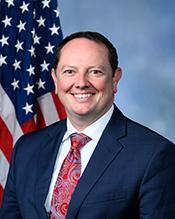
Eric Burlison
RRepublicanMO-7 · Representative
59
/ 100
Average
Attendance95
Avg: 96
Independence16
Avg: 4
Bipartisan Tone10
Avg: 15
Ethics Record100
Avg: 99
Transparency68
Avg: 53
Accountability Score — composite of attendance, independence, bipartisan tone, ethics record & transparency.
Methodology16
Bills Sponsored
0
Enacted into Law
2
Passed a Chamber
13
In Committee
All Sponsored Bills
HR10015In Committee
Great American Healthcare Act
The proposal would make changes to health savings accounts (special accounts where people can set aside pre-tax money for medical expenses) and require hospitals and insurance companies to publicly disclose their prices so patients can compare costs before getting care. These changes would affect workers who use health savings accounts, patients shopping for medical services, hospitals, and insurance companies. The bill has been sent to multiple congressional committees for review.
HR4123Passed House
FIT Procurement Act
Federal Improvement in Technology Procurement Act or the FIT Procurement Act This bill addresses various issues related to federal procurement policy and the federal acquisition workforce. For example, the bill requires the Federal Acquisition Institute (FAI) to establish a pilot program to consider incorporating experiential learning into the Federal Credentials Program, the Federal Acquisition Certification-Contracting Officer’s Representative Program, and the Federal Acquisition Certification for Program and Project Managers Program; FAI to provide information and communications technology acquisition training for certain acquisition workforce members; the General Services Administration to assume responsibility from the Office of Management and Budget for developing and implementing an artificial intelligence training program for certain acquisition workforce members; the Office of Federal Procurement Policy (OFPP) to issue guidance on when a wider range of projects, including commercial or non-government projects, should be accepted as relevant past performance so as to increase competition among eligible firms; and the OFPP to implement regulatory and other non-legislative actions, based on input from the Chief Acquisition Officers Council and the public, to remove barriers to entry for small businesses seeking to participate in federal government procurement. The bill also increases the simplified acquisition threshold from $250,000 to $500,000 and the micro purchase threshold from $10,000 to $25,000. (The federal government uses less complex procedures for the purchase of property and services valued below the simplified acquisition threshold. Purchases below the micro purchase threshold generally do not require soliciting competitive quotations if the contracting officer considers the price to be reasonable.)
HRES1412In Committee
Expressing support for July, the month of America's birthday, to become "National Fireworks Month".
The resolution would designate July as "National Fireworks Month" to celebrate America's Independence Day and promote fireworks as part of Fourth of July traditions. This symbolic measure would recognize the cultural significance of fireworks displays across the country during the nation's birthday celebrations. The designation would not create new laws or regulations, but rather express Congress's support for highlighting this patriotic tradition.
HR9264In Committee
No Exceptions for Non-Citizens Voting Act
This bill would eliminate all current exceptions that allow non-citizens to vote in any U.S. elections, making it illegal for anyone who is not a U.S. citizen to cast a ballot in federal, state, or local races. The change would affect immigration policy and voting eligibility rules across the country by removing any loopholes that might currently permit non-citizens to participate in elections. The bill is currently under review by the House Judiciary Committee.
HR8677In Committee
Make the American Dream Real Again Act
The proposal would give first-time homebuyers a refundable tax credit to help cover costs associated with purchasing a home, meaning they could get money back from the government even if they owe no taxes. This would make homeownership more affordable for people who are buying their first house, particularly those with lower incomes who might struggle to save for down payments and closing costs.
HR8602In Committee
Davis-Bacon Repeal Act
The proposal would eliminate the requirement that workers on federal construction projects be paid prevailing wages (the standard wage rates in their area). This would likely reduce labor costs for federal construction projects but could lower wages for construction workers on those projects. The change would affect construction companies bidding on federal contracts and the workers they employ.
HR8324In Committee
Great American Healthcare Plan
This bill would let people save more money in health savings accounts (special tax-advantaged accounts for medical expenses) and would require hospitals and insurance companies to publicly disclose their prices so patients can compare costs before getting care. The measure affects workers with health savings accounts, patients shopping for medical services, hospitals, and insurance companies. The bill has been referred to multiple committees in Congress for review.
HR7388Passed House
Smart Space Act of 2026
Smart Space Act of 2026 This bill requires the General Services Administration (GSA) to publish a recommended list of public building projects for which public-private partnerships and alternative financing methods should be used. Under the bill, GSA must hold consultation meetings to identify alternative financing solutions for the construction, renovation, or preparation for disposal of public buildings that will reduce costs to the federal government. Such meetings must include experts in private commercial real estate and federal real estate. If available, state real estate experts with experience leveraging private financing for public buildings and facilities must also be included. GSA must submit to the President and Congress, and publish on its website (1) recommendations on types of public-private partnerships and alternative financing methods best suited for meeting the federal government's public building needs, and (2) a list of recommended projects for which such methods should be used. Projects included on the recommended projects list must meet certain criteria, including consolidating or relocating federal agencies out of costly, inefficient, and underutilized spaces that GSA intends to sell or dispose of once vacated.
HR2409Reported
Guidance Clarity Act of 2025
Guidance Clarity Act of 2025 This bill requires federal agencies to state on the first page of guidance documents that such guidance (1) does not have the force and effect of law, and (2) is intended only to provide clarity to the public about existing legal requirements or agency policies.
HR7525In Committee
Counter Drone State and Local Defender Act
This bill would allow state and local law enforcement agencies to detect, track, and disable drones that pose a threat to public safety or critical infrastructure, without needing federal permission first. It aims to give police departments and other local authorities the tools to protect airports, power plants, government buildings, and other sensitive areas from unauthorized or dangerous drone activity. The bill addresses growing concerns about drones being used for illegal surveillance, smuggling, or attacks while clarifying what local officials can legally do to stop them.
HR6734In Committee
Auto Data Privacy and Autonomy Act
This bill would require automakers to let car owners control what data their vehicles collect and how that information is used, similar to privacy protections in other industries. It would give drivers the right to know what personal information their cars are gathering—such as location, driving habits, or phone contacts—and allow them to opt out of data sharing with third parties. The rules would apply to car manufacturers and the companies they sell vehicle data to, affecting both the auto industry and data brokers.
HR3949In Committee
Propane Accessibility and Regulatory Relief Act
This bill would reduce government regulations on propane companies and suppliers to make it easier and cheaper for them to do business, while potentially lowing costs and improving access to propane for heating, cooking, and other uses. The changes would likely affect propane distributors, retailers, and the millions of Americans who rely on propane, particularly in rural areas where it's a primary energy source. The bill is currently being reviewed by two congressional committees to determine which parts fall under their authority.
HR722In Committee
Life at Conception Act
Life at Conception Act This bill declares that the right to life guaranteed by the Constitution is vested in each human being at all stages of life, including the moment of fertilization, cloning, or other moment at which an individual comes into being. Nothing in this bill shall be construed to authorize the prosecution of any woman for the death of her unborn child.
HR335In Committee
Repeal the NFA Act
This proposal would eliminate the National Firearms Act, a federal law that currently requires people to register certain weapons like machine guns and short-barreled rifles with the government and pay a $200 tax stamp for each one. Removing this law would allow Americans to own these weapons without federal registration or the tax, though states could still impose their own restrictions. The change would primarily affect gun owners and manufacturers, while reducing federal tax revenue from these registrations.
HR221In Committee
Abolish the ATF Act
Abolish the ATF Act This bill abolishes the Bureau of Alcohol, Tobacco, Firearms and Explosives.
HRES15In Committee
Rescinding the subpoenas issued by the January 6th Select Committee on September 23, 2021, October 6, 2021, and February 9, 2022, and withdrawing the recommendations finding Stephen K. Bannon, Mark Randall Meadows, Daniel Scavino, Jr., and Peter K. Navarro in contempt of Congress.
This resolution rescinds subpoenas and recommendations issued by the House Select Committee to Investigate the January 6th Attack on the United States Capitol. Specifically, the resolution rescinds subpoenas issued on September 23, 2021, October 6, 2021, and February 9, 2022, to Steve Bannon, Mark Meadows, Peter Navarro, and Dan Scavino. The resolution also withdraws, dismisses, and concludes resolutions that the House find Steve Bannon, Mark Meadows, Peter Navarro, and Dan Scavino in contempt of Congress.