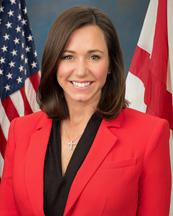
Katie Boyd Britt
RRepublicanAL · Senator
56
/ 100
Average
Attendance98
Avg: 97
Independence23
Avg: 23
Bipartisan Tone24
Avg: 14
Ethics Record100
Avg: 100
Transparency14
Avg: 47
Accountability Score — composite of attendance, independence, bipartisan tone, ethics record & transparency.
Methodology26
Bills Sponsored
2
Enacted into Law
0
Passed a Chamber
21
In Committee
Bills That Became Law
All Sponsored Bills
S1750In Committee
Poarch Band of Creek Indians Parity Act
Poarch Band of Creek Indians Parity Act This bill applies the Indian Reorganization Act (IRA) to the Poarch Band of Creek Indians. Additionally, the bill reaffirms previous decisions by the Department of the Interior to take land into trust for the tribe under the IRA. A 2009 Supreme Court case, Carcieri v. Salazar, decided that Interior could not take land into trust for a specified tribe because that tribe had not been under federal jurisdiction when the IRA was enacted in 1934. This bill (1) affirms the applicability of the IRA to the Poarch Band of Creek Indians, thereby deeming the tribe to be under federal jurisdiction as of June 18, 1934, for purposes of the IRA; and (2) reaffirms prior decisions by Interior to take land into trust for the benefit of the tribe.
S5452In Committee
A bill to amend the Financial Stability Act of 2010 to provide for tailoring and indexing enhanced regulations.
S5337In Committee
Keep Our Communities Safe Act of 2026
S5209In Committee
PERFORM Act
The proposal would cap the bonuses that can be paid to the Postmaster General, the leader of the U.S. Postal Service, limiting how much extra compensation this official can receive beyond their regular salary. The change affects how the federal government manages executive pay at the Postal Service and could reduce taxpayer spending on executive bonuses. The bill is currently under review by a Senate committee.
SRES802In Committee
A resolution honoring and celebrating National Boys and Girls Club Week.
This resolution calls on the people of the United States to celebrate National Boys and Girls Club Week.
S1003Enacted
Lulu’s Law
Lulu’s Law This act requires the Federal Communications Commission to issue an order explicitly permitting the transmission of wireless emergency alerts to mobile phones in the event of a shark attack. (Under current regulations, authorized government authorities are permitted to send wireless emergency alerts regarding public safety emergencies, including severe weather, missing children, and other threats to life or property.)
S4673In Committee
PATH Act
The legislation would encourage people living in federally-assisted public housing to work by potentially offering incentives or adjusting program rules to reward employment. The changes would affect low-income families and individuals who receive housing assistance from the federal government, aiming to increase the percentage of residents who participate in the workforce rather than relying solely on government benefits.
S4620In Committee
Mandatory E-Verify Act of 2026
The federal government would make the E-Verify system permanent and require all employers to use it to check whether job applicants are legally allowed to work in the United States. Currently, E-Verify is a voluntary program that some employers use, but this bill would make it mandatory for every business hiring workers. The change would affect millions of employers and job applicants across the country.
S4555In Committee
GAME Act of 2026
Major social media and digital advertising platforms would be banned from showing targeted ads for sports gambling to anyone under 18, protecting young people from marketing that encourages them to gamble. The law would apply to companies that collect personal data to customize ads, meaning platforms like Facebook, Instagram, TikTok, and YouTube would need to stop directing sports betting promotions to minors based on their browsing habits or interests. Violations could result in penalties enforced by the Federal Trade Commission.
S1885In Committee
Stop the Scroll Act
This bill would regulate how social media platforms and websites use algorithms to keep users scrolling and engaged, likely by requiring companies to disclose how their recommendation systems work and potentially limiting features designed to be addictive. The legislation aims to protect users—especially young people—from spending excessive time on these platforms by making it harder for companies to use psychological tactics to maximize screen time. Social media companies and tech platforms would need to comply with new transparency and design requirements.
SRES660Introduced
A resolution honoring the service and sacrifice of Air Force Major John A. Klinner, Air Force Major Ariana G. Savino, Air Force Technical Sergeant Ashley B. Pruitt, Air Force Captain Seth R. Koval, Air Force Captain Curtis J. Angst, and Air Force Master Sergeant Tyler H. Simmons.
This resolution honors six Air Force service members for their service and sacrifice to the country. The Senate unanimously approved the resolution to recognize these officers and enlisted personnel for their contributions to the military and national defense.
S846In Committee
Child Care Workforce Act
This bill would improve pay, benefits, and working conditions for child care workers by providing federal funding and support to help states increase wages and offer better benefits like health insurance and retirement plans. The goal is to address the shortage of child care workers and make it easier for families to find affordable, quality care for their children. Child care centers, workers, and families with young children would be the main groups affected.
S2544Reported
GUARD Act
Guarding Unprotected Aging Retirees from Deception Act or the GUARD Act This bill allows state, local, and tribal law enforcement agencies and grantees that receive funds from certain law enforcement grant programs to use the funds to investigate general financial fraud, elder financial fraud, and pig butchering. Pig butchering refers to a confidence and investment fraud in which a victim is gradually lured into transferring increasing amounts of money, generally in the form of cryptocurrency, into a fake virtual investment. The bill allows federal law enforcement agencies to assist state, local, and tribal law enforcement agencies and fusion centers in the use of tracing tools for blockchain and related technology tools. Finally, the bill requires the Department of the Treasury and the Financial Crimes Enforcement Network (FinCEN) to report on efforts and recommendations related to general financial fraud, elder financial fraud, pig butchering, and scams. The bill also requires Treasury and FinCEN to report on the state of scams in the United States, including information about crimes committed, federal civil and criminal enforcement actions, and federal efforts to address the crimes.
S3808In Committee
Fighting Trade Cheats Act of 2026
Fighting Trade Cheats Act of 2026 This bill increases penalties for, and establishes additional enforcement mechanisms related to, fraudulent and grossly negligent violations of U.S. customs laws. Specifically, the bill increases the maximum civil penalty for a fraudulent violation to three times the domestic value of the merchandise. (Currently, the maximum penalty is the domestic value of the merchandise.) It prohibits a person who commits a fraudulent violation from importing merchandise into the United States for a five-year period. Additionally, the bill increases the maximum civil penalty for a grossly negligent violation to the lesser of (1) 3 times the domestic value of the merchandise; or (2) 10 times the lawful duties, taxes, and fees. (Currently, the maximum penalty is the lesser of the domestic value of the merchandise or four times the lawful duties, taxes, and fees.) It prohibits a person who commits a grossly negligent violation from importing merchandise into the United States for a two-year period. Further, the bill applies these importation bans to an affiliated person (e.g., a family member or employee) of the person who committed the fraudulent or grossly negligent violation. The bill establishes a private right of action for an interested party (e.g., a manufacturer) affected by customs fraud or grossly negligent violations. The bill prohibits any person (or an affiliated person) who commits a fraudulent or grossly negligent violation from participating in the U.S. Customs and Border Protection's Importer of Record program, and further requires revocation of their importer of record numbers.
S3411In Committee
Improving Access to Small Business Information Act
This bill would make it easier for small business owners and entrepreneurs to find and access financial information and resources they need to start or grow their businesses. The legislation likely aims to improve how the government shares data about loans, grants, and other financing options so that small companies can more easily understand what help is available to them. By streamlining access to this information, the bill could help reduce barriers that prevent small business owners from finding the funding and support they need.
S3254In Committee
NIH IMPROVE Act
The bill aims to improve how the National Institutes of Health operates and conducts medical research, likely by updating funding processes, research priorities, or management practices. The changes would affect researchers, medical institutions, and patients who depend on NIH-funded discoveries for new treatments and cures. The bill is currently being reviewed by the Senate committee responsible for health policy.
S3177In Committee
Citizen Ballot Protection Act
S1523Reported
Water Research Optimization Act of 2025
S2924In Committee
Small Entity Update Act
This bill would likely update financial regulations that apply to small businesses and financial institutions, making it easier for them to comply with federal rules. The changes would probably reduce paperwork requirements or adjust reporting standards for smaller companies that don't have large compliance departments. Small business owners, community banks, and credit unions would be the main groups affected by these regulatory adjustments.
S2352In Committee
PROTECTED Act
The bill would establish new protections and regulations for the financial sector, though the specific provisions are not detailed in the available information. Once referred to the Banking Committee, lawmakers will examine how these protections might affect banks, financial institutions, and consumers who use financial services. The committee will determine whether the proposed changes should move forward for a full vote in Congress.
S1630In Committee
MOMS Act
The MOMS Act would likely address maternal health and support for mothers, though the specific provisions aren't detailed in the available information. Based on its referral to the health committee, it probably aims to improve access to healthcare, pregnancy services, or financial assistance for mothers and pregnant women. The bill is currently under review and hasn't yet been debated or voted on by Congress.
S1544In Committee
Insurance Data Protection Act
Insurance Data Protection Act This bill limits the ability of federal entities to compel insurance companies to share information. Specifically, the bill eliminates the subpoena power of the Federal Insurance Office. Under current law, the office has the power to subpoena information from insurers to, among other purposes, identify issues that could contribute to a systemic crisis in the insurance industry or the U.S. financial system. The bill also eliminates the ability of the Office of Financial Research to subpoena insurance companies. When seeking to collect insurance company data under specified consumer protection laws, a financial regulator must obtain the data from other regulators or from publicly available sources if possible. Otherwise, the financial regulator may only collect this data directly from the insurance company if the regulator complies with the Paperwork Reduction Act.
S847In Committee
Child Care Availability and Affordability Act
This bill would likely use tax credits or deductions to help families afford child care and encourage the expansion of child care services across the country. It would reduce the out-of-pocket costs that working parents pay for child care by making it more affordable through the tax system, while potentially incentivizing businesses or organizations to open new child care facilities. The changes would primarily benefit working families with young children who struggle with high child care expenses.
S639In Committee
Clergy Act
Clergy Act This bill establishes a two-year window for certain members of the clergy and Christian Science practitioners to revoke their exemption from Social Security and Medicare taxes on ministerial earnings. Under current law, such individuals who object to participation in public insurance programs on religious or conscientious grounds may apply to the Internal Revenue Service for an irrevocable exemption and will not receive Social Security or Medicare benefits in retirement unless they have qualifying credits from other employment. The Internal Revenue Service must develop a plan to inform members of the clergy and Christian Science practitioners of their eligibility to revoke prior exemptions, pursuant to the bill's changes.
S424In Committee
Retirement Fairness for Charities and Educational Institutions Act of 2025
Retirement Fairness for Charities and Educational Institutions Act of 2025 This bill allows 403(b) retirement plans (i.e., retirement plans designed for certain employees of public schools, charities, and churches) to invest in collective investment trusts, which are a group of pooled investment assets held by a bank or trust company, and in insurance company separate accounts.
S5Enacted
Laken Riley Act
Laken Riley Act This act requires the Department of Homeland Security (DHS) to detain certain non-U.S. nationals ( aliens under federal law) who have been arrested for burglary, theft, larceny, shoplifting, assault of a law enforcement officer, or any crime that results in death or serious bodily injury to another person. The act also authorizes states to sue the federal government for decisions or alleged failures related to immigration enforcement. Under this act, DHS must detain an individual who (1) is unlawfully present in the United States or did not possess the necessary documents when applying for admission; and (2) has been charged with, arrested for, convicted of, or admits to having committed acts that constitute the essential elements of the above crimes. The act also authorizes state governments to sue for injunctive relief over certain immigration-related decisions or alleged failures by the federal government if the decision or failure caused the state or its residents harm, including financial harm of more than $100. Specifically, the state government may sue the federal government over a decision to release a non-U.S. national from custody; failure to fulfill requirements relating to inspecting individuals seeking admission into the United States, including requirements related to asylum interviews; failure to fulfill a requirement to stop issuing visas to nationals of a country that unreasonably denies or delays acceptance of nationals of that country; violation of limitations on immigration parole, such as the requirement that parole be granted only on a case-by-case basis; or failure to detain an individual who has been ordered removed from the United States.