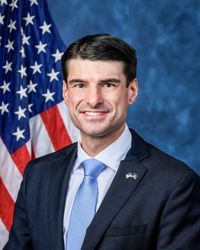
Robert P. Bresnahan, Jr.
RRepublicanPA-8 · Representative
50
/ 100
Average
Attendance99
Avg: 96
Independence5
Avg: 4
Bipartisan Tone5
Avg: 15
Ethics Record100
Avg: 99
Transparency19
Avg: 53
Accountability Score — composite of attendance, independence, bipartisan tone, ethics record & transparency.
Methodology15
Bills Sponsored
0
Enacted into Law
3
Passed a Chamber
12
In Committee
All Sponsored Bills
HR10770In Committee
To amend title III of the Public Health Service Act to temporarily limit the use of rebates under the 340B Program.
HR10328In Committee
Badge-to-Business Act
HR10224In Committee
To designate the facility of the United States Postal Service located at 6 Pennsylvania Avenue in Matamoras, Pennsylvania, as the "PFC Edward Kuhn Memorial Post Office".
This bill designates the facility of the United States Postal Service located at 6 Pennsylvania Avenue in Matamoras, Pennsylvania, as the "PFC Edward Kuhn Memorial Post Office".
HR9502In Committee
Protect Seniors and Veterans from Health Care Fraud Act of 2026
This legislation would strengthen protections against fraud and abuse in healthcare programs serving seniors and veterans, likely by increasing penalties for fraudsters, improving detection systems, and giving authorities better tools to investigate suspicious billing and medical claims. The bill would affect Medicare and Veterans Affairs beneficiaries who could face fewer fraudulent charges, as well as healthcare providers and insurers who would face stricter oversight. By cracking down on waste and fraud, the measure aims to preserve healthcare resources for legitimate patient care.
HR9262In Committee
Local Control Protection Act
Local governments would keep control over zoning decisions for data centers in their areas instead of having the federal government override those choices, and companies seeking federal tax breaks for data center projects would be required to negotiate community benefit agreements with local residents and officials. This would affect tech companies and data center developers who want to build facilities, as well as communities concerned about the environmental and infrastructure impacts of large data centers in their neighborhoods.
HRES1302In Committee
Designating May 2026 as "National Electrical Safety Month" in the United States and supporting the goals and ideals of "National Electrical Safety Month" to raise awareness of electrical hazards in homes, schools, and workplaces and the action citizens can take to protect against electrically related hazards.
The federal government would officially recognize May 2026 as National Electrical Safety Month to educate Americans about the dangers of electrical hazards in their homes, schools, and workplaces. The designation aims to increase public awareness about how people can protect themselves from electrical injuries and accidents. This symbolic recognition would support efforts by safety organizations and officials to promote electrical safety practices among all citizens.
HR7488In Committee
CFTC Office of the Chief Economist Act of 2026
This bill would establish an independent Office of the Chief Economist within the Commodity Futures Trading Commission (CFTC), the federal agency that oversees futures markets and derivatives trading. The office would conduct economic research and analysis to help the CFTC make better-informed decisions about regulating financial markets and protecting investors and traders from fraud and manipulation. This change would give the agency more in-house economic expertise to understand complex market trends and risks.
HR4782In Committee
Local Farmers Feeding our Communities Act
This bill would likely support local and regional farming by making it easier for small farmers to sell directly to schools, hospitals, and other institutions in their communities. It probably includes funding or regulatory changes to help local food systems compete with large national suppliers and reduce the distance food travels from farm to table. The measure would benefit small farmers, local food producers, and communities seeking fresher, locally-grown food options.
HR6075In Committee
Water Infrastructure Modernization Act of 2025
This bill would fund and authorize improvements to aging water systems across the country, including repairs to pipes, treatment facilities, and infrastructure that delivers clean water to homes and businesses. The legislation likely aims to address widespread problems like lead contamination, water main breaks, and outdated systems in communities nationwide. It would affect water utilities, local governments, and the millions of Americans who depend on reliable access to safe drinking water.
HR6022In Committee
Sgt. Walter F. Hartnett IV Green Star Veterans Service Act
Sgt. Walter F. Hartnett IV Green Star Veterans Service Act This bill requires the Department of Veterans Affairs to design and designate the Green Star Service Flag to identify next of kin of veterans who died of suicide on or after September 11, 2001. An individual who is next of kin of such a veteran may display the flag.
HR5905In Committee
Helping Our Heroes Act
The proposal would provide tax benefits to military service members and veterans, likely including tax credits or deductions for expenses related to their service or transition to civilian life. This would reduce the amount of taxes that eligible veterans and active-duty personnel owe to the federal government. The specific tax breaks would need to be determined as the bill moves through the House Committee on Ways and Means.
HR3428Passed House
Mid-Atlantic River Basin Commissions Review Act
Mid-Atlantic River Basin Commissions Review Act This bill directs the Government Accountability Office (GAO) to review and report on the ethics policies, practices used to communicate with the public, and funding of the Mid-Atlantic River Basin Commissions. These commissions are the Susquehanna River Basin Commission, the Delaware River Basin Commission, and the Interstate Commission on the Potomac River Basin. The GAO must submit a report to Congress on (1) the findings of the review, and (2) any recommendations to increase the transparency or congressional oversight of the commissions. Within 90 days of the GAO submitting its report, and annually thereafter for five years, each commission must submit to Congress a plan detailing actions the commission has taken to comply with the recommendations contained in the GAO's report.
HR2987Passed House
CEASE Act of 2025
Capping Excessive Awarding of SBLC Entrants Act or the CEASE Act This bill limits the number of for-profit small business lending companies that are authorized make 7(a) loans to not more than 16 at any time.
HR1286Passed House
Simplifying Forms for Veterans Claims Act
Simplifying Forms for Veterans Claims Act This bill requires the Department of Veterans Affairs (VA) to seek to enter an agreement with a federally funded research and development center to assess the forms that the VA sends to claimants. The center must submit a written assessment to the VA that includes recommendations on how the VA may make the forms clearer and more organized. The VA must implement certain recommendations in the assessment within two years after the assessment is received.
HR2989In Committee
Time to Choose Act of 2025
Time to Choose Act of 2025 This bill prohibits the federal government from awarding consulting services contracts to any entity that provides consulting services to covered foreign entities. Foreign entities covered by the bill include the government of China, the Chinese Communist Party, the People's Liberation Army, or any Chinese security service or intelligence agency; the government of Russia or any entity sanctioned under Executive Order 13662 ; the government of any country determined by the Department of State to have repeatedly provided support for international terrorism; and any entity on certain lists maintained by the Department of Commerce, such as the Denied Persons List or the Military End User List. An agency may waive the prohibition on a case-by-case basis if it is in the national security interests of the United States and no other entity without a conflict of interest can perform the work.