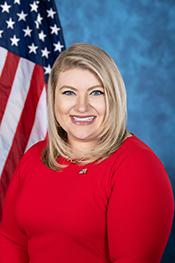
Kat Cammack
RRepublicanFL-3 · Representative
54
/ 100
Average
Attendance99
Avg: 96
Independence7
Avg: 4
Bipartisan Tone23
Avg: 15
Ethics Record100
Avg: 99
Transparency22
Avg: 53
Accountability Score — composite of attendance, independence, bipartisan tone, ethics record & transparency.
Methodology19
Bills Sponsored
0
Enacted into Law
3
Passed a Chamber
16
In Committee
All Sponsored Bills
HR9139In Committee
Medicaid Financing Clarification Act of 2026
The proposal would clarify how Congress intends for states to finance their Medicaid programs, which provide health insurance to low-income individuals and families. By spelling out Congressional intent in the law, the amendment aims to resolve confusion or disputes about what funding methods and policies states are allowed to use when managing their Medicaid programs. This would affect state governments, Medicaid beneficiaries, and healthcare providers who participate in the program.
HR8784In Committee
Bereaved Parents Rights Act
Hospitals and birth centers would be required to inform mothers who experience miscarriages about their legal rights regarding the remains of the fetus, such as options for burial, cremation, or donation. The requirement would apply to facilities that receive Medicare funding and would ensure mothers have clear information about what they can do with fetal remains after a miscarriage. This affects pregnant women, hospitals, and birth centers across the country.
HR8367In Committee
Answering the Call Act of 2026
The bill would expand suicide prevention services specifically for first responders like firefighters, police officers, and paramedics by improving how they learn about and access the National Suicide Prevention Lifeline. First responders face higher rates of suicide than the general population, so this legislation aims to make sure they know about available mental health resources and can easily reach out for help. The changes would be made to the existing Public Health Service Act to ensure the lifeline program does targeted outreach to these high-risk workers.
HR8603In Committee
Dismemberment Abortion Ban Act of 2026
The proposal would make it a federal crime to perform a specific abortion procedure involving dismemberment of fetal tissue, with exceptions for cases where the pregnant person's life is in danger. Doctors who violate the ban could face criminal penalties, and the measure would apply across all states. The bill affects pregnant women seeking abortions and medical providers who perform them.
HR8001In Committee
First Responders’ Equipment Access Act
This bill would likely make it easier for firefighters, police officers, and other emergency workers to get the equipment and gear they need to do their jobs safely. The legislation probably addresses barriers that prevent first responders from accessing or purchasing protective equipment, vehicles, or other critical tools quickly and affordably. It would affect local fire departments, police forces, and emergency services across the country.
HRES1124In Committee
Supporting the designation of March 21, 2026, as "National Women in Agriculture Day".
This resolution supports the designation of National Women in Agriculture Day. It also recognizes the important role of women in agriculture as producers, educators, leaders, mentors, and more.
HR1665Passed House
DIGITAL Applications Act
Deploying Infrastructure with Greater Internet Transactions And Legacy Applications Act or the DIGITAL Applications Act This bill requires the Department of the Interior and the Forest Service to each establish an online portal for accepting, processing, and disposal of applications for communications use authorizations. These are requests for easements, rights-of-way, leases, licenses, or other authorizations to locate or modify a transmitting device, support structure, or other communications facility on public lands or National Forest System land. Interior and the Forest Service must also notify the National Telecommunications and Information Administration (NTIA) within three business days of establishing their respective portals, and once the portals are established, the NTIA must link to them from its website.
HR7422In Committee
NEST Act
The NEST Act appears to address tax policy, though the specific details would depend on the bill's full text. Based on its referral to the House Ways and Means Committee, it likely proposes changes to how certain income, investments, or retirement savings are taxed, potentially affecting workers, savers, or businesses. Without more information about the bill's provisions, the exact impact on taxpayers cannot be determined.
HR1519In Committee
Public Safety Communications Act
Public Safety Communications Act This bill provides statutory authority for the Office of Public Safety Communications within the National Telecommunications and Information Administration to support efforts related to public safety communications. The duties of the office include (1) administering federal grant programs for Next Generation 9-1-1 systems, which are interoperable Internet Protocol-based systems for receiving 9-1-1 calls; and (2) managing and auditing the First Responder Network Authority (known as FirstNet), which oversees the communications network for emergency responders and the public safety community.
HR143In Committee
Unauthorized Spending Accountability Act
Unauthorized Spending Accountability Act This bill reduces budgetary levels for certain federal programs that are funded through the annual appropriations process and do not have an authorization of appropriations. Under the bill, budgetary levels are spending allocations provided to the congressional appropriations committees by a congressional budget resolution or a deeming resolution. The allocations are provided under the Congressional Budget Act of 1974 and are often referred to as 302(a) allocations. The bill applies to programs included in the Congressional Budget Office's (CBO's) annual report listing programs that are funded through the appropriations process and have an authorization of appropriations that has either expired or will expire during the year. If a program is listed in the CBO report, the bill requires specified reductions to be implemented over a three-year period and terminates the unauthorized programs at the end of the third unauthorized year.
HR4783In Committee
COP Act of 2025
The legislation would establish new requirements and procedures related to immigration enforcement and law enforcement operations at the federal level. The bill affects immigration officers, local law enforcement agencies, and individuals subject to immigration enforcement actions. The proposal has been sent to the House Judiciary Committee for review and consideration.
HRES611In Committee
Expressing the importance of accurate information for medical professionals treating pregnant women and their unborn children in the emergency department, and for informing the general public, and for other purposes.
The resolution emphasizes that doctors and emergency room staff should have access to accurate medical information when treating pregnant women and their developing babies, and that the public should also receive correct health information on this topic. It expresses support for ensuring medical professionals have reliable guidance to make informed decisions during emergency situations involving pregnancy. The measure has been sent to the House Committee on Energy and Commerce for consideration.
HR1520Passed House
Charlotte Woodward Organ Transplant Discrimination Prevention Act
Charlotte Woodward Organ Transplant Discrimination Prevention Act This bill expressly prohibits health care providers and other entities involved in matching donated organs with recipients from denying or restricting an individual's access to organ transplants solely on the basis of the individual's disability, except in limited circumstances. Specifically, these entities may consider an individual's disability when making decisions about transplants only if a physician finds, based on an individualized evaluation, that the individual's physical or mental disability is medically significant to the provision of the transplant. A disability shall not be considered medically significant if the individual has an adequate support system in place to comply with transplant-related medical requirements. These entities must also make reasonable changes to their policies to make transplants and related care more available to individuals with disabilities. Aggrieved individuals may bring claims of discrimination to the Office of Civil Rights of the Department of Health and Human Services. The bill provides for expedited resolutions of these claims. In addition, the board of directors of the Organ Procurement and Transplantation Network may not issue policies that prohibit or hinder access to an organ transplant based solely on the individual's disability. This network is a public-private partnership linking professionals involved in the U.S. organ donation and transplantation system.
HR1664Passed House
Deploying American Blockchains Act of 2025
Deploying American Blockchains Act of 2025 This bill requires the Department of Commerce to support the leadership of the United States in the use of blockchain technology and other distributed ledger technology, tokens, and tokenization. Generally, blockchain technology is a distributed digital ledger that uses cryptography to share verified information across a network of computers. Tokens refer to the transferrable, digital representation of information recorded on blockchain technology and tokenization is the process of creating a token. Specifically, Commerce must advise the President on policies related to the deployment and use of blockchain technology and other distributed ledger technology, applications built on blockchain technology or other distributed ledger technology, tokens, and tokenization. Commerce also must establish advisory committees to support the adoption of blockchain technology to facilitate the development of best practices with respect to blockchain technology, applications built on blockchain technology, tokens, and tokenization. Commerce must report annually on the activities under this bill and provide any recommendations for additional legislation to strengthen U.S. competitiveness with respect to blockchain technology.
HRES500In Committee
Amending the Rules of the House of Representatives to require employees of the House to be subject to criminal background checks conducted by the United States Capitol Police, and for other purposes.
The proposal would require all House of Representatives employees to undergo criminal background checks performed by the Capitol Police, strengthening security screening for people who work in Congress. This would apply to staff members across all congressional offices and support positions, helping ensure that individuals with certain criminal histories don't have access to the Capitol building or sensitive congressional operations.
HR3864In Committee
Protecting Health Care for All Patients Act of 2025
Protecting Health Care for All Patients Act of 2025 This bill prohibits all federal health care programs, including the Federal Employees Health Benefits Program, and federally funded state health care programs (e.g., Medicaid) from using prices that are based on quality-adjusted life years (i.e., measures that discount the value of a life based on disability, age, or terminal illness) to determine relevant thresholds for coverage, reimbursements, or incentive programs. The Government Accountability Office must annually report on how the use of quality-adjusted life years negatively affects individuals with intellectual and developmental disabilities. The bill also reduces funding for the Prevention and Public Health Fund for FY2026-FY2031.
HR2491In Committee
ABC Act
Alleviating Barriers for Caregivers Act or the ABC Act This bill requires federal agencies to review and modify the administrative processes related to Medicare, Medicaid, the Children's Health Insurance Program (CHIP), and Social Security programs in order to streamline these processes for family caregivers. Specifically, the Centers for Medicare & Medicaid Services (CMS) and the Social Security Administration (SSA) must review processes related to eligibility determinations, applications, forms, and communications for these programs and identify ways to simplify and streamline these processes for family caregivers (e.g., reducing the need for family caregivers to submit the same information for multiple programs). The CMS and SSA must solicit input from family caregivers and state and regional organizations, implement any identified improvements, and report on these efforts to Congress. In addition, the CMS must issue a letter to state Medicaid and CHIP programs that encourages states to conduct a similar review and that provides potential improvements.
HRES49In Committee
Prohibiting Members of the House of Representatives from bringing or displaying a flag of a foreign nation on the floor of the House, and for other purposes.
This resolution prohibits a Member, Delegate, or Resident Commissioner from bringing or displaying any flag of a foreign nation on the House floor while it is in session. However, the prohibition does not apply to a Member wearing a flag of a foreign nation as a lapel pin or using a depiction of such a flag as part of an exhibit during a speech or debate under House rules.
HR142In Committee
Regulations from the Executive in Need of Scrutiny Act of 2025
Regulations from the Executive in Need of Scrutiny Act of 20 25 This bill revises provisions relating to congressional review of agency rulemaking. Specifically, the bill establishes a congressional approval process for a major rule. A major rule may only take effect if Congress approves of the rule. A major rule is a rule that has resulted in or is likely to result in (1) an annual effect on the economy of $100 million or more; (2) a major increase in costs or prices for consumers, individual industries, government agencies, or geographic regions; or (3) significant adverse effects on competition, employment, investment, productivity, innovation, or the ability of U.S.-based enterprises to compete with foreign-based enterprises. The bill generally preserves the current congressional review process for a nonmajor rule.