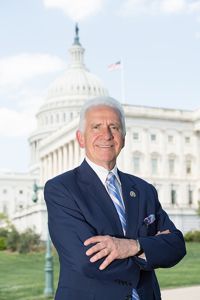
Jim Costa
DDemocratCA-21 · Representative
57
/ 100
Average
Attendance96
Avg: 96
Independence10
Avg: 4
Bipartisan Tone19
Avg: 15
Ethics Record100
Avg: 99
Transparency47
Avg: 53
Accountability Score — composite of attendance, independence, bipartisan tone, ethics record & transparency.
Methodology23
Bills Sponsored
0
Enacted into Law
0
Passed a Chamber
23
In Committee
All Sponsored Bills
HR10772In Committee
Frontline Innovation Act
HRES1611In Committee
Expressing support for the designation of October 8, 2026, as "National Hydrogen and Fuel Cell Day".
This resolution supports the designation of National Hydrogen and Fuel Cell Day.
HRES1356In Committee
A resolution commemorating the Day of Portugal, Camões, and the Portuguese Communities, and for other purposes.
This resolution recognizes and commemorates the Day of Portugal, Camões, and the Portuguese Communities, a holiday celebrating Portuguese heritage and culture named for the 16th century poet Luís Vaz de Camões. The resolution also honors the contributions of Portuguese Americans to society.
HRES1190In Committee
Supporting the designation of April 19 through April 25, 2026, as "National Crime Victims' Rights Week".
This resolution would officially designate the week of April 19-25, 2026, as "National Crime Victims' Rights Week" to raise awareness about the rights and needs of people who have been harmed by crime. The designation would encourage communities, organizations, and government agencies to recognize and support crime victims during that week through events and educational activities. This is a symbolic measure that doesn't create new laws or programs, but rather highlights an important cause.
HR7609In Committee
Rural Development Modernization Act
This bill would update federal programs that help develop rural areas, likely including improvements to loans, grants, and infrastructure projects for farming communities and small towns. The changes would probably affect farmers, rural businesses, and residents in less populated regions who rely on government support for things like broadband internet, water systems, and economic development. Since the bill has been sent to multiple committees, it likely touches on agriculture, energy, natural resources, and financial services in rural America.
HR5111In Committee
CRP Improvement and Flexibility Act of 2025
CRP Improvement and Flexibility Act of 2025 This bill increases federal assistance and incentives for eligible participants and entities in the Conservation Reserve Program (CRP) of the Farm Service Agency. CRP is a land conservation program that provides an annual rental payment to farmers in exchange for farmers removing environmentally sensitive land from agricultural production and planting species that will improve environmental health and quality. The bill increases the CRP annual rental payment limitation from $50,000 to $125,000. The bill also permanently establishes a continuous enrollment procedure for land that will be enrolled under the State Acres for Wildlife Enhancement Initiative. Additionally, the bill provides federal cost sharing payments for the establishment of grazing infrastructure on all CRP contracts and practices, if grazing is included in the conservation plan and addresses a resource concern. It also provides federal cost sharing payments under CRP for management activities to implement the conservation plan that are not related to haying or grazing. Further, the bill allows emergency haying on CRP land during the primary nesting season in response to drought, flooding, wildfire, or other emergencies if certain conditions are met. It also modifies the conditions under which haying and grazing may be permitted on CRP land.
HR5875In Committee
COWS Act of 2025
The COWS Act would establish new regulations or programs related to cattle farming and dairy production in the United States. Based on its agricultural focus, the bill likely aims to address issues affecting livestock farmers, such as animal welfare standards, environmental practices, or market support programs. The proposal is currently under review by the House Agriculture Committee.
HR5796In Committee
BUILD Act
The BUILD Act would likely provide federal funding and support for infrastructure projects, economic development, and public building improvements across the country. The bill appears designed to help communities invest in construction, renovation, and modernization of public facilities while potentially creating jobs in the construction and development sectors. Local governments, construction companies, and workers in infrastructure-related fields would be the primary beneficiaries of this legislation.
HR338In Committee
Every Drop Counts Act
Every Drop Counts Act This bill expands the Bureau of Reclamation's Small Storage Program, which is a grant program for small surface water or groundwater storage projects in certain western states. First, the bill expands the types of projects that are eligible for grants under the program. Specifically, the bill makes a project eligible for a grant if the project (1) has water storage capacity of recharges no less than 200 acre-feet and no more than 150,000 acre-feet on an average annual basis over the life of the project for storage or use; and (2) increases groundwater aquifer storage, conveys water to or recovers water from groundwater storage, and stabilizes groundwater levels. Next, it extends Reclamation's authority to carry out the grant program for another five years.
HR5747In Committee
Preventing Illegal Laboratories and Protecting Public Health Act of 2025
This bill would crack down on illegal drug manufacturing operations by strengthening enforcement against clandestine labs that produce dangerous substances like methamphetamine and fentanyl, protecting communities from the environmental contamination and public health risks these operations create. The legislation likely increases penalties for operating unlicensed labs, improves law enforcement tools to detect and shut down these facilities, and may provide resources for cleaning up contaminated sites left behind by illegal drug producers.
HRES788In Committee
Expressing support for the designation of October 8, 2025, as "National Hydrogen and Fuel Cell Day".
This resolution supports the designation of National Hydrogen and Fuel Cell Day.
HR5355In Committee
Ian Kalvinskas Pediatric Liver Cancer Early Detection and Screening Act
The proposal would establish a national program to screen children for liver cancer early, before symptoms appear, with the goal of catching the disease when it's easier to treat. It would fund research and education efforts to help doctors identify liver cancer risk factors in young patients and develop better detection methods. Pediatric patients, their families, and healthcare providers would benefit from improved early warning systems and screening guidelines.
HR4879In Committee
Emergency Rural Water Response Act of 2025
This bill would provide emergency funding and resources to help rural communities deal with water supply problems, such as contamination, system failures, or natural disasters that leave residents without safe drinking water. It aims to help small towns and agricultural areas that often lack the money and infrastructure that larger cities have to fix water emergencies quickly. The bill has been sent to a congressional subcommittee for review.
HR3099In Committee
STOP Health Threats Act
Safety Training for Officers on Public Health Threats Act or the STOP Health Threats Act This bill directs the Department of Health and Human Services to award grants to local governments for the training of local enforcement officers on the public health threats resulting from building code violations.
HR3098In Committee
FAIR Fleets Act
The proposal would require federal agencies to report on the fuel efficiency and environmental impact of their vehicle fleets, and establish standards to reduce emissions from government-owned cars and trucks. Federal agencies and taxpayers would benefit from lower fuel costs and reduced pollution, while the government would gain better data on how its transportation spending affects the environment. The measure aims to make federal fleet management more transparent and environmentally responsible.
HR3035In Committee
Restoring WIFIA Eligibility Act
HR2496In Committee
Dairy Nutrition Incentive Program Act of 2025
Dairy Nutrition Incentive Program Act of 2025 This bill directs the Department of Agriculture (USDA) to establish a dairy nutrition incentive program to develop and test methods to increase the purchase and consumption of dairy under the Supplemental Nutrition Assistance Program (SNAP). Specifically, the program must provide an incentive to SNAP benefit recipients for the purchase of naturally nutrient-rich dairy, which the bill defines to include fluid milk, yogurt, and cheese made from cow's milk. To carry out the program, USDA must enter into cooperative agreements with, or provide competitive grants to, state or local governments and nonprofit organizations for projects. The bill provides funding for the program for each fiscal year. USDA must provide for an independent evaluation of each project that measures, to the maximum extent practicable, the effect of incentives on purchases of naturally nutrient-rich dairy by SNAP recipients. Projects currently carried out by the USDA Healthy Fluid Milk Incentives (HFMI) program must be transitioned to the new dairy nutrition incentive program; the bill repeals the HFMI program one year after USDA certifies that the transition is complete.
HR1376In Committee
Healthy Poultry Assistance and Indemnification Act of 2025
Healthy Poultry Assistance and Indemnification Act of 2025 This bill expands the Animal and Plant Health Inspection Service (APHIS) producer indemnity and compensation program to include compensation for all poultry growers and layers located in an APHIS-determined control area, which may include non-infected poultry. Currently, APHIS provides indemnity and compensation to producers to remove animals classified as affected, suspect, or exposed to diseases of concern, including highly pathogenic avian influenza (HPAI). An APHIS-determined control area consists of both an infected zone and a buffer zone. Under the bill, APHIS must compensate all owners of poultry growing or laying facilities for flocks of birds that the facility owner was prohibited from growing or laying due to the location of the facility within a control area. This may include facilities that are located in the buffer zones and have non-infected poultry. Further, the bill establishes a new compensation payment formula that requires payments to be based on the owner’s average income from the five most recent flocks. Under the bill, APHIS's compensation determination is final and not subject to judicial or administrative review (other than by the Secretary of Agriculture or a designee).
HR2106In Committee
Expanding Medical Education Act
Expanding Medical Education Act This bill authorizes the Department of Health and Human Services (HHS) to award grants to institutions of higher education, or consortia of such institutions, to establish or expand medical schools. In awarding these grants, HHS must prioritize minority-serving institutions or those that propose to establish or expand schools in medically underserved communities or areas with shortages of health professionals where no such schools exist.
HR1856In Committee
CASE LOAD Act of 2025
The bill addresses caseload management within the legal system, likely aiming to reduce the burden on courts and improve case processing efficiency. Based on its referral to the House Judiciary Committee, it probably proposes changes to how courts handle their workload, which could affect judges, court staff, attorneys, and people waiting for their cases to be resolved. The specific reforms would determine whether it impacts court timelines, resources, or procedures for different types of legal cases.
HR605In Committee
Headwaters Protection Act of 2025
Headwaters Protection Act of 2025 This bill reauthorizes through FY2033 and expands the Water Source Protection Program (WSPP) under which the Forest Service carries out watershed protection and restoration projects on federal land. It also requires the Forest Service's Watershed Condition Framework for National Forest System land to ensure certain activities and authorizations do not result in long-term degradation of the health of a watershed. The bill authorizes the WSPP to support projects on state, local, or private land that is adjacent to projects on National Forest System land, so long as (1) the adjacent land is within the same watershed as the project on federal land, and (2) the owner of the adjacent land supports the project. Further, the bill expands the types of end water users that may participate in the program to include (1) an acequia association (an organization that manages traditional irrigation systems found in the Southwest); (2) a public entity that manages water infrastructure, such as stormwater or wastewater resources; (3) certain land grant entities in New Mexico called land-grant mercedes; and (4) a local, regional, or other private entity that has water delivery authority. The bill requires projects under the program to (1) protect and restore watershed health, water supply and quality, a municipal or agricultural water supply system, and water-related infrastructure; (2) protect and restore forest health from insect infestation and disease or wildfire; or (3) advance any combination of those purposes. Additionally, the bill reduces the cost share for nonfederal WSPP participants.
HR1189In Committee
National Plan for Epilepsy Act
National Plan for Epilepsy Act This bill requires the Department of Health and Human Services (HHS) to establish a national plan, form an advisory council, and take other actions to address epilepsy. The requirements sunset on December 31, 2035. Specifically, the bill requires HHS to carry out a National Plan for Epilepsy to prevent, diagnose, treat, and cure epilepsy. In carrying out the plan, HHS must implement activities such as coordinating research and services across all federal agencies and soliciting public comments. Also, HHS must establish an Advisory Council on Epilepsy Research, Care, and Services. The advisory council must report to HHS and Congress every two years with an evaluation of federally funded efforts. Additionally, HHS must annually report to Congress with recommended actions based on its assessments of the nation’s progress on epilepsy.
HR337In Committee
To provide technical and financial assistance for groundwater recharge, aquifer storage, and water source substitution projects.
This bill modifies the Infrastructure Investment and Jobs Act to allow unobligated balances of amounts made available to the Bureau of Reclamation for western water infrastructure to be made available to Reclamation for FY2026-2031 to provide financial or technical assistance for (1) groundwater recharge projects, (2) aquifer storage and recovery projects, or (3) water source substitution for aquifer protection projects.