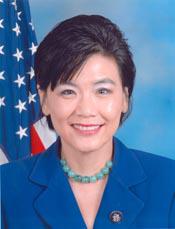
Judy Chu
DDemocratCA-28 · Representative
55
/ 100
Average
Attendance100
Avg: 96
Independence2
Avg: 4
Bipartisan Tone18
Avg: 15
Ethics Record100
Avg: 99
Transparency42
Avg: 53
Accountability Score — composite of attendance, independence, bipartisan tone, ethics record & transparency.
Methodology34
Bills Sponsored
0
Enacted into Law
1
Passed a Chamber
33
In Committee
All Sponsored Bills
HRES1608In Committee
Expressing support for the designation of October 5, 2026, as the "National Beyond the Milky Way Day" and celebrating a transformative achievement in American science.
HR10651In Committee
End Tax Breaks for Dark Money Act
HRES1574In Committee
Expressing support for the recognition of September 27, 2026, to October 3, 2026, as "Asian American and Native American Pacific Islander-Serving Institutions Week".
HRES1532In Committee
Expressing support for the designation of the week of September 13 through September 19, 2026, as "Community School Coordinators Appreciation Week".
HRES1509In Committee
Recognizing the extraordinary resilience and courage of children and families fighting neuroblastoma and supports the incredible effort of clinicians and researchers working to address this disease and expressing support for September 3, 2026, to be designated as "Neuroblastoma Awareness Day".
HR10045In Committee
Protect American Values Act
HR9699In Committee
Drug Deal Disclosure Act
The government would be required to publicly release documents and communications about drug pricing agreements it has made with pharmaceutical manufacturers, including deals involving "most favored nation" pricing where the government pays the same price as other countries. This would give patients, lawmakers, and the public visibility into how the government negotiates drug prices and what deals it strikes behind closed doors. The measure affects pharmaceutical companies, federal health agencies, and anyone who buys or pays for prescription drugs.
HR9400In Committee
American Rescuers of the Holocaust Congressional Gold Medal Act of 2026
This bill would award a Congressional Gold Medal to Americans who risked their lives to rescue and protect Jews and other refugees fleeing Nazi persecution during the Holocaust. These individuals, known as "Righteous Among the Nations," helped save tens of thousands of people from certain death through acts of courage and compassion. The medal recognizes their extraordinary humanitarian contributions during one of history's darkest periods.
HRES1324In Committee
Recognizing the 1885 Rock Springs Chinese Massacre.
This resolution acknowledges and commemorates the 1885 Rock Springs Massacre, when a mob of white miners attacked Chinese immigrant workers in Wyoming, killing dozens and destroying their homes and businesses. The measure recognizes this historical tragedy and its impact on Chinese Americans, serving as an official acknowledgment of a violent event that had been largely forgotten in American history. It has been referred to committees in Congress for consideration.
HR9024In Committee
Harry Lew and Danny Chen Military Justice Reform Act
The Department of Defense would be required to study whether the military should create a specific law against hazing in its justice system, separate from existing rules. This analysis would help determine if a dedicated hazing law would be practical and beneficial for protecting service members from abuse by their peers or superiors. The findings would inform whether Congress should establish this new rule to address hazing incidents more directly in the military.
HR7463In Committee
Foster Youth Postsecondary Education Access and Success Act
This bill would help young people who grew up in foster care attend and complete college or other training programs after high school by providing financial support and removing barriers they face. It aims to address the fact that foster youth have much lower college completion rates than other students, often because they lack family financial support and face unique challenges like housing instability. The legislation would likely expand grants, scholarships, or other assistance specifically for this vulnerable group of students.
HRES1260In Committee
Supporting the designation of May 10, 2026, as "National Asian American, Native Hawaiian, and Pacific Islander Mental Health Day".
The proposal would officially recognize May 10, 2026, as a national day dedicated to raising awareness about mental health issues affecting Asian American, Native Hawaiian, and Pacific Islander communities. The designation aims to highlight mental health challenges and resources for these groups, who often face unique barriers to accessing mental health care and support. This observance would encourage education, community engagement, and conversations about mental wellness within these populations.
HR8604In Committee
Language Access Board Act of 2026
The proposal would create a new government board focused on helping people who don't speak English access federal services and information. This board would work to ensure that non-English speakers can understand and use government programs, apply for benefits, and communicate with federal agencies without language barriers. The change would affect millions of Americans with limited English skills, federal agencies that serve the public, and organizations that help translate government materials.
HR8498In Committee
Increasing Access to Foster Care Through Age 21 Act
States would receive federal funding incentives to continue providing foster care support and services to young people until age 21, rather than ending support at age 18, and would allow young adults to re-enter the foster care system after turning 18 if they need help. The bill removes requirements that parents' or guardians' income level determine eligibility for these extended services, meaning more young people aging out of foster care could access housing, education, and other support regardless of their family's financial situation. This would help vulnerable youth transition to adulthood with greater stability and access to resources.
HRES1148In Committee
Expressing support for the recognition of April as "National Language Access Month".
This resolution asks the federal government to officially recognize April as "National Language Access Month" to raise awareness about the importance of providing services and information in multiple languages for people who don't speak English fluently. The measure highlights how language barriers can prevent immigrants, refugees, and non-English speakers from accessing healthcare, education, legal services, and government benefits. If approved, it would encourage government agencies, schools, and organizations to promote programs that help break down these communication barriers.
HRES1078In Committee
Of inquiry requesting the President and directing the Secretary of Health and Human Services to transmit, respectively, certain documents to the House of Representatives relating to the "Defend the Spend" freeze on child care payments to all States, Tribes, and Territories.
Congress is asking the President and the Secretary of Health and Human Services to provide documents explaining a freeze on federal child care payments to states, tribes, and territories. The request aims to get information about this "Defend the Spend" policy so lawmakers can understand how it affects families and child care access across the country. This is currently being reviewed by the House Committee on Ways and Means.
HR7608In Committee
Southeast Asian Deportation Relief Act of 2026
This bill would provide relief from deportation for certain Southeast Asian immigrants who have lived in the United States for extended periods, likely addressing cases where people from countries like Vietnam, Cambodia, and Laos face removal despite long-term residence and community ties. The measure would affect immigrants with criminal records or other deportation grounds who currently have limited legal options to stay in the country. It aims to balance immigration enforcement with humanitarian concerns for people who have established lives and families in America.
HR7171In Committee
Fair Legal Access Grants Act
This bill would provide federal grants to help states and local communities improve access to legal representation for people who cannot afford lawyers, particularly in criminal cases. The funding would support public defender offices, legal aid organizations, and other programs that help low-income defendants navigate the court system. The money aims to reduce delays in cases and ensure that poor people have better legal help when facing criminal charges.
HR7170In Committee
Language Access to Gun Violence Prevention Strategies Act of 2026
This bill would require that information about gun violence prevention programs and resources be made available in multiple languages so that non-English speakers can access these services and understand safety initiatives. The measure would affect law enforcement agencies, public health organizations, and communities working to reduce gun violence by ensuring language barriers don't prevent people from getting help or learning about prevention strategies.
HRES980In Committee
A resolution observing the 1-year anniversary of the 2025 Southern California wildfires.
This resolution marks the one-year anniversary of the 2025 Southern California wildfires by formally recognizing the event in Congress. The measure honors the impact of these fires on affected communities, first responders, and residents while acknowledging the disaster's significance to the region. As a resolution rather than a law, it does not create new policies or funding but serves as an official congressional statement of remembrance.
HR6841In Committee
PEERS Act of 2025
Without access to the bill's text, I cannot provide an accurate summary of what the PEERS Act of 2025 would specifically do. To write a meaningful plain-English explanation of its concrete effects on patients, workers, or other groups, I would need to review the actual bill provisions. I recommend checking Congress.gov for the full bill text to understand its specific policy goals.
HR6783In Committee
San Gabriel Mountains, Foothills, and Rivers Protection Act of 2025
This bill would protect a large area of the San Gabriel Mountains and surrounding foothills in California by designating it as a national monument or protected public land, which would restrict certain activities like mining and logging while allowing recreation and conservation efforts. The protection would affect outdoor enthusiasts, local communities, environmental groups, and companies that operate in the region, potentially limiting some resource extraction but preserving the landscape for future generations. The bill is currently under review by the House Committee on Natural Resources to determine whether it should move forward.
HR6131In Committee
Increasing Access to Mental Health in Schools Act
This bill would expand mental health services available to students in schools by increasing funding and resources for school counselors, psychologists, and mental health professionals. It aims to help students access support for issues like anxiety, depression, and stress without having to leave school or rely solely on outside providers. The changes would affect public schools and the students they serve, potentially making mental health care more available to young people who might otherwise go without treatment.
HR4840In Committee
CREATE Act
Without access to the full bill text, the CREATE Act likely addresses tax policy changes, possibly related to business taxation, tax credits, or tax reform. The bill has been sent to the House Ways and Means Committee, which handles all federal tax legislation, suggesting it would affect how businesses, individuals, or specific industries pay taxes or receive tax benefits.
HR4787In Committee
To amend the Internal Revenue Code of 1986 to extend the deduction for film and television productions and to make certain changes with respect to the calculation of such deduction.
The proposal would extend a tax break that allows film and television production companies to deduct certain production costs from their taxes, and would modify how that deduction is calculated. This tax incentive is designed to encourage movie and TV studios to produce content in the United States rather than overseas. The change would affect entertainment companies and potentially influence where they choose to film their projects.
HR4443In Committee
Asunción Valdivia Heat Illness, Injury, and Fatality Prevention Act of 2025
This bill would require employers to establish heat safety standards and protections for workers, including mandatory rest breaks, access to water and shade, and emergency response plans during hot weather conditions. The law would apply to both indoor and outdoor workers across various industries to prevent heat-related illnesses, injuries, and deaths. Employers who fail to comply could face penalties, while workers would gain new protections and the right to report unsafe heat conditions.
HR4163In Committee
PRIDE Act of 2025
The proposal would modify tax rules related to retirement accounts and investment income for individuals and businesses. The changes would affect how people save for retirement and how investment earnings are taxed, potentially impacting workers with 401(k)s and similar plans, as well as investors and small business owners. The House Committee on Ways and Means is currently reviewing the proposal to determine whether it should move forward.
HR12In Committee
Women’s Health Protection Act of 2025
Women's Health Protection Act of 2025 This bill prohibits governmental restrictions on the provision of, and access to, abortion services. Before fetal viability, governments may not restrict providers from using particular abortion procedures or drugs, offering abortion services via telemedicine, or immediately providing abortion services if delaying risks the patient's health. Furthermore, governments may not require providers to perform unnecessary medical procedures, provide medically inaccurate information, or comply with credentialing or other conditions that do not apply to providers who offer medically comparable services to abortions. Additionally, governments may not require patients to make medically unnecessary in-person visits before receiving abortion services or disclose their reasons for obtaining services. After fetal viability, governments may not restrict providers from performing abortions when necessary to protect a patient's life and health. The same provisions that apply to abortions before viability also apply to necessary abortions after viability. Additionally, states may authorize post-viability abortions in circumstances beyond those that the bill considers necessary. Further, the bill recognizes an individual's right to interstate travel, including for abortion services. The bill also prohibits governments from implementing measures that are similar to those restricted by the bill or that otherwise target and impede access to abortion services, unless the measure significantly advances the safety of abortion services or health of patients and cannot be achieved through less restrictive means. The Department of Justice, individuals, or providers may sue states or government officials to enforce this bill, regardless of certain immunity that would otherwise apply.
HRES407In Committee
Supporting the designation of May 10, 2025, as "National Asian American, Native Hawaiian, and Pacific Islander Mental Health Day".
The proposal would officially recognize May 10, 2025, as a national day dedicated to raising awareness about mental health issues affecting Asian American, Native Hawaiian, and Pacific Islander communities. The designation aims to highlight mental health challenges and resources for these populations, who often face unique barriers to accessing mental health care and support. This observance would encourage education, community engagement, and discussion about mental wellness within these communities.
HR3316In Committee
Stop Mental Health Stigma in Our Communities Act of 2025
HR2495In Committee
Nutrition CARE Act of 2025
Nutrition Counseling Aiding Recovery for Eating Disorders Act of 2025 or the Nutrition CARE Act of 2025 This bill provides for Medicare coverage of medical nutrition therapy services for individuals with eating disorders. Such services must be furnished by a registered dietitian or nutrition professional pursuant to a referral from a physician, psychologist, or other authorized mental health professional.
HR1667In Committee
Acupuncture for Our Seniors Act of 2025
Acupuncture for Our Seniors Act of 2025 This bill provides for Medicare coverage of acupuncturist services, including those provided by a physician (as authorized under state law).
HR754Passed House
Investing in Main Street Act of 2025
Investing in Main Street Act of 2025 This bill authorizes certain banking entities to invest up to 15% of their capital and surplus in one or more small business investment companies (SBICs) or in any entity established to invest solely in SBICs. The current limit is 5%.
HR924In Committee
NO BAN Act
National Origin-Based Antidiscrimination for Nonimmigrants Act or the NO BAN Act This bill imposes limitations on the President's authority to suspend or restrict aliens from entering the United States. It also prohibits religious discrimination in various immigration-related decisions, such as whether to issue an immigrant or nonimmigrant visa, unless there is a statutory basis for such discrimination. The President may temporarily restrict the entry of any aliens or class of aliens after the Department of State determines that the restriction would address specific and credible facts that threaten U.S. interests such as public safety. The bill also imposes limitations on such restrictions, such as requiring the President, State Department, and the Department of Homeland Security (DHS) to (1) only issue a restriction when required to address a compelling government interest, and (2) narrowly tailor the suspension to use the least restrictive means to achieve such an interest. Before imposing a restriction, the State Department and DHS shall consult with Congress. The State Department and DHS shall report to Congress about the restriction within 48 hours of the restriction's imposition. If such a report is not made, the restriction shall immediately terminate. Individuals or entities present in the United States and unlawfully harmed by such a restriction may sue in federal court. The bill transfers the authority to suspend the entry of aliens traveling to the United States on a commercial airline that failed to comply with regulations related to detecting fraudulent travel documents from the Department of Justice to DHS.