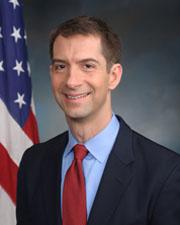
Tom Cotton
RRepublicanAR · Senator
51
/ 100
Average
Attendance98
Avg: 97
Independence22
Avg: 23
Bipartisan Tone7
Avg: 14
Ethics Record100
Avg: 100
Transparency5
Avg: 47
Accountability Score — composite of attendance, independence, bipartisan tone, ethics record & transparency.
Methodology75
Bills Sponsored
1
Enacted into Law
0
Passed a Chamber
70
In Committee
All Sponsored Bills
S5458In Committee
Supply Relief and Domestic Production Cost Reduction Act
S5454In Committee
Small Business Audit Correction Act of 2026
S5422In Committee
Arkansas Delta National Heritage Area Act
S4615Introduced
Intelligence Authorization Act for Fiscal Year 2027
The federal government would receive funding authorization for intelligence agencies and activities during 2027, including money for the CIA, various intelligence operations, and the retirement and disability benefits system for CIA employees. This bill determines how much money intelligence agencies can spend on their operations and personnel costs for that fiscal year. The measure affects intelligence workers, CIA retirees, and the overall national security operations that gather and analyze information to protect the country.
S5083In Committee
Fiscal Sponsorship Transparency Act of 2026
Charitable organizations that provide fiscal sponsorship arrangements—where they manage money and projects on behalf of other groups—would be required to report details about these arrangements to the IRS. This would increase transparency and help tax authorities track how charitable funds are being used through intermediary organizations. The requirement primarily affects nonprofits and charitable groups that use fiscal sponsorship as part of their operations.
S4984In Committee
Restoration of Employment Choice for Adults with Disabilities Act
The proposal would change federal rules to give young adults with disabilities more freedom in choosing their own jobs and career paths, rather than being limited to certain government-approved work programs. It aims to expand opportunities for people with disabilities to work in regular community jobs alongside non-disabled coworkers, with the support and accommodations they need to succeed.
S4939In Committee
Countering CCP Act
The federal government would be required to examine medical devices made in China to identify potential cybersecurity weaknesses that could allow hackers to access or interfere with them. This review would help protect patients who rely on these devices by catching security problems before they cause harm. The measure affects medical device manufacturers, healthcare providers, and patients who use imported medical equipment.
S4795In Committee
FREEDOM Act
The bill would set strict deadlines for federal agencies to approve or deny energy projects that have already received permits, and would make it harder for the government to stop projects that are fully permitted. It would also allow companies and project developers to go to court faster if they believe federal agencies are unfairly delaying their decisions or blocking their work.
S4764In Committee
A bill to amend the FISA Amendments Act of 2008 to extend the authorities of title VII of the Foreign Intelligence Surveillance Act of 1978, and for other purposes.
The government would continue using a surveillance tool that allows intelligence agencies to collect communications from foreign targets without individual court warrants, as long as the target is reasonably believed to be outside the United States. This authority, which is set to expire, would be extended to keep the program operating. The change affects how the FBI, NSA, and other intelligence agencies can monitor suspected foreign threats and their communications.
S4760In Committee
A bill to amend the FISA Amendments Act of 2008 to extend the authorities of title VII of the Foreign Intelligence Surveillance Act of 1978, and for other purposes.
The government would continue its ability to collect communications from foreign targets living outside the United States without getting individual court warrants, a surveillance power that was set to expire. This affects how the FBI, CIA, and NSA can monitor suspected foreign threats and terrorists, though civil liberties groups worry it could sweep up communications from Americans who talk to people overseas. The bill extends these surveillance authorities that have been in place since 2008 and are considered essential tools for national security by intelligence agencies.
S4729In Committee
Biosecurity Smuggling Deterrence Act of 2026
The proposal would require judges to impose minimum prison sentences for people convicted of plotting to illegally bring dangerous biological materials into the United States or lying to federal agents about such smuggling activities. This would affect anyone involved in bioterrorism conspiracies or cover-ups, removing judges' ability to sentence below the mandatory minimums even in unusual circumstances. The bill is currently under review by the Senate Judiciary Committee.
S4526In Committee
No Safe Haven for Terrorist Families Act
The proposal would make it harder for close family members of people designated as foreign terrorists to enter or stay in the United States by creating a new legal reason to deny them entry or immigration benefits. This would affect immigrants and visa applicants who have relatives involved in terrorist organizations, even if those family members themselves have not committed any crimes. The measure is currently being reviewed by the Senate Judiciary Committee.
S4344Introduced
A bill to extend section 702 of the Foreign Intelligence Surveillance Act of 1978 for 3 years.
The government would be allowed to continue a surveillance program that lets intelligence agencies collect communications of foreign targets without a warrant for another three years. This program, known as Section 702, is used by the FBI, NSA, and CIA to monitor phone calls, emails, and other communications of people outside the United States, though it sometimes incidentally captures communications involving Americans. The bill would extend this authority, which was set to expire, giving the government continued power to conduct this type of foreign intelligence gathering.
S4461In Committee
Visual Protection of Strategic Assets Act
The legislation would strengthen federal laws that prevent people from spying for foreign countries or sharing classified national security information with enemies of the United States. The changes would update these espionage laws to better protect sensitive government secrets and make it clearer what actions are illegal. This would affect government employees, military personnel, contractors with access to classified information, and anyone else who might handle sensitive national security materials.
S4465Enacted
A bill to amend the FISA Amendments Act of 2008 to extend the authorities of title VII of the Foreign Intelligence Surveillance Act of 1978, and for other purposes.
This act extends the authorities of Title VII of the Foreign Intelligence Surveillance Act (FISA) until June 12, 2026. Title VII of FISA generally addresses electronic surveillance and other methods of acquiring foreign intelligence information that are directed at targets outside the United States. Title VII includes surveillance under Section 702, which concerns acquiring communications of non-U.S. persons believed to be outside the United States to obtain foreign intelligence information. Information about U.S. persons may incidentally be acquired by this type of surveillance and subsequently queried (searched) under certain circumstances. For additional information see CRS In Focus, IF11451 Foreign Intelligence Surveillance Act (FISA) ; and CRS Report, R48592 FISA Section 702 and the 2024 Reforming Intelligence and Securing America Act .
S4380In Committee
Critical Infrastructure Airspace Defense Act
Private companies that operate critical infrastructure like power plants, water treatment facilities, and communication networks would be allowed to use technology that detects and disables drones flying over their property. Currently, only the federal government and military have legal permission to use such counter-drone systems, so this bill would expand that authority to help protect important facilities from unauthorized drone activity. The measure is intended to give infrastructure owners better tools to defend against potential security threats.
S4327In Committee
Securing America’s Drug Supply from Communist China Act
The bill would require federal regulators to review and potentially restrict pharmaceutical products and ingredients coming from Chinese companies or manufacturers before they can be sold in the United States. This would give the government more oversight of drug supply chains and could affect both the medications available to patients and the companies that produce or import them. The goal appears to be ensuring the safety and security of America's drug supply by scrutinizing foreign pharmaceutical sources.
S4300In Committee
JOAN Act
This bill would improve how different federal agencies work together when reviewing applications for natural gas pipelines and related projects under the Natural Gas Act. By coordinating better between agencies, the goal is to streamline the approval process while ensuring environmental and safety standards are still met. The bill affects natural gas companies seeking permits, environmental groups monitoring projects, and communities where pipelines might be built.
S4303In Committee
ENDS Chinese Vapes Act of 2026
This bill would increase financial penalties for people and companies that illegally import or carelessly bring vaping devices and e-cigarettes into the United States, with harsher fines for repeat offenders. The penalties would get progressively steeper each time someone violates the rule, encouraging importers to follow the law or face increasingly expensive consequences. The measure targets both intentional smuggling and negligent violations by customs violators and importers.
S3034In Committee
Reliable Power Act
The bill aims to strengthen the reliability and stability of the nation's electrical grid by establishing standards and requirements for power generation and distribution systems. It likely addresses how utilities maintain consistent electricity supply during peak demand periods and extreme weather events, affecting both energy companies and the households and businesses that depend on steady power. The proposal has advanced to the committee hearing stage where lawmakers are gathering information before deciding whether to move forward.
S4106In Committee
Rx ACCESS Act
The Rx ACCESS Act would allow military service members and their families to access prescription medications more easily, likely by expanding pharmacy options or reducing costs for drugs covered under military health insurance. The bill aims to improve healthcare access for active duty personnel, retirees, and dependents who rely on military medical benefits. This could mean faster refills, more participating pharmacies, or lower out-of-pocket costs for prescriptions.
S4235In Committee
American Security Robotics Act of 2026
Based on the title and referral to the Homeland Security committee, this bill likely aims to establish rules or standards for how robots and robotic systems can be used in security and law enforcement operations across the United States. The legislation probably addresses concerns about the deployment, safety, and oversight of security robots by federal, state, and local agencies, potentially affecting both government operations and companies that manufacture or sell these technologies. Without more detailed information about the bill's specific provisions, the exact scope of regulations or requirements remains unclear.
S4206In Committee
Know Your American Customer Act
This bill would require banks and financial institutions to verify the immigration status of their customers, likely as part of their existing identity-checking procedures. The measure would affect both individuals opening accounts and the financial institutions that serve them, potentially making it harder for undocumented immigrants to access banking services.
S4165In Committee
Educational Visa Transparency Act of 2026
This bill would require the government to publicly report detailed information about student visas, including how many are issued, where students come from, what they study, and where they work after graduation. The transparency would help lawmakers, schools, and the public understand the impact of international student programs on American education and the job market. Students, universities, and immigration officials would all be affected by these new reporting requirements.
S4158In Committee
A bill to temporarily suspend the clean electricity production credit to support the Strategic Petroleum Reserve.
This bill would pause a tax credit that encourages companies to produce clean electricity from sources like wind and solar, temporarily redirecting the money that would have gone to those credits toward filling the Strategic Petroleum Reserve (the government's emergency stockpile of oil). The suspension would affect renewable energy companies and investors who currently benefit from the tax incentive, while freeing up federal funds for oil purchases.
S4105In Committee
Naturalization Accountability Act
The bill would likely establish new requirements or oversight procedures for the naturalization process—the system by which immigrants become U.S. citizens. Based on the title's emphasis on "accountability," it probably aims to add checks, audits, or stricter verification steps to ensure the naturalization system is working properly and prevent fraud or errors. This would affect immigrants applying for citizenship and the government agencies that process their applications.
S4077In Committee
Trucking Security and CCP Disclosure Act of 2026
This bill would require trucking companies to disclose any connections to Chinese Communist Party entities and establish security measures to prevent foreign interference in the trucking industry. It aims to protect national security by ensuring transparency about foreign ownership or control of companies that transport goods across the United States, which could affect military supply chains and critical infrastructure.
S1552Reported
Living Donor Protection Act of 2025
Living Donor Protection Act of 2025 This bill prohibits life insurance, disability insurance, and long-term insurance carriers from denying or otherwise restricting coverage for living organ donors. Specifically, carriers may not deny, cancel, vary premiums, or otherwise impose conditions on policies based on an individual's status as a living organ donor. The bill also expressly specifies that recovery from organ-donation surgery constitutes a serious health condition that entitles eligible employees to job-protected medical leave. In addition, the Department of Health and Human Services must update educational materials on living organ donation to include information about the benefits and risks of living organ donation and the impact of donation on insurance access, particularly with respect to the bill's changes.
S3839In Committee
Ratepayer Affordability and Transparency in Energy Act of 2026
This bill would require electric utilities to be more transparent about how they set rates and would establish protections to keep energy bills affordable for households and small businesses. It likely aims to give consumers better information about what they're paying for and prevent utilities from raising rates too quickly or unfairly. The bill has been sent to the Senate's energy committee for review.
S3773In Committee
Enforce Immigration or Lose Transportation Act
This bill would tie federal transportation funding to states' enforcement of immigration laws, potentially reducing highway and transit money for states that don't comply with federal immigration policies. The measure would affect state and local governments that receive federal transportation dollars, as well as commuters and businesses that depend on roads and public transit systems. States would face financial penalties if they don't cooperate with federal immigration enforcement efforts.
S3741In Committee
Biosecurity Modernization and Innovation Act of 2026
This bill would update and strengthen the nation's defenses against biological threats by modernizing how the government detects, responds to, and prevents disease outbreaks and bioterrorism. It likely includes funding and new tools for laboratories, disease surveillance systems, and coordination between federal agencies and private companies that work on infectious disease research. The changes would affect public health officials, research institutions, and companies involved in biotechnology and medical diagnostics.
S3708In Committee
MERICA Act of 2026
The MERICA Act addresses energy policy, though the specific details are not yet publicly available since the bill has just been referred to committee. Based on the title and energy focus, it likely proposes changes to how the United States produces, distributes, or regulates energy sources, potentially affecting energy companies, consumers' utility bills, or environmental standards. The bill will be reviewed by the Senate Energy and Natural Resources Committee before any votes take place.
S3652In Committee
Welfare Fraud Deterrence and Recovery Act of 2026
S3645In Committee
Deportation Acceleration Act
S3585In Committee
DATA Act of 2026
The DATA Act of 2026 would establish new requirements for collecting, standardizing, and sharing data about energy production, consumption, and infrastructure across the United States. This would help the government, energy companies, and researchers better understand how energy flows through the country and identify ways to improve efficiency and reliability. The bill affects energy utilities, power generators, and federal agencies responsible for monitoring the nation's energy systems.
S3558In Committee
National Guard Protective Zone Act
This bill would likely establish special legal protections or designated zones where the National Guard operates, possibly to shield Guard members or facilities from certain crimes or legal challenges. The measure focuses on crime and law enforcement issues, suggesting it aims to address security concerns related to National Guard operations, though the specific protections and zones would depend on the bill's detailed language. It currently awaits review by the Senate Judiciary Committee.
S3488In Committee
Asylum Reform and Loophole Closure Act
S3452In Committee
Biological Intellectual Property Protection Act of 2025
The legislation would establish protections for biological materials and genetic information developed by U.S. companies and researchers, preventing other countries from using or profiting from American biological innovations without permission or compensation. It aims to strengthen international agreements and enforcement mechanisms to stop the unauthorized use of U.S. biological intellectual property abroad, affecting pharmaceutical companies, biotech firms, universities, and research institutions that develop new medicines, crops, and biological products. The bill addresses concerns that valuable biological discoveries are being stolen or copied by foreign competitors, costing American businesses money and competitive advantage.
S3423In Committee
Lowering Egg Prices Act of 2025
Lowering Egg Prices Act of 2025 This bill permits unrefrigerated surplus eggs originally intended for hatching to be repurposed for use in pasteurized liquid egg products intended for consumption. Under current regulations, most eggs intended for consumption must be refrigerated within 36 hours of being laid. The bill would exempt from this requirement surplus broiler hatching eggs (eggs originally intended to be hatched and raised for meat) that are repurposed for sale to an egg breaker (a facility that sells liquid egg to food manufacturers). (Broiler hatching eggs are generally held at a warmer temperature than other eggs in order to facilitate incubation. Because these eggs are not refrigerated, current regulations prohibit the sale of any surplus broiler hatching eggs to egg breakers for use in liquid egg products. Liquid egg products distributed for consumption are separately required under current law to be pasteurized, or treated to destroy bacteria.) The bill also requires the Food and Drug Administration to revise the refrigeration requirement to permit surplus broiler hatching eggs held at temperatures suitable for hatching chicks to be sold to egg breakers for processing as liquid egg products.
S3318In Committee
American Citizens First Act
The proposal would prioritize hiring American citizens and permanent residents for jobs by requiring employers to recruit domestically before hiring foreign workers on temporary visas, and would increase fees and reduce the number of available temporary work visas. The changes would affect businesses that rely on foreign workers, job seekers competing for positions, and immigrants seeking to work in the United States.
S3305In Committee
CLEAR Act of 2025
S3134In Committee
Combating Counterfeit Pharmaceuticals Act of 2025
This bill aims to crack down on fake and substandard medications that enter the U.S. market from other countries, protecting patients from dangerous drugs that don't contain the promised ingredients or dosages. It likely involves working with international partners to strengthen supply chain security, improve tracking of medications, and increase penalties for those involved in distributing counterfeit drugs. The legislation would affect pharmaceutical companies, importers, healthcare providers, and ultimately patients who rely on safe, authentic medications.
S3013In Committee
Secure Commercial Driver Licensing Act of 2025
S3003In Committee
Fair Sentencing Act
S2993In Committee
Protect Our Prosecutors and Judges Act of 2025
This bill would likely increase protections and security measures for prosecutors and judges who face threats or violence because of their work. It probably includes provisions for things like security funding, threat assessment programs, or legal protections for these officials and their families. The measure aims to help law enforcement and judicial officials do their jobs safely without fear of retaliation.
S2985In Committee
Preventing Violence Against Female Inmates Act of 2025
Preventing Violence Against Female Inmates Act of 2025 This bill establishes a framework to prohibit correctional institutions at the federal and state levels from housing inmates of one biological sex with inmates of the other biological sex. Specifically, the federal Bureau of Prisons may not co-locate inmates in detention facilities if they are not of the same biological sex, other than on a temporary basis that does not include overnight housing. States must certify that they have implemented the same requirements for their detention facilities in order to receive funds under the Edward Byrne Memorial Justice Assistance Grant program.
S2941In Committee
Visa Cap Enforcement Act
The legislation would strengthen enforcement of existing limits on the number of visas the U.S. government can issue each year, particularly for employment-based visas. This would affect employers seeking to hire foreign workers and immigrants trying to come to the United States for jobs, potentially making it harder for companies to fill positions with international talent and for foreign nationals to obtain work visas.
S2940In Committee
OPT Fair Tax Act
The legislation would change how international students on Optional Practical Training (OPT) visas are taxed, potentially reducing their tax burden or clarifying their tax obligations. This would affect foreign students who work in the United States after completing their studies, as well as the companies that employ them. The bill is currently under review by the Senate Finance Committee.
S2768In Committee
No Bail Post-Jail Act
This bill would likely change bail rules for people who are released from jail, possibly by restricting when bail can be set or requiring certain conditions for those with prior convictions. The legislation would affect defendants in criminal cases and potentially impact how courts handle pretrial release decisions. The specific details of how bail would be reformed are not yet clear from the title alone, but the bill appears aimed at addressing concerns about repeat offenders being released before trial.
S2567In Committee
CAP Act of 2025
I don't have access to the specific details of what the CAP Act of 2025 would do, as the bill's full text and provisions aren't provided. To write an accurate summary explaining what this bill would actually accomplish, I would need information about its specific provisions, which workers or groups it affects, and what changes it would make to immigration policy. Could you provide the bill's text or key provisions so I can create an accurate summary?
S2342Introduced
Intelligence Authorization Act for Fiscal Year 2026
This bill authorizes funding and sets policies for U.S. intelligence agencies like the CIA, NSA, and FBI for the 2026 fiscal year, determining how much money they can spend and what activities they can conduct. It affects intelligence workers, national security operations, and oversight of classified programs, while also establishing rules that intelligence agencies must follow. The bill has generated some disagreement, as indicated by minority views being filed alongside the committee's report.
S2433In Committee
Neonatal Care Transparency Act of 2025
The legislation would require hospitals and neonatal intensive care units to publicly report detailed information about their services, costs, and patient outcomes for newborns receiving specialized care. Parents and families would gain access to transparent data about infection rates, survival rates, and pricing at different facilities to help them make informed decisions about where to seek care for critically ill infants. The requirement aims to improve accountability among healthcare providers and help families compare quality and affordability across neonatal care centers.
S2274In Committee
Constitutional Citizenship Clarification Act of 2025
S2226In Committee
Necessary Environmental Exemptions for Defense Act
SRES313In Committee
A resolution honoring the Yell County Wildlife Federation.
S2000In Committee
Mitigating Extreme Lawlessness and Threats Act
S2001In Committee
No Visas for Violent Criminals Act
S1972In Committee
Bioweapon Prevention Act of 2025
Bioweapon Prevention Act of 2025 This bill prohibits federal funding for any research center or laboratory in which a national of a country of concern conducts agricultural research. Under the bill, a country of concern includes Cuba, Iran, Russia, China, Venezuela, and North Korea.
S1934In Committee
Securing Energy Supply Chains Act
This bill would strengthen protections for America's energy infrastructure by establishing new rules to prevent foreign companies and hostile nations from controlling critical parts of the energy supply chain, particularly in oil, gas, and renewable energy sectors. It likely aims to reduce dependence on foreign suppliers for key energy materials and equipment while ensuring that energy companies can reliably access the materials they need to produce and deliver power to homes and businesses.
S1822In Committee
SAFE FOOD Act of 2025
Study And Framework for Efficiency in Food Oversight and Organizational Design Act of 2025 or the SAFE FOOD Act of 2025 This bill directs the Department of Agriculture (USDA) to conduct a study and submit a report to Congress on the consolidation of federal food safety agencies into a single agency. Federal agencies that currently have a role in food safety include the Food Safety and Inspection Service, which is part of the USDA, and the Food and Drug Administration and the Centers for Disease Control and Prevention, which are part of the Department of Health and Human Services.
S1793In Committee
COUNTER Act
S1770In Committee
Racehorse Health and Safety Act of 2025
S1745In Committee
Dismantling Ideological Policies for Semiconductors and Science Act
Dismantling Ideological Policies for Semiconductors and Science Act This bill repeals requirements and eliminates positions related to diversity, equity, and inclusion (DEI) in various federal programs and offices focused on science. Each of the repealed provisions was originally included in the CHIPS and Science Act. Among other modifications, the bill repeals a provision authorizing the National Institute for Standards and Technology to conduct outreach to and develop research collaborations with historically Black colleges and universities, tribal colleges and universities, and other minority-serving institutions; eliminates the position of Chief Diversity Officer within the National Science Foundation (NSF); repeals an NSF grant program to enable institutions of higher education and nonprofit organizations to increase the participation of women and underrepresented minorities in science, technology, engineering, and math (STEM) studies and careers; and eliminates references to diversity in the purposes and responsibilities of the Office of STEM Engagement within the National Aeronautics and Space Administration. The bill also prohibits executive branch agencies from requiring entities seeking federal funding to have certain policies in place, unless such a requirement is imposed by a federal statute. Such policies include those related to hiring, training, and retaining a diverse workforce; providing childcare for employees; minimizing adverse impacts on the environment and local communities; and consultation with labor organizations. (On January 20, 2025, President Trump issued an executive order titled Ending Radical and Wasteful Government DEI Programs and Preferencing , which directed the termination of all federal DEI programs, offices, and positions, including Chief Diversity Officer positions.)
S1705In Committee
Chip Security Act
Chip Security Act This bill requires covered integrated circuit products (e.g., advanced computing chips) to incorporate certain security mechanisms. Specifically, the bill directs the Department of Commerce to require any covered integrated circuit product to have chip security mechanisms that implement location verification before the product is exported, reexported, or in-country transferred to or in a foreign country. Commerce must require any person that has received a license or other authorization under the Export Control Reform Act of 2018 to export, reexport, or in-country transfer a covered product to promptly report to Commerce's Bureau of Industry and Security if the person obtains credible information that the product has been diverted away from its intended location or has been subjected to tampering. Commerce must, in coordination with the Department of Defense (DOD), conduct an assessment and report to Congress on whether additional chip security mechanisms should be adopted. If Commerce determines additional security measures are necessary, then Commerce must require any covered product to include the secondary chip security mechanisms before the product is exported, reexported, or in-country transferred to or in a foreign country. The bill authorizes Commerce to take certain enforcement actions, such as verifying the ownership and location of a covered product that has been exported, reexported, or in-country transferred to or in a foreign country. Commerce must coordinate with DOD, within two years of the bill's enactment and annually thereafter for three years, to assess new chip security mechanisms and report to Congress.
S1407In Committee
ABC Safe Drug Act
The bill aims to improve drug safety by establishing or strengthening standards for how medications are manufactured, tested, and distributed to consumers. It likely affects pharmaceutical companies, healthcare providers, and patients by requiring additional safety measures or oversight to prevent contaminated or counterfeit drugs from reaching the market. The proposal is currently under review by the Senate Finance Committee.
S1255In Committee
Cormorant Relief Act of 2025
S1224In Committee
RIFLE Act
The RIFLE Act addresses tax policy, though the specific details of what changes it would make are not clear from the title alone. Based on its referral to the Senate Finance Committee, the bill likely proposes modifications to federal tax law that could affect individuals, businesses, or both. Once the committee reviews it, the specific impacts on taxpayers and the economy will become clearer.
S1137In Committee
Cellphone Jamming Reform Act of 2025
S929In Committee
GATE Act of 2025
Based on the title and referral to the Energy and Natural Resources Committee, this bill likely addresses national security concerns related to energy infrastructure, possibly involving protections for critical power systems, nuclear facilities, or other energy assets that could be vulnerable to threats. The measure probably aims to strengthen oversight, security standards, or coordination between military and energy sector officials to safeguard infrastructure essential to national defense. Without seeing the full text, the specific protections or requirements would depend on the bill's detailed provisions.
S937In Committee
No Student Loans for Campus Criminals Act
No Student Loans for Campus Criminals Act This bill prohibits an individual who is convicted of any federal or state offense related to the individual's conduct at or during the course of a protest at an institution of higher education from receiving certain federal student loan benefits. Specifically, an individual who is convicted of such an offense shall not be eligible to have any covered loan forgiven, cancelled, waived, or modified under the Higher Education Act of 1965, under any executive order, or through any action taken by the Department of Education. Covered loans refer to Federal Family Education Loans, Federal Direct Loans, Federal Perkins Loans, and loans under the Health Education Assistance Loan Program. Additionally, an individual who is convicted of such an offense shall not be eligible to receive Federal Direct Loans.
S754In Committee
Farm and Food Cybersecurity Act of 2025
Farm and Food Cybersecurity Act of 2025 This bill directs the Department of Agriculture (USDA) to (1) assess cybersecurity threats in the agriculture and food critical infrastructure sector, and (2) conduct annual crisis simulation exercises for food-related emergencies or disruptions. The agriculture and food critical infrastructure sector includes (1) any activity relating to the production, processing, distribution, storage, transportation, consumption, or disposal of agricultural or food products; and (2) any entity involved in any of these activities. Specifically, USDA, in coordination with the Department of Homeland Security (DHS) Cybersecurity and Infrastructure Security Agency, must conduct a risk assessment every two years on the cybersecurity threats to, and security vulnerabilities in, this sector. The risk assessment must include any recommendations for federal legislative or administrative actions to address related threats and vulnerabilities. USDA must also conduct an annual simulation exercise relating to a food-related emergency or disruption in coordination with DHS, the Department of Health and Human Services (HHS), and the Office of the Director of National Intelligence (ODNI). Among other things, the exercise must (1) involve a realistic and plausible scenario that simulates a food-related emergency or disruption that affects multiple sectors and jurisdictions, and (2) incorporate input from experts and stakeholders from various disciplines and sectors (e.g., agriculture, public health, emergency management, transportation, and energy). USDA, in consultation with DHS, HHS, and ODNI, must submit a report to Congress on each simulation exercise, including recommendations to enhance the cybersecurity and resilience of the agriculture and food critical infrastructure sector.
S663In Committee
DEFENSE Act
Disabling Enemy Flight Entry and Neutralizing Suspect Equipment Act or the DEFENSE Act This bill allows the Department of Homeland Security (DHS) or the Department of Justice (DOJ) to deputize state or local law enforcement officers to take certain drone countermeasures to protect stadiums and other public gatherings. Specifically, DHS or DOJ may provide state or local law enforcement officers with the authority to identify, monitor, and track drones; warn drone operators; disrupt or take control of drones; or use reasonable force to disable, damage, and seize or destroy drones deemed to pose a threat. This authority applies for the purposes of protecting an event, stadium, or venue; certain large public gatherings (e.g., gatherings that are primarily outdoors with an estimated attendance of at least 100,000 people); or other public gatherings protected by specific temporary flight restrictions imposed by the Federal Aviation Administration (FAA). Prior to being deputized, a state or local law enforcement officer must complete training in the use of the drone countermeasure authority. DHS or DOJ, in coordination with the Department of Transportation and the FAA, must exercise oversight over the use of this authority by deputized state or local law enforcement officers. Finally, the bill limits the equipment authorized for detecting, identifying, monitoring, or tracking drones to systems or technologies that are included on a list of authorized equipment maintained by DHS, in coordination with DOJ, the FAA, the Federal Communications Commission, and the National Telecommunications and Information Administration.
S209In Committee
Protecting Minors from Medical Malpractice Act of 2025
Protecting Minors from Medical Malpractice Act of 2025 This bill makes a medical practitioner who performs a gender-transition procedure on an individual who is less than 18 years of age liable for any physical, psychological, emotional, or physiological harms from the procedure for 30 years after the individual turns 18. Additionally, if a state requires medical practitioners to perform gender-transition procedures, that state shall be ineligible for federal funding from the Department of Health and Human Services. Under the bill, g ender-transition procedures generally include certain surgeries or hormone therapies that change the body of an individual to correspond to a sex that is discordant with the individual's biological sex. They exclude, however, interventions to treat (1) individuals who either have ambiguous external biological sex characteristics or lack a normal sex chromosome structure, sex steroid hormone production, or sex steroid hormone action; (2) infections, injuries, diseases, or disorders caused by a gender-transition procedure; or (3) a physical disorder, injury, or illness that places an individual in imminent danger of death or impairment of a major bodily function.
SRES25In Committee
A resolution condemning the commutation of the death sentence of Marvin Charles Gabrion II granted by President Biden on December 23, 2024.
This resolution condemns the commutation of the death sentence of Marvin Charles Gabrion II by President Biden.
SRES24In Committee
A resolution condemning the commutation of the death sentence of Anthony George Battle granted by President Biden on December 23, 2024.
This resolution condemns the commutation of the death sentence of Anthony George Battle by President Biden.