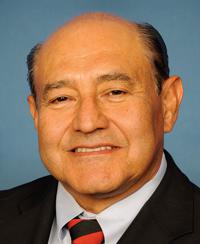
J. Luis Correa
DDemocratCA-46 · Representative
62
/ 100
Average
Attendance95
Avg: 96
Independence5
Avg: 4
Bipartisan Tone9
Avg: 15
Ethics Record100
Avg: 99
Transparency100
Avg: 53
Accountability Score — composite of attendance, independence, bipartisan tone, ethics record & transparency.
Methodology20
Bills Sponsored
0
Enacted into Law
1
Passed a Chamber
18
In Committee
All Sponsored Bills
HR10815In Committee
Bright Beginnings Act
HR10798In Committee
Silicosis Prevention and Treatment Act
HRES1621In Committee
Expressing profound sorrow over the death of Alexander Michel Odeh.
HR10724In Committee
To amend title 11, United States Code, to clarify the rules for the exceptions to the discharge of the debt of an individual debtor, and for other purposes.
HR10655In Committee
VA Medicinal Cannabis Research Act of 2026
HRES1533In Committee
Honoring the life and legacy of John Seymour, the late Senator for the State of California.
HRES1488In Committee
Recognizing the significance of "Chicano/Chicana Heritage Month" in August as an important time to celebrate the significant contributions of Mexican Americans to the history of the United States.
HR10048In Committee
Truth in Labeling Act of 2026
HR9845In Committee
Public Safety Officers’ Benefits Enhancement Act of 2026
The bill would make it easier for families of police officers, firefighters, and other public safety workers to receive death benefits when their loved one dies from a heart attack or stroke while on the job. Currently, families have to go through a complicated process to prove the death was work-related, so this change would streamline that paperwork and make it faster for grieving families to get the financial support they're entitled to. The change affects the Public Safety Officer Benefit program, which provides payments to help support the families of public safety workers who die in the line of duty.
HRES1372In Committee
Remembering kindness in the United States and affirming our commitment to fostering community and building resiliency through every day acts of kindness.
This resolution expresses Congress's support for promoting kindness and community resilience through everyday actions, encouraging Americans to build stronger neighborhoods and support systems. The measure affirms the importance of small acts of kindness in strengthening social bonds and helping communities recover from challenges. While largely symbolic, it signals congressional backing for initiatives and values centered on compassion and mutual aid among citizens.
HR8605In Committee
Honor Our Commitment Act of 2026
The legislation would prevent the federal government from deporting certain Vietnamese nationals who are currently living in the United States. This would primarily affect Vietnamese immigrants and refugees who face removal proceedings, allowing them to remain in the country rather than being sent back to Vietnam.
HR7821In Committee
Promoting Reduction of Emissions through Landscaping Equipment Act
This bill would likely offer tax credits or deductions to encourage people and businesses to switch from gas-powered lawn mowers and landscaping equipment to electric or zero-emission alternatives. The tax incentives would make it cheaper for homeowners, landscaping companies, and municipalities to buy cleaner equipment, helping reduce air pollution and greenhouse gas emissions from yard maintenance. The measure is currently under review by the House committee that handles tax policy.
HRES800In Committee
Expressing profound sorrow over the death of Alexander Michel Odeh.
HR4057Reported
CBP Canine Home Kenneling Pilot Act
CBP Canine Home Kenneling Pilot Act This bill requires the Office of Field Operations within U.S. Customs and Border Protection to establish a canine home kenneling pilot program. In home kenneling programs, canines used for law enforcement purposes are housed and cared for at the residences of their assigned handlers.
HR5226In Committee
Deceptive Downsizing Prohibition Act of 2025
The legislation would prohibit companies from reducing product sizes or quantities while keeping prices the same or raising them, a practice known as "shrinkflation." Consumers would be protected from deceptive packaging that makes it appear they're getting the same amount of product when they're actually getting less. Companies that violate these rules could face penalties, affecting how manufacturers price and package goods on store shelves.
HR4643In Committee
Business Uninterrupted Monetary Program Act of 2025
This bill likely aims to establish or modify a funding program to support transportation and infrastructure projects, possibly by creating a more stable or continuous stream of money for highways, transit systems, and related public works. The program would help ensure that transportation projects can proceed without interruption due to funding gaps or budget uncertainties. Businesses, construction companies, and communities that depend on transportation infrastructure would benefit from more predictable investment in roads, bridges, and transit systems.
HR3624In Committee
Improving Mental Health Access for Students Act
This bill would expand mental health services available to students in schools by increasing funding and resources for school counselors, psychologists, and mental health programs. It aims to help students get faster access to support for issues like anxiety, depression, and stress without having to wait for appointments outside of school. The bill would affect school districts, students, and their families by making mental health care more readily available during the school day.
HR2623In Committee
Innovative Therapies Centers of Excellence Act of 2025
This bill would establish specialized medical centers within the military health system to research and provide advanced treatments for service members, likely focusing on cutting-edge therapies for injuries, illnesses, or conditions common among active-duty personnel and veterans. The centers would serve as hubs for developing and testing new medical approaches while also treating patients, combining research with direct patient care. This affects active-duty military members, veterans, and military families who use the Defense Department's health services.
HR993Passed House
Emerging Innovative Border Technologies Act
Emerging Innovative Border Technologies Act This bill requires U.S. Customs and Border Protection (CBP) and the Science and Technology Directorate of the Department of Homeland Security to develop a plan to identify, integrate, and deploy emerging and innovative technologies to improve border security operations. Such technologies may incorporate artificial intelligence, machine-learning, automation, fiber-optic sensing technology, nanotechnology, optical and cognitive radar, modeling and simulation technology, hyperspectral and LIDAR sensors, and imaging, identification, and categorization systems. The bill authorizes CBP to establish one or more Innovation Teams to research and adapt commercial technologies that may be used by CBP. The plan must describe how the Innovation Teams have been implemented and also detail goals and timelines for adoption of qualifying technologies, metrics and key performance parameters for determining the plan's effectiveness, which technologies used by other federal agencies CBP may also utilize, which existing authorities CBP may use to procure technologies, how CBP legacy border technology programs may be replaced, the expected privacy and security impact of security-related technology on border communities, and recent technological advancements in specified technologies. CBP must provide the plan to Congress within 180 days of the bill’s enactment. The bill also requires CBP to annually report to Congress regarding the activities of the Innovation Teams.
HR1058In Committee
DRONE Act of 2025