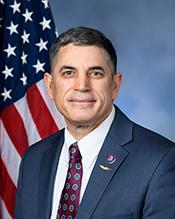
Andrew S. Clyde
RRepublicanGA-9 · Representative
55
/ 100
Average
Attendance95
Avg: 96
Independence11
Avg: 4
Bipartisan Tone11
Avg: 15
Ethics Record100
Avg: 99
Transparency46
Avg: 53
Accountability Score — composite of attendance, independence, bipartisan tone, ethics record & transparency.
Methodology16
Bills Sponsored
1
Enacted into Law
1
Passed a Chamber
14
In Committee
All Sponsored Bills
HR10377In Committee
MAGA Act
HR9453In Committee
End EPA Abuse Act of 2026
The proposal would restrict the federal government's ability to regulate air pollution and vehicle emissions under the Clean Air Act, while also limiting rules that could affect the electric grid's capacity. It would preserve consumer options in vehicle types, potentially slowing the transition toward electric vehicles by preventing stricter emission standards. The changes would affect automakers, power companies, and consumers who buy vehicles.
HRES1351In Committee
Impeaching Eleanor Louise Ross, Judge of the United States District Court for the Northern District of Georgia, for high crimes and misdemeanors.
This resolution seeks to remove Eleanor Louise Ross, a federal judge in Georgia, from her position by charging her with high crimes and misdemeanors. The House Judiciary Committee will review the allegations and determine whether to proceed with an impeachment trial in the Senate, where a two-thirds majority would be needed to remove her from office. If successful, this would result in Judge Ross losing her lifetime appointment to the federal bench.
HR8460In Committee
Territorial Protection and Sovereignty Act
The proposal would eliminate the government's ability to grant temporary protected status, a program that currently allows foreign nationals from countries experiencing armed conflict, natural disasters, or epidemics to live and work in the United States temporarily. This change would affect hundreds of thousands of immigrants currently in the country under this protection, potentially requiring them to leave or face deportation. The measure has been sent to the House Judiciary Committee for review.
HR5107Passed House
Common-Sense Law Enforcement and Accountability Now in DC Act of 2025
Common-Sense Law Enforcement and Accountability Now in DC Act or the CLEAN DC Act This bill repeals the Comprehensive Policing and Justice Reform Amendment Act of 2022, enacted by the Council of the District of Columbia. Any provision of law amended or repealed by that act is restored or revived as if it had not been enacted. (The act sets forth a variety of measures that focus on policing, including measures prohibiting the use of certain neck restraints by law enforcement officers, requiring additional procedures related to body-worn cameras, and expanding access to police disciplinary records.)
HR4788In Committee
To require the District of Columbia to permit Members of Congress who have a valid license or permit which is issued pursuant to the law of a State which permits the Member to carry a concealed firearm, or who is otherwise entitled to carry a concealed firearm in the State in which the Member resides, to carry a concealed firearm in the District of Columbia, and for other purposes.
Members of Congress who have a valid concealed carry permit from their home state would be allowed to carry concealed firearms in Washington, D.C., regardless of D.C.'s own gun laws. The bill would essentially override D.C.'s stricter firearms regulations for this specific group of federal lawmakers. This would affect how Members of Congress can carry weapons while working in the nation's capital.
HJRES42Enacted
Providing for congressional disapproval under chapter 8 of title 5, United States Code, of the rule submitted by the Department of Energy relating to "Energy Conservation Program for Appliance Standards: Certification Requirements, Labeling Requirements, and Enforcement Provisions for Certain Consumer Products and Commercial Equipment".
This joint resolution eliminates new, more stringent certification, labeling, and enforcement requirements related to energy conservation standards for specific types of appliances. Specifically, the joint resolution nullifies a rule titled the Energy Conservation Program for Appliance Standards: Certification Requirements, Labeling Requirements, and Enforcement Provisions for Certain Consumer Products and Commercial Equipment and published by the Department of Energy (DOE) on October 9, 2024. Under the rule, DOE modified its regulations on the energy efficiency of certain types of consumer products (e.g., washing machines and dishwashers) and industrial equipment (e.g., computer room air conditioners). DOE modified certification requirements, labeling requirements, and enforcement provisions for these products and equipment to (1) align reporting requirements with currently applicable energy conservation standards and test procedures, and (2) provide DOE with the information necessary to determine the appropriate classification of products for the application of standards.
HR3228In Committee
Constitutional Hearing Protection Act
This bill would remove the federal tax and registration requirements for firearm silencers, treating them like regular gun accessories instead of heavily regulated items. Currently, silencers are taxed at $200 and require extensive paperwork and background checks similar to machine guns, but this legislation would eliminate those barriers for gun owners. The bill affects firearm manufacturers, gun owners, and federal tax revenue while raising questions about noise regulation and public safety.
HR2395In Committee
SHORT Act
Without access to the full bill text, the SHORT Act appears to address tax policy, though the specific provisions are unclear from the title alone. Based on its referral to both the Ways and Means Committee and the Judiciary Committee, it likely involves changes to federal tax law that may also have legal implications. The bill is currently under review to determine which committee will handle which parts of the legislation.
HJRES48In Committee
Providing for congressional disapproval under chapter 8 of title 5, United States Code, of the rule submitted by the Board of Governors of the Federal Reserve System relating to "Quality Control Standards for Automated Valuation Models".
This joint resolution nullifies the final rule issued by the Office of the Comptroller of the Currency, the Federal Reserve System, the Federal Deposit Insurance Corporation, the National Credit Union Administration, the Consumer Financial Protection Bureau, and the Federal Housing Finance Agency titled Quality Control Standards for Automated Valuation Models and published on August 7, 2024. The rule requires the implementation of quality control standards for automated valuation models used by mortgage originators and secondary market issuers when determining the value of real estate securing a mortgage.
HJRES49In Committee
Providing for congressional disapproval under chapter 8 of title 5, United States Code, of the rule submitted by the Federal Deposit Insurance Corporation relating to "Quality Control Standards for Automated Valuation Models".
This joint resolution nullifies the final rule issued by the Office of the Comptroller of the Currency, the Federal Reserve System, the Federal Deposit Insurance Corporation, the National Credit Union Administration, the Consumer Financial Protection Bureau, and the Federal Housing Finance Agency titled Quality Control Standards for Automated Valuation Models and published on August 7, 2024. The rule requires the implementation of quality control standards for automated valuation models used by mortgage originators and secondary market issuers when determining the value of real estate securing a mortgage.
HJRES44In Committee
Providing for congressional disapproval under chapter 8 of title 5, United States Code, of the rule submitted by the Environmental Protection Agency relating to "National Primary Drinking Water Regulations for Lead and Copper: Improvements (LCRI)".
This joint resolution nullifies the rule titled National Primary Drinking Water Regulations for Lead and Copper: Improvements (LCRI) , which was submitted by the Environmental Protection Agency on October 30, 2024. The rule modifies the regulations under the Safe Drinking Water Act to further reduce lead in drinking water, including by directing water systems to replace all lead and certain galvanized service lines under their control within 10 years.
HJRES47In Committee
Providing for congressional disapproval under chapter 8 of title 5, United States Code, of the rule submitted by the Office of the Comptroller of the Currency relating to "Quality Control Standards for Automated Valuation Models".
This joint resolution nullifies the final rule issued by the Office of the Comptroller of the Currency, the Federal Reserve System, the Federal Deposit Insurance Corporation, the National Credit Union Administration, the Consumer Financial Protection Bureau, and the Federal Housing Finance Agency titled Quality Control Standards for Automated Valuation Models and published on August 7, 2024. The rule requires the implementation of quality control standards for automated valuation models used by mortgage originators and secondary market issuers when determining the value of real estate securing a mortgage.
HJRES51In Committee
Providing for congressional disapproval under chapter 8 of title 5, United States Code, of the rule submitted by the Bureau of Consumer Financial Protection relating to "Quality Control Standards for Automated Valuation Models".
This joint resolution nullifies the final rule issued by the Office of the Comptroller of the Currency, the Federal Reserve System, the Federal Deposit Insurance Corporation, the National Credit Union Administration, the Consumer Financial Protection Bureau, and the Federal Housing Finance Agency titled Quality Control Standards for Automated Valuation Models and published on August 7, 2024. The rule requires the implementation of quality control standards for automated valuation models used by mortgage originators and secondary market issuers when determining the value of real estate securing a mortgage.
HR1180In Committee
To repeal the Impoundment Control Act of 1974.
This bill repeals the Impoundment Control Act of 1974 (ICA). The ICA generally limits the authority of the President to impound (i.e., withhold from obligation or expenditure) funds that have been appropriated by Congress and establishes related procedures. It also establishes expedited legislative procedures that Congress may use to consider legislation to enact rescissions proposed by the President.
HRES56In Committee
Memorializing the unborn by lowering the United States flag to half-staff on the 22d day of January each year.
This resolution expresses support for recognizing a Day of Tears and lowering flags to half-staff to honor unborn lives lost to abortion.