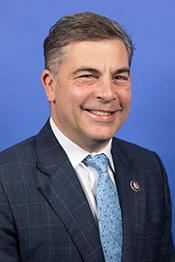
Mike Carey
RRepublicanOH-15 · Representative
56
/ 100
Average
Attendance99
Avg: 96
Independence3
Avg: 4
Bipartisan Tone30
Avg: 15
Ethics Record100
Avg: 99
Transparency28
Avg: 53
Accountability Score — composite of attendance, independence, bipartisan tone, ethics record & transparency.
Methodology29
Bills Sponsored
1
Enacted into Law
3
Passed a Chamber
25
In Committee
All Sponsored Bills
HR10813In Committee
Historic Preservation and Land Conservation Certainty Act
HR10812In Committee
Armenian American Cultural Heritage Act
HR10650In Committee
American Glove Act of 2026
HR9839In Committee
STRONG Kids Act
The federal government would create a grant program that gives money to local organizations to help more young people participate in sports and physical activities, while also addressing any negative effects that come from youth sports participation. Organizations like schools, community centers, and nonprofits could apply for these grants to expand access to sports programs and improve how they're run. The program aims to get more kids active and healthy while making sure youth sports are safe and beneficial for everyone involved.
HR9840In Committee
S Corporation Modernization Act of 2026
The proposal would change tax rules for S corporations, which are small to mid-sized businesses that pass profits directly to their owners' personal tax returns. The specific reforms would affect how these business owners pay taxes and potentially change which types of investors can own shares in these companies. Small business owners and investors in S corporations would see the most direct impact from these changes.
HR9841In Committee
ACCESS Act
The proposal would update tax rules for publicly traded partnerships, which are investment structures that trade on stock exchanges and currently face special tax treatment. The changes would modernize how these partnerships are taxed and regulated to reflect modern business practices. This would primarily affect investors in these partnerships and the companies that use this business structure.
HR9573In Committee
Housing Opportunities and Preservation Enhancement Act of 2026
The proposal would change tax rules to give financial breaks to people and companies that own residential rental properties, making it cheaper for them to invest in or maintain apartment buildings and rental homes. These tax incentives could potentially affect renters by influencing how much landlords invest in their properties, while also impacting government tax revenue. The specific details of which rental properties qualify and what incentives apply would be determined as the bill moves through Congress.
HR9424In Committee
Save Our Pedestrians Act of 2026
States would be required to set aside a portion of their federal highway funding specifically for safety projects at pedestrian crossings where injuries and deaths are highest, such as installing better lighting, wider sidewalks, or traffic signals. This would help protect pedestrians, cyclists, and other vulnerable road users by forcing states to prioritize the most dangerous crossing locations. The change would affect state transportation departments and communities across the country that struggle with pedestrian safety issues.
HR9398In Committee
Historic Preservation and Land Conservation Certainty Act
The legislation would allow certain partnerships that donated conservation easements to resolve tax disputes with the IRS through an election process rather than going through lengthy court battles. This would primarily affect business owners and investors who made conservation easement donations and are facing IRS challenges over the tax deductions they claimed. The measure aims to provide a faster, less costly way to settle these disagreements about whether the donations qualify for the tax benefits the donors claimed.
HR9383In Committee
Small Business and Consumer Credit Act of 2026
The proposal would change tax rules for banks and other financial institutions that experience significant losses, allowing them to carry those losses backward and forward in specific ways to reduce their tax bills. This would primarily affect large financial companies and could influence how much tax they owe in years when they operate at a loss. The measure is currently under review by the House committee responsible for tax policy.
HR9175In Committee
Tax Clarity for Mining and Staking Act
The legislation would clarify how the federal government taxes income from cryptocurrency mining and staking activities, which are processes where people use computers to validate transactions and earn digital coins as rewards. This would affect cryptocurrency miners and stakers by providing clearer rules about when and how they owe taxes on their earnings, potentially reducing confusion about their tax obligations.
HR8872Passed House
Preventing Waste, Fraud, and Abuse in TANF Act
Preventing Waste, Fraud, and Abuse in TANF Act This bill limits how and when states may use Temporary Assistance for Needy Families (TANF) funds and establishes an eligibility threshold for all TANF-funded assistance and services. Currently, each state sets its own eligibility threshold for TANF-funded cash assistance. The bill establishes an upper limit on eligibility applicable to all assistance and services (including non-cash benefits) funded by TANF family assistance grants. Under this provision, only families with income under 200% of the federal poverty guidelines may receive TANF-funded assistance and services. Further, the bill generally requires states to obligate TANF funds by the end of the fiscal year after they are paid and to spend funds by the end of the second fiscal year after they are paid. However, states may reserve a specified portion of their TANF funds for future use. (There is currently no requirement to use TANF funds within a specified period.) The bill also explicitly requires states to use federal TANF funds to supplement, not replace, state and local funding for TANF-supported programs. (Current law requires states to spend a specified minimum amount on TANF-eligible activities and populations, known as the maintenance of effort requirement.) States must also take specified steps to track and report on improper payments of federal funds (e.g., overpayments, underpayments, payments to ineligible recipients). Within one year of enactment, HHS must submit to Congress a plan to reduce or eliminate improper payments made by states under the TANF program within 10 years.
HR9012In Committee
Affordable Housing Credit Carryback Act
The proposal would let developers and investors who build affordable housing claim tax credits for up to five years after they initially qualify, rather than having to use them immediately. This change would give housing developers more flexibility in managing their taxes and potentially make it easier for them to finance affordable housing projects. The measure is currently under review by the House Committee on Ways and Means.
HR8810In Committee
No Wasted Space Act
The government would create a special commission to study how the Arts and Industries Building on the National Mall in Washington, D.C. could be used in the future. The commission would examine different options for what the building could house or become, helping lawmakers decide on its best purpose. This affects visitors to the National Mall, the Smithsonian Institution, and the federal government's management of its historic properties.
HR6431Passed House
New Opportunities for Business Ownership and Self-Sufficiency Act
New Opportunities for Business Ownership and Self-Sufficiency Act This bill increases the percentage of individuals who may participate in a Self-Employment Assistance (SEA) program, generally expands eligibility for such programs, and modifies certain SEA program requirements. As background, an SEA program provides an individual with an SEA allowance, rather than regular unemployment compensation benefits, if such individual is (1) eligible for unemployment compensation benefits and identified as likely to exhaust such benefits, (2) participating in self-employment assistance activities which include entrepreneurial training, business counseling, and technical assistance and are approved by the state, and (3) working full-time on establishing a business and becoming self-employed. Under current law, the number of individuals participating in an SEA program may not exceed 5% of the individuals receiving regular unemployment compensation benefits in the state. The bill increases the percentage of individuals who may participate in a state SEA program to 10%, eliminates the requirement that an individual be determined likely to exhaust unemployment compensation benefits (generally expanding individual eligibility for an SEA program), and requires individuals to certify (at least weekly) that they are working full-time on establishing a business and becoming self-employed. Finally, the bill allows individuals to meet the requirement to participate in state-approved self-employment assistance activities if such activities either (1) include entrepreneurial training, business counseling, and technical assistance (permitted under current law); or (2) are performed pursuant to a state-approved business plan and market feasibility study.
HR8497In Committee
Supporting Energy and Economic Development (SEED) Act
The proposal would extend tax credits and incentives for biodiesel and renewable diesel fuel production, helping make these cleaner fuel alternatives more affordable and competitive with traditional petroleum diesel. This would benefit fuel producers, refineries, and potentially consumers by encouraging the use of fuels made from renewable sources like vegetable oils and animal fats instead of fossil fuels.
HR7527In Committee
Pay Less at the Pump Act of 2026
This bill would likely reduce federal taxes on gasoline and diesel fuel to lower prices at the pump for drivers and businesses that rely on fuel. The exact tax cuts would need to be determined in committee, but the goal is to make filling up a vehicle cheaper for everyday Americans and commercial trucking companies. The proposal is currently being reviewed by the House Ways and Means Committee, which handles tax legislation.
HR6735In Committee
Connecting Caregivers to Medicare Act of 2025
The bill would expand Medicare coverage or benefits for family members and other unpaid caregivers who help elderly or disabled patients manage their health care needs. It likely aims to recognize and support the millions of Americans who provide essential care to loved ones by connecting them with Medicare resources, training, or financial assistance. The proposal has been sent to two congressional committees for review to determine how it would affect Medicare's budget and healthcare delivery.
HR4639In Committee
Infertility Treatment Affordability Act of 2025
The proposal would make infertility treatments more affordable by allowing people to deduct the costs of fertility procedures and related medical expenses from their taxes, similar to other healthcare expenses. This would primarily benefit individuals and couples struggling with infertility who are seeking treatments like in vitro fertilization (IVF) or other fertility services. The tax deduction would reduce the out-of-pocket costs for these expensive medical procedures.
HR4160In Committee
Veterans Border Patrol Training Act
Veterans Border Patrol Training Act This bill requires the Department of Homeland Security (DHS) to collaborate with the Department of Defense (DOD) and Department of Veterans Affairs to establish a five-year interdepartmental pilot program, under which DHS must use the DOD SkillBridge Program to train and hire transitioning servicemembers as border patrol agents for U.S. Customs and Border Protection.
HR1453Passed House
Clean Energy Demonstration Transparency Act of 2025
Clean Energy Demonstration Transparency Act of 2025 This bill directs the Department of Energy (DOE) to submit and publish online semiannual reports on the status of certain clean energy demonstration projects that are managed or supported by DOE's Office of Clean Energy Demonstrations.
HJRES25Enacted
Providing for congressional disapproval under chapter 8 of title 5, United States Code, of the rule submitted by the Internal Revenue Service relating to "Gross Proceeds Reporting by Brokers That Regularly Provide Services Effectuating Digital Asset Sales".
This joint resolution nullifies requirements for persons effectuating decentralized financial (DeFi) transactions to report certain information regarding digital asset sales to the Internal Revenue Service (IRS). Specifically, the joint resolution nullifies the requirements included in the rule titled Gross Proceeds Reporting by Brokers That Regularly Provide Services Effectuating Digital Asset Sales and issued by the IRS on December 30, 2024. Decentralized finance refers to the suite of financial activities and services that are facilitated by cryptocurrency and intended to be conducted without any sort of reliance on traditional financial tools or intermediaries.
HR2672In Committee
Religious Workforce Protection Act
Religious Workforce Protection Act This bill allows the Department of Homeland Security (DHS) to extend the nonimmigrant visa status of certain religious workers. Under current law, if specified conditions are met, nonimmigrant religious workers may receive a visa for a period not to exceed five years. The bill allows DHS to grant an extension until the individual’s application for adjustment of status to permanent resident or an immigrant visa has been processed and a decision has been made. To be eligible for the extension, the individual must be (1) the beneficiary of a certain type of immigrant petition, and (2) eligible for such immigrant status absent the application of certain numerical limitations. Such individuals who have pending adjustment of status applications are also granted certain job flexibilities, such as the ability to change employers. Individuals who have previously departed the U.S. due to the expiration of their visa are exempt from the one-year foreign residence requirement to renew their visa.
HR2538In Committee
CARE Act of 2025
Comprehensive Alternative Response for Emergencies Act of 2025 or the CARE Act of 2025 This bill requires the Center for Medicare and Medicaid Innovation (CMMI) to test a five-year model that provides for Medicare payment for ground ambulance services that do not result in the transport of the patient. Under the model, Medicare payment may be furnished for ground ambulance services when an ambulance is dispatched in response to an emergency medical call but the ambulance does not end up transporting the patient. Payment rates under the model must generally align with the payment rates that apply when there is an actual transport. The Government Accountability Office must report on the general access of Medicare beneficiaries to emergency medical services, including the impact of the model on beneficiary access and outcomes.
HR2410In Committee
Revitalizing Downtowns and Main Streets Act
This bill would likely create tax incentives or breaks for businesses and property owners who invest in revitalizing struggling downtown areas and main streets across the country. The goal is to encourage development, attract new businesses, and bring people back to these community centers by making it financially attractive for investors and developers to participate. Small business owners, property developers, and local communities hoping to boost their economies would be the main beneficiaries.
HR2359In Committee
Improve Transparency and Stability for Families and Children Act
The proposal would require states to provide clearer information to families about how their eligibility for welfare and child support benefits is determined, and would establish more consistent rules across states to reduce sudden changes in benefits. This would help families better understand what assistance they qualify for and make it easier to plan their finances without worrying about unexpected benefit cuts.
HR2104In Committee
National STEM Week Act
National STEM Week Act This bill requires the National Science and Technology Council's Committee on STEM to designate a week each calendar year as National STEM Week. (STEM refers to science, technology, engineering, and mathematics.) During this established week, the committee must encourage educational institutions (i.e., elementary schools, secondary schools, and institutions of higher education) to participate in the week and also encourage families of students attending these educational institutions to participate in STEM activities. Additionally, the committee must encourage STEM industries to (1) engage with students enrolled in educational institutions by providing mentorship programs, site visits, and guest lectures; and (2) support STEM education initiatives at these educational institutions through funding, resources, and expertise. The committee must annually report to Congress on the activities conducted during the established week.
HR2036In Committee
Credit for Caring Act of 2025
The bill would allow people to claim a tax credit for expenses related to caring for family members, such as costs for adult day care, in-home care services, or other caregiving support. This tax break would help workers—particularly those juggling jobs and family caregiving responsibilities—reduce their tax burden by offsetting some of the significant costs of caring for aging parents, disabled relatives, or other dependent family members. The measure aims to provide financial relief to families managing both employment and caregiving duties.
HR662In Committee
Promoting Domestic Energy Production Act
Promoting Domestic Energy Production Act This bill allows corporations to reduce their adjusted financial statement income to account for certain intangible costs related to oil, gas, or geothermal well drilling and development for purposes of calculating the corporate alternative minimum tax. Under current law, a 15% corporate alternative minimum tax is imposed on a corporation with adjusted financial statement income exceeding an average of $1 billion for a consecutive three-year period (or an average of $100 million for a U.S. corporation that is part of a foreign parent multinational group if the adjusted financial statement income of such group exceeds an average of $1 billion for a consecutive three-year period). Adjusted financial statement income generally is the net income or loss reported on the corporation’s applicable financial statement for a tax year, with adjustments for specific items. This bill expands the reductions that may be made to a corporation’s adjusted financial statement income to include (1) intangible drilling and development costs incurred by an operator of a domestic oil, gas, or geothermal well that are allowed as a deduction in the current tax year when computing regular taxable income; and (2) any depletion expenses related to the intangible oil, gas, or geothermal well drilling and development costs.