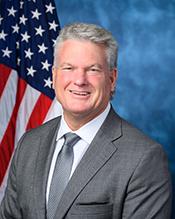
Mike Collins
RRepublicanGA-10 · Representative
47
/ 100
Below Average
Attendance98
Avg: 96
Independence7
Avg: 4
Bipartisan Tone20
Avg: 15
Ethics Record80
Avg: 99
Transparency4
Avg: 53
Accountability Score — composite of attendance, independence, bipartisan tone, ethics record & transparency.
Methodology11
Bills Sponsored
0
Enacted into Law
3
Passed a Chamber
8
In Committee
All Sponsored Bills
HR8679In Committee
To amend title 38, United States Code, to require the Secretary of Veterans Affairs to transmit a veteran's history of opioid prescriptions to a Community Care health care provider.
The Department of Veterans Affairs would be required to share a veteran's complete history of opioid prescriptions with private healthcare providers when a veteran receives care through the VA's Community Care program. This would help prevent veterans from obtaining duplicate or excessive opioid prescriptions from multiple providers and reduce the risk of addiction or overdose. The change affects veterans who use both VA and private healthcare services.
HJRES158In Committee
Encouraging States to establish "Veterans Tax Relief Weekends" that coincide with Memorial Day, Independence Day, and Veterans Day, providing a practical way for communities across the country to recognize the service of veterans and members of the Armed Forces by providing financial relief to them.
States would be encouraged to create special tax-free shopping weekends around Memorial Day, Independence Day, and Veterans Day where veterans and active-duty military members could purchase goods without paying sales tax. This would give communities a way to honor military service while providing financial relief to those who served. The proposal is currently being reviewed by the House Judiciary Committee.
HRES1204In Committee
Expressing the sense of the House of Representatives that as the United States marks 250 years of independence, establishing a "Veterans Appreciation Month" offers a simple but powerful way for the Nation to recognize the men and women whose service has protected American freedom for generations.
The House is proposing to officially recognize a "Veterans Appreciation Month" to honor the military service members and veterans who have fought to protect the country throughout its 250-year history. This symbolic gesture would give Americans a dedicated time each year to acknowledge and thank veterans for their sacrifices and contributions to national defense. The proposal is currently being reviewed by the House Committee on Oversight and Government Reform.
HRES1205In Committee
Encouraging military discounts in honor of the 250th anniversary of the United States.
The bill encourages businesses to offer discounts to military members and veterans as a way to honor the 250th anniversary of the United States. It aims to recognize and show appreciation for those who have served in the armed forces by promoting voluntary participation from companies in providing special pricing or deals. The proposal has been sent to two congressional committees to review how it might affect energy, commerce, and small businesses.
HR8079In Committee
Diesel Truck Liberation Act of 2026
This bill would likely loosen environmental regulations on diesel trucks, possibly by delaying or rolling back emissions standards that manufacturers must meet. The changes would affect trucking companies and manufacturers by reducing compliance costs, though it could increase air pollution and harm public health, particularly for people living near highways and ports. Environmental groups would likely oppose the measure while the trucking industry would probably support it.
HR3679Passed House
Small Business Artificial Intelligence Advancement Act
Small Business Artificial Intelligence Advancement Act This bill directs the National Institute of Standards and Technology (NIST) to develop or identify resources for small businesses to address concerns relating to the use of artificial intelligence (AI). Resources must be generally applicable, technology neutral, and based on relevant voluntary international standards, among other requirements. NIST must coordinate with the Small Business Administration with respect to the distribution of these resources. NIST must also review and update the resources at least biennially.
HR3898Passed House
PERMIT Act
Promoting Efficient Review for Modern Infrastructure Today Act or the PERMIT Act This bill limits the scope of the Clean Water Act by redefining navigable waters to exclude (1) waste treatment systems, (2) ephemeral features that flow only in direct response to precipitation, (3) prior converted cropland, (4) groundwater, or (5) any other features determined to be excluded by the U.S. Army Corps of Engineers.
HR5258In Committee
Lawsuit Abuse Reduction Act of 2025
Lawsuit Abuse Reduction Act of 2025 This bill strengthens the sanctions provisions under Rule 11 of the Federal Rules of Civil Procedure. Rule 11 establishes standards for pleadings, written motions, and other papers that are presented to a district court and establishes sanctions for an attorney, law firm, or party who does not comply with the standards. Under the Rule 11 standards, a pleading, written motion, or other paper must not be presented for an improper purpose and must make contentions that are reasonably supported by fact and law. Currently, the purpose of sanctions is to deter future violations of the Rule 11 standards. Rule 11 authorizes judges to impose sanctions on an attorney, law firm, or party who fails to comply with the standards; allows awards of compensation to an injured party only when necessary for effective deterrence; and requires a motion for sanctions to be served on a party 21 days before it is filed in court, creating a 21-day "safe harbor" within which a party may withdraw or correct a filing that allegedly violates Rule 11 standards. This bill amends Rule 11 to expressly state that the purpose of sanctions is to compensate the injured party as well as to deter future violations. The bill mandates sanctions for violations of the Rule 11 standards; requires sanctions to include compensation for the injured party for reasonable expenses incurred as a result of the violation, including attorneys' fees; and eliminates the 21-day safe harbor.
HR2662In Committee
Staged Accident Fraud Prevention Act of 2025
Staged Accident Fraud Prevention Act of 2025 This bill makes staging a collision with a commercial motor vehicle a federal crime. Specifically, a person who is operating a motor vehicle and intentionally causes a collision with a commercial motor vehicle (or arranges for another person to cause such a collision) is subject to a fine, a prison term of up to 20 years, or both. If the collision results in serious bodily injury or death, the prison term may not be less than 20 years.
HR1241In Committee
SAFE for America Act of 2025
Security And Fairness Enhancement for America Act of 2025 or SAFE for America Act of 2025 This bill eliminates the diversity visa program. This program provides up to 55,000 visas annually to individuals from countries with low rates of immigration to the United States.
HR29Passed House
Laken Riley Act
Laken Riley Act This bill requires the Department of Homeland Security (DHS) to detain certain non-U.S. nationals ( aliens under federal law) who have been arrested for burglary, theft, larceny, or shoplifting. The bill also authorizes states to sue the federal government for decisions or alleged failures related to immigration enforcement. Under this bill, DHS must detain an individual who (1) is unlawfully present in the United States or did not possess the necessary documents when applying for admission; and (2) has been charged with, arrested for, convicted of, or admits to having committed acts that constitute the essential elements of burglary, theft, larceny, or shoplifting. The bill also authorizes state governments to sue for injunctive relief over certain immigration-related decisions or alleged failures by the federal government if the decision or failure caused the state or its residents harm, including financial harm of more than $100. Specifically, the state government may sue the federal government over a decision to release a non-U.S. national from custody; failure to fulfill requirements relating to inspecting individuals seeking admission into the United States, including requirements related to asylum interviews; failure to fulfill a requirement to stop issuing visas to nationals of a country that unreasonably denies or delays acceptance of nationals of that country; violation of limitations on immigration parole, such as the requirement that parole be granted only on a case-by-case basis; or failure to detain an individual who has been ordered removed from the United States.