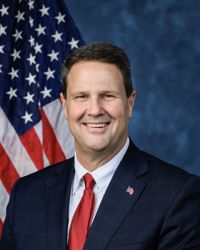
Jeff Crank
RRepublicanCO-5 · Representative
51
/ 100
Average
Attendance100
Avg: 96
Independence5
Avg: 4
Bipartisan Tone7
Avg: 15
Ethics Record100
Avg: 99
Transparency26
Avg: 53
Accountability Score — composite of attendance, independence, bipartisan tone, ethics record & transparency.
Methodology10
Bills Sponsored
0
Enacted into Law
1
Passed a Chamber
9
In Committee
All Sponsored Bills
HR10773In Committee
RELA Act of 2026
HR10657In Committee
SPROUT Act of 2026
HRES1490Passed House
Providing for the condemnation and denouncement of socialism in all its forms, and for other purposes.
This resolution states that the House of Representatives condemns and denounces socialism in all its forms, including the Democratic Socialists of America, and opposes the implementation of socialist policies in the United States; reaffirms its support for free, fair, and secure elections and calls for enactment of the SAVE America Act; reiterates that American elections are for American citizens only; and recommits itself to upholding the U.S. Constitution.
HR10084In Committee
First Time Homebuyer Debt Reduction Act
HRES1443In Committee
Amending the Rules of the House of Representatives to prohibit Members of the House from entering inappropriate relationships with House employees.
The proposal would establish new rules preventing House members from having romantic or sexual relationships with people who work for the House, including staff members and other employees. The rule aims to protect House workers from potential abuse of power and create clearer standards for workplace conduct among elected representatives. The measure is currently being reviewed by the House Ethics Committee.
HR8680In Committee
Armed Forces Carry Rights Protection Act of 2026
This proposal would change military rules to allow service members to carry personal firearms on military bases unless commanders have a specific reason to prohibit it, shifting the current default that generally bans personal weapons on base. The change would affect active-duty soldiers, sailors, airmen, and Marines, as well as military installation security policies. Military leaders would need to document their reasoning if they want to prevent an individual service member from carrying a personal firearm rather than having to approve each request.
HR7979In Committee
Public Lands Access Restoration Act
This bill would restore or expand public access to federal lands that may have been closed or restricted, allowing hunters, hikers, and other outdoor enthusiasts to use these areas again. The legislation likely aims to reverse recent closures or access limitations on public lands managed by agencies like the Bureau of Land Management or Forest Service, affecting both recreational users and potentially local communities that depend on outdoor tourism.
HR1913In Committee
BLOC Act
Blocking Lawless Open Border Cities and States Act of 2025 or the BLOC Act This bill prohibits federal funding of certain infrastructure and transportation projects in jurisdictions that do not require federal notification prior to release from custody of a non-U.S. national ( alien under federal law) who is not lawfully present. Specifically, the Department of Transportation is prohibited from providing funds for infrastructure projects, including for highway construction, to a political subdivision of a state that does not have certain statutory requirements or other practices in place a year after enactment of this bill. Political subdivisions of a state must require entities of the political subdivision to notify the Department of Homeland Security (DHS) 48 hours prior to releasing from custody an individual determined to be not lawfully present in the United States if DHS has notified the entity of the status of the individual and the individual has been in custody for at least 48 hours.
HR7282In Committee
FRAMER Act
The FRAMER Act likely aims to address housing affordability and community development by modifying how federal housing programs operate or how funding flows to local communities. Based on its focus on housing and community development, the bill probably affects homebuyers, renters, developers, and local governments seeking federal support for housing initiatives. The specific details of what changes it would make are not yet clear from the title alone, but it has been sent to the House Financial Services Committee for review.
HR4075In Committee
Fire Weather Development Act of 2025
Fire Weather Development Act of 2025 This bill establishes programs and requirements related to wildfire forecasting, detection, and management, particularly with respect to communication and collaboration among officials and first responders. For example, the National Oceanic and Atmospheric Administration (NOAA) must establish a program to improve fire forecasting and service delivery through collaboration between federal, state, and local entities. The program must seek to improve the understanding and prediction of wildfires, the assessment of fire weather, and the timeliness of related communications with state and local officials. Under the program, NOAA may conduct research and development activities related to fire weather and environments, contract with private entities to obtain airborne and space-based data to support fire prediction and monitoring, and conduct pilot programs to test the use of unmanned aircraft systems (i.e., drones) for fire weather observations. The bill also establishes (1) an interagency committee to coordinate the development of wildfire forecasting and the delivery of related products and services to state and local officials; (2) a national advisory committee to offer recommendations on streamlining federal forecasting information, the management and activities of the interagency committee, and other topics; and (3) a fire weather testbed to enable engagement among governments and other stakeholders. The bill exempts emergency wildfire suppression work performed by incident meteorologists of the National Weather Service from certain premium pay limitations. Finally, the National Institute of Standards and Technology must publish recommendations for improving coordination of communications among first responders and fire management officials.