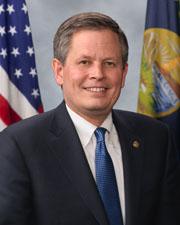
Steve Daines
RRepublicanMT · Senator
58
/ 100
Average
Attendance97
Avg: 97
Independence23
Avg: 23
Bipartisan Tone9
Avg: 14
Ethics Record100
Avg: 100
Transparency49
Avg: 47
Accountability Score — composite of attendance, independence, bipartisan tone, ethics record & transparency.
Methodology54
Bills Sponsored
2
Enacted into Law
0
Passed a Chamber
39
In Committee
All Sponsored Bills
S240Enacted
Crow Tribe Water Rights Settlement Amendments Act of 2025
Crow Tribe Water Rights Settlement Amendments Act of 2025 This bill revises the water rights settlement agreement entered into by the Crow Tribe of Montana and Montana. The Crow Tribe Water Rights Settlement Act of 2010 ratified, authorized, and confirmed the water rights compact between the tribe and Montana. Among other provisions, this settlement act authorized the Bureau of Reclamation to plan, design and construct the following two major projects on the Crow Reservation: (1) the rehabilitation and improvement of the Crow Irrigation Project (CIP); and (2) the planning, design, and construction of the MR&I System (the municipal, rural, and industrial water system of the Crow Reservation). Among other provisions, the bill revises the settlement act to replace references to the MR&I System with MR&I Projects ; establish a nontrust, interest-bearing account (to be known as the Crow CIP Implementation Account) to allow Reclamation to continue to work on the rehabilitation of the CIP; create a new MR&I Projects Account, through which the tribe must use funds for activities related to water production, treatment, or delivery infrastructure; and extend by five years (to 2030) the period during which the tribe has the exclusive right to construct hydropower facilities on the Yellowtail Afterbay Dam in Montana.
S5616In Committee
ADAPT Act
S239Reported
Crow Revenue Act
Crow Revenue Act This bill addresses the exchange of mineral interests in Montana involving the federal government, the Crow Tribe of Montana, and a private party. Specifically, the bill requires the Department of the Interior to accept the relinquishment of a specified federal coal lease associated with the Bull Mountains Mine near Roundup, Montana (the current operator of the mine is Signal Peak Energy); the Joe and Barbara Hope Mineral Trust (Hope Family Trust) to convey approximately 4,660 acres of subsurface mineral interests located within the boundaries of the Crow Indian Reservation in Big Horn County, Montana, to the tribe; and Interior to convey approximately 4,530 acres of subsurface mineral interests and 940 acres of surface interests located in Musselshell County, Montana, to the Hope Family Trust. Prior to these conveyances, the tribe must notify Interior that the tribe and the Hope Family Trust have agreed on a revenue-sharing formula for the development of the mineral and surface interests in Musselshell County, Montana. The mineral interests conveyed by the Hope Family Trust to the tribe shall be held in trust by the United States for the benefit of the tribe, upon the tribe's request. These mineral interests shall not be subject to state or local taxation.
SRES816In Committee
A resolution honoring 35 years of independence for the countries of Central Asia and recognizing the importance of the United States growing relationship with Kazakhstan, Kyrgyzstan, Tajikistan, Turkmenistan, and Uzbekistan.
This resolution celebrates the 35th anniversary of independence for five Central Asian nations and expresses support for strengthening U.S. relationships with Kazakhstan, Kyrgyzstan, Tajikistan, Turkmenistan, and Uzbekistan. The measure recognizes the growing importance of these countries to American foreign policy and diplomatic interests in the region. It is a symbolic statement rather than a law that creates new programs or funding.
S4041Reported
Cooperative Watershed Management Program Reauthorization Act of 2026
This bill would extend and update a federal program that helps states, tribes, and local communities work together to manage water resources and solve water-related problems in their regions. The program provides funding and support for projects like improving water quality, protecting watersheds, and addressing water shortages, affecting farmers, cities, environmental groups, and water utilities that depend on healthy water systems.
S5048In Committee
Hydropower Licensing Affordability Act
The proposal would update how the federal government approves and manages licenses for hydropower dams and facilities, making the process faster and more efficient for energy companies while potentially streamlining environmental reviews. The changes would affect hydropower operators, environmental groups, and communities near dams by altering how projects are evaluated and approved. The bill is currently under review by the Senate's energy committee.
S4489In Committee
Dry-Redwater Regional Water Authorization Act
The bill would authorize a new water system in Montana called the Dry-Redwater Regional Water Authority to provide water services to communities and agricultural areas in that region. This would allow the authority to operate and manage water distribution infrastructure for local residents and farmers who need reliable access to water. The proposal is currently under review by the Senate's energy and natural resources committee.
SRES837Introduced
A resolution designating the week of August 22 through August 30, 2026, as "National Park Week".
S3635In Committee
Fort Peck Water System Reauthorization Act
This bill would reauthorize federal funding and support for the water system serving the Fort Peck Indian Reservation in Montana, allowing the government to continue investing in water infrastructure projects that provide drinking water and irrigation to the reservation's residents and agricultural operations. The legislation addresses water supply needs for Native American communities and agricultural users in the region by maintaining or updating the federal commitment to maintain and improve these water systems.
S1175Reported
Small County PILT Parity Act
This bill would adjust how the federal government distributes payments to small counties that contain federal lands, aiming to give them fairer compensation for hosting national forests, parks, and other public property that generates tax-free revenue. Counties with smaller populations or less developed federal land often receive smaller payments despite their reliance on federal property, so this legislation would work to level the playing field. The changes would help rural and small county governments better fund local services like schools and roads that serve both residents and visitors to federal lands.
S4992In Committee
A bill to require the Secretary of the Army to issue guidance relating to the review of applications for alteration or temporary or permanent occupation or use of certain hydropower projects, and for other purposes.
The Army Secretary would have to create clear rules for how the government reviews requests from companies or individuals who want to change, temporarily use, or permanently use existing hydropower dams and water projects. This would make the approval process more consistent and transparent for businesses and organizations that depend on these facilities for power generation or water management. The bill affects hydropower companies, dam operators, and anyone seeking to modify how these water projects are used.
SRES798In Committee
A resolution designating June 2026 as "Great Outdoors Month".
The resolution would officially recognize June 2026 as "Great Outdoors Month" to encourage Americans to spend time enjoying parks, forests, and other natural spaces. This symbolic designation aims to promote outdoor recreation and appreciation for the nation's natural resources among the general public.
SRES787In Committee
A resolution celebrating the historic anniversary of the June 24, 2022, decision of the Supreme Court of the United States in Dobbs v. Jackson Women's Health Organization.
This resolution commemorates the Supreme Court's June 24, 2022 decision in Dobbs v. Jackson Women's Health Organization, which eliminated the federal constitutional right to abortion and allowed states to set their own abortion policies. The resolution celebrates this court decision as a historic moment. It has been referred to the Judiciary Committee for consideration.
SRES795Introduced
A resolution commemorating the 150th anniversary of the Battle of the Little Bighorn.
This resolution honors the 150th anniversary of the Battle of the Little Bighorn, a significant military conflict that took place in 1876 between the U.S. Army and Native American tribes including the Lakota Sioux, Northern Cheyenne, and Arapaho. The resolution recognizes the historical importance of this battle and its lasting impact on American history and Native American communities. The Senate has already approved this commemorative measure.
S4838In Committee
Outdoor Recreational Outfitting and Guiding Act
The proposal would allow outdoor recreation companies to pay workers in guiding and outfitting services less than the federal minimum wage and require them to work longer hours without overtime pay. This exemption would apply to employees like hiking guides, rafting instructors, and hunting outfitters who work in outdoor recreational activities. The change would affect thousands of outdoor industry workers across the country who could see their wages and hour protections reduced.
S1547Reported
America the Beautiful Act
This bill likely aims to protect or improve public lands and natural resources across the United States, though the specific details would depend on its provisions. Based on the title and subject matter, it could involve measures like expanding national parks, protecting wilderness areas, funding conservation efforts, or managing public lands more sustainably. The bill would affect outdoor enthusiasts, environmental groups, local communities near public lands, and potentially the federal agencies that manage these areas.
S4752In Committee
A bill to amend the Internal Revenue Code of 1986 to increase criminal and civil penalties for unauthorized disclosure of taxpayer information, and for other purposes.
The proposal would strengthen penalties—both criminal and financial—for people who illegally share private tax information about individuals and businesses. This would affect IRS employees, contractors, and anyone else with access to confidential tax records, making the consequences more severe if they improperly disclose that sensitive data. The bill aims to better protect taxpayers' privacy by deterring unauthorized leaks of their financial information.
SRES746Introduced
A resolution designating May 2026 as "National Brain Tumor Awareness Month".
The Senate has designated May 2026 as "National Brain Tumor Awareness Month" to increase public attention to brain tumors and the people affected by them. This symbolic designation encourages awareness campaigns, educational efforts, and fundraising activities related to brain tumor research and patient support during that month. The resolution passed with unanimous agreement and does not create new laws or funding, but rather serves as an official recognition to promote awareness of this health issue.
SRES726Introduced
A resolution expressing support for the designation of May 5, 2026, as "National Day of Awareness for Missing and Murdered Indigenous Women and Girls".
This resolution expresses support for the designation of May 5, 2026, as the National Day of Awareness for Missing and Murdered Indigenous Women and Girls.
S1020Enacted
A bill to require the Federal Energy Regulatory Commission to extend the time period during which licensees are required to commence construction of certain hydropower projects.
This act authorizes the Federal Energy Regulatory Commission (FERC) to extend construction deadlines for hydropower projects that were issued a license before March 13, 2020. FERC is authorized, upon the request of the licensees, to extend the deadline for beginning construction on such projects an additional six years beyond the eight-year extension FERC is authorized to provide under current law. The extension must consist of no more than three consecutive two-year periods. The act also provides that FERC may reinstate certain expired licenses for projects with construction deadlines extended under this act, effective as of the date they expire.
S4314In Committee
Foster Youth Education and Workforce Opportunity Act of 2026
The bill would increase financial support for foster youth pursuing education and job training after high school by raising the maximum voucher amount they can receive and expanding access to workforce development programs. Young people who have been in the foster care system would get more help paying for college, vocational schools, and other training to prepare them for adult careers. The changes aim to give foster youth better tools to become self-sufficient and succeed once they leave the system.
S3409In Committee
Lower Yellowstone River Native Fish Conservation Act
This bill aims to protect native fish species in the Lower Yellowstone River by establishing conservation measures and potentially modifying how water is managed in that region. The legislation would likely affect farmers, ranchers, hydroelectric dam operators, and fishing communities that depend on the river, as it could change water allocation rules or require new environmental protections. The bill is currently being reviewed by congressional committees to determine what specific conservation strategies should be implemented.
S3527In Committee
Montana Sportsmen Conservation Act
This bill would protect and manage public lands in Montana to support hunting, fishing, and outdoor recreation while balancing conservation efforts. It likely includes provisions for wildlife habitat improvement, access to federal lands for sportsmen, and funding for conservation projects that benefit both hunters and fishermen. The measure affects outdoor enthusiasts, conservation groups, and federal land management agencies in Montana.
S3940In Committee
Access to Fair Financing for Opportunity and Resilient Development Act
This bill would likely expand access to credit and financial services for individuals and small businesses that have difficulty obtaining traditional loans, possibly through new lending programs or requirements for banks to serve underserved communities. The legislation appears aimed at helping lower-income Americans and entrepreneurs build financial stability and grow their businesses by making it easier to access fair financing options. It would primarily affect banks, lending institutions, and consumers seeking credit in underserved areas.
S3834In Committee
Expanded Telehealth Access Act
Expanded Telehealth Access Act This bill expands the types of health care practitioners who may provide telehealth services under Medicare. Specifically, the bill permanently allows audiologists, physical therapists, occupational therapists, speech-language pathologists, and other providers designated by the Centers for Medicare & Medicaid Services to provide telehealth services under Medicare. It also specifically allows occupational therapy assistants and physical therapist assistants to provide such services.
S362Reported
A bill to allow certain Federal minerals to be mined consistent with the Bull Mountains Mining Plan Modification, and for other purposes.
This bill authorizes coal to be mined on approximately 800 acres of federal land in Musselshell County, Montana. Specifically, it allows all federal coal reserves in such federal land and leased under Federal Coal Lease MTM 97988 to be mined in accordance with the 2020 Bull Mountains Mining Plan Modification. The Bull Mountains Mine is operated by Signal Peak Energy. This bill directs the Department of the Interior, without modification or delay, to approve the Bull Mountains Mining Plan Modification to the extent necessary to mine such land.
S3671In Committee
Increasing Investor Opportunities Act
This bill would likely expand opportunities for individuals and investment firms to participate in financial markets, possibly by relaxing rules about who can invest in certain types of securities or how much money they need to get started. The changes would affect everyday investors, wealthy individuals, investment companies, and potentially small businesses looking to raise money through investments. The goal appears to be making it easier for more people to invest and for companies to access investment capital.
S3486In Committee
Expand the Behavioral Health Workforce Now Act
Expand the Behavioral Health Workforce Now Act This bill requires the Centers for Medicare & Medicaid Services to issue guidance for states on ways to increase education, training, recruitment, and retention of mental health and substance use disorder providers under Medicaid and the Children's Health Insurance Program (CHIP), particularly in rural and underserved areas.
S451In Committee
Restoring State Mineral Revenues Act
Restoring State Mineral Revenues Act This bill increases payments states receive for specified revenue generated from oil, gas, geothermal steam, coal, and certain other natural resources on onshore federal land. Specifically, the bill eliminates the 2% administrative fee that the Bureau of Land Management currently deducts from a state's payment for such natural resources developed within the state.
S3103In Committee
A bill to authorize the extension of nondiscriminatory treatment (normal trade relations treatment) to products of certain countries.
This bill addresses trade between the United States and covered countries. Under this bill, a covered country is any country excluding Belarus, Cuba, and North Korea. Specifically, the bill authorizes the President to determine that Section 402 of the Trade Act of 1974 (commonly known as the Jackson-Vanik amendment) does not apply to a covered country. The Jackson-Vanik amendment denies normal trade relations (NTR) status to some current and former nonmarket economy countries unless they comply with certain freedom-of-emigration requirements. Under a provision of this amendment, the President may extend NTR status to a country affected by the amendment by waiving the freedom-of-emigration requirements or determining that the country is not in violation of those requirements, subject to an annual review. Additionally, the bill authorizes the President to extend permanent NTR status to a covered country.
S3064In Committee
Relief of Chronic Pain Act of 2025
Relief of Chronic Pain Act of 2025 This bill reduces cost-sharing and prohibits the imposition of certain utilization requirements under the Medicare prescription drug benefit for certain non-opioid drugs for chronic pain management. Specifically, the bill requires such drugs to be covered without a deductible and to be placed on the lowest cost-sharing tier (if any). The bill also prohibits the imposition of prior authorization requirements (i.e., requiring prior approval from a plan) or step therapy requirements (i.e., requiring the use of alternative drugs before a drug is covered under a plan) with respect to such drugs.
SJRES61In Committee
A joint resolution providing for congressional disapproval under chapter 8 of title 5, United States Code, of the rule submitted by the Bureau of Land Management relating to "Miles City Field Office Record of Decision and Approved Resource Management Plan Amendment".
This joint resolution nullifies the rule submitted by the Bureau of Land Management (BLM) relating to the Record of Decision and Approved Resource Management Plan (RMP) Amendment for the Miles City Field Office in Montana and issued on November 20, 2024. By way of background, such an amendment revises an RMP, which guides the management of lands administered by BLM. This Miles City Field Office RMP Amendment made no acres available for coal leasing and 1,745,040 acres unavailable for further consideration for coal leasing.
S2715In Committee
FAIR Act of 2025
Fair Access In Residency Act of 2025 or the FAIR Act of 2025 This bill requires hospitals that receive graduate medical education (GME) payments under Medicare to report certain information about the composition of their medical residency training programs. Specifically, hospitals must provide to the Centers for Medicare & Medicaid Services (CMS) (1) the number of applicants for residencies who are from osteopathic medical schools and from allopathic medical schools, (2) the number of applicants who are accepted from each of these types of medical schools, and (3) an affirmation that the hospital considers applicants from each of these types of medical schools and accepts specified related examination results, as appropriate. Hospitals that do not provide this information are subject to a 2% reduction in their GME payments. The CMS must post the information it receives on a public website.
S2704In Committee
CDFI Fund Transparency Act
This bill would require Community Development Financial Institutions (CDFIs)—lenders that provide credit and financial services to underserved communities—to disclose more detailed information about their operations, lending practices, and financial performance to the public. The increased transparency would help borrowers, investors, and regulators better understand how these institutions use federal funding and whether they're effectively serving low-income neighborhoods and small businesses. The measure aims to ensure accountability while these organizations receive government support to expand economic opportunity in disadvantaged areas.
S2577In Committee
McCarran-Walter Technical Corrections Act
S2461In Committee
Promotion and Expansion of Private Employee Ownership Act of 2025
The legislation would expand tax incentives and reduce regulatory barriers to help workers buy ownership stakes in the companies where they work through employee stock ownership plans (ESOPs) and similar programs. It aims to make it easier and more affordable for employees to become partial owners of their businesses while giving companies tax breaks for facilitating these arrangements. The changes would primarily affect workers seeking ownership opportunities and businesses looking to share ownership with their employees.
SRES279Introduced
A resolution designating June 2025 as "Great Outdoors Month".
Congress is officially recognizing June 2025 as "Great Outdoors Month" to encourage Americans to spend time in nature and appreciate public lands like national parks and forests. The resolution celebrates outdoor activities and recreation while raising awareness about the importance of protecting natural spaces for future generations. This symbolic designation doesn't create new laws or funding, but serves as a national call to get outside and enjoy the environment.
SJRES58In Committee
A joint resolution proposing an amendment to the Constitution of the United States authorizing the Congress to prohibit the physical desecration of the flag of the United States.
S1967In Committee
PROTECT Act of 2025
Protection for Reservation Occupants against Trafficking and Evasive Communications Today Act of 2025 or the PROTECT Act of 2025 This bill expands special tribal criminal jurisdiction (STCJ) to include certain controlled substance-related offenses and firearms offenses. It also allows tribal courts to execute warrants for electronic material. STCJ allows participating tribes to investigate, prosecute, convict, and sentence both Indian and non-Indian offenders who commit covered crimes in Indian country against Indian victims. Covered crimes currently include assault of tribal justice personnel, child violence, dating violence, domestic violence, obstruction of justice, sexual violence, sex trafficking, stalking, and a violation of a protection order. The bill expands STCJ to allow participating tribes to prosecute individuals for controlled substance-related offenses (i.e., drug trafficking, unlawful drug possession, or unlawful possession of drug paraphernalia) and firearms offenses (i.e., use or possession of a firearm in furtherance of a covered crime or by a person who has been convicted of domestic violence). Additionally, the bill allows participating tribes to exercise STCJ over a controlled substance-related offense or a firearms offense if neither the defendant nor the alleged victim is an Indian. (Currently, this exception only applies in cases of obstruction of justice or assault of tribal justice personnel.) The bill allows offenders convicted pursuant to STCJ to be incarcerated through the Bureau of Prisons Tribal Prisoner Program. The bill gives tribal courts the same authority as state courts to compel service providers to disclose stored electronic communication information through court-issued warrants, court orders, or administrative subpoenas.
S1858In Committee
A bill to require that national cemeteries be open to visitors on legal public holidays.
This bill requires that national cemeteries administered by the Department of Defense, Department of Veterans Affairs, or the National Park Service must be open to visitors on the 11 legal public holidays (e.g., Memorial Day).
S1912In Committee
Protecting Veteran Community Care Act
Protecting Veteran Community Care Act This bill requires the Department of Veterans Affairs (VA) to furnish residential mental health or substance-use services to certain veterans through the Veterans Community Care Program (VCCP). Specifically, the VA must furnish such care if a veteran (1) meets VA criteria for priority admission to a VA Mental Health Residential Rehabilitation Treatment Program and the VA is unable to accommodate priority admission, or (2) has contacted the VA to request such mental health services and the VA is not able to furnish such services in a manner that complies with VA access standards for specialty care provided under the VCCP. The VA must ensure that a referral to an alternate Mental Health Residential Rehabilitation Treatment Program does not take precedence over timely access to mental health or substance-use services unless the referral is requested by the veteran. The VA is prohibited from determining a veteran is ineligible for VCCP care solely because VCCP providers are unable to comply with wait times or access standards. If multiple options for care or services are available, the VA must permit a veteran to elect the option the veteran prefers. Additionally, the bill provides minimum standards for residential mental health or substance-use services provided under the VCCP (e.g., treatment programs or facilities must be licensed and accredited for the specified services).
SRES232Introduced
A resolution designating May 2025 as "National Brain Tumor Awareness Month".
This resolution designates May 2025 as National Brain Tumor Awareness Month.
S1696In Committee
DRIVE Act
Deregulating Restrictions on Interstate Vehicles and Eighteen-wheelers Act or the DRIVE Act This bill prohibits the Federal Motor Carrier Safety Administration (FMCSA) from issuing any rule or regulation to require a commercial motor vehicle to be equipped with a speed limiting device set to a maximum speed. The FMCSA issued an advance notice of supplemental proposed rulemaking on this subject on May 4, 2022. A commercial motor vehicle includes a vehicle operating in interstate commerce that (1) has a gross vehicle weight of 10,001 pounds or more, (2) is designed or used to transport more than 8 passengers for compensation, (3) is designed or used to transport more than 15 passengers and is not used to transport passengers for compensation, or (4) is used to transport certain quantities of hazardous materials.
SRES200Introduced
A resolution expressing support for the designation of May 5, 2025, as the "National Day of Awareness for Missing and Murdered Indigenous Women and Girls".
This resolution expresses support for the designation of May 5, 2025, as the National Day of Awareness for Missing and Murdered Indigenous Women and Girls.
S1567In Committee
Jobs and Opportunity with Benefits and Services (JOBS) for Success Act of 2025
Jobs and Opportunity with Benefits and Services (JOBS) for Success Act of 2025 This bill reauthorizes the Temporary Assistance for Needy Families (TANF) program through FY2030, establishes new metrics for measuring states’ performance within the program, and makes other changes to the program’s requirements. Under current law, states participating in TANF are required to meet certain minimum participation rates, or percentages of beneficiaries engaged in work. The bill eliminates minimum participation rates and replaces them with metrics tied to employment outcomes, such as former beneficiaries’ rates of unsubsidized employment and earnings at particular points in time. The Department of Health and Human Services must publish a website with information on each state’s performance. The bill also requires states to create an individual opportunity plan for each beneficiary and to meet with each work-eligible beneficiary at least every 90 days to review the individual’s progress under their plan. (Under current law, individual plans are optional.) Further, the bill prohibits states from using TANF funds to provide benefits to families with monthly incomes that exceed twice the poverty line. Finally, the bill requires states to spend at least 25% of their TANF grant funds on certain activities, including work supports, education and training, and apprenticeships. The bill also lowers the percentage of TANF funds that a state may spend on administrative costs to 10%, with an exception for costs related to case management necessary to assist in the development of individual opportunity plans.
SRES180Introduced
A resolution designating the week of April 19 through April 27, 2025, as "National Park Week".
The resolution officially recognizes the week of April 19-27, 2025, as National Park Week to celebrate and raise awareness about America's national parks and public lands. This symbolic designation encourages Americans to visit and appreciate the natural and historical sites managed by the National Park Service. The resolution has already passed the Senate without any objections.
S1159In Committee
GAZA Act
S808In Committee
Stop Russian Market Manipulation Act
Stop Russian Market Manipulation Act This bill prohibits the importation of specified minerals from Russia. Specifically, the bill prohibits the importation of platinum, palladium, braggite, rhodium, ruthenium, nickel, cooper, or zinc if the mineral is (1) produced in Russia or by a Russian entity; or (2) determined to have been exchanged with, swapped for, or otherwise obtained in lieu of such a mineral in a manner designed to evade or circumvent this prohibition. The President may not waive this prohibition. The prohibition shall continue to apply until one year after the President certifies to Congress that the Russian government has ended all hostilities against Ukraine. If the Russian government resumes hostilities against Ukraine within three years of a certification, then the prohibition shall resume effect.
S704In Committee
Voluntary Public Access Improvement Act of 2025
Voluntary Public Access Improvement Act of 2025 This bill reauthorizes through FY2029 and increases funding for the Voluntary Public Access and Habitat Incentive Program (VPA-HIP). This Natural Resources Conservation Service program provides state and tribal governments competitive grants to encourage owners and operators of privately-held land (i.e., farm, ranch, and forest land) to allow public access for hunting, fishing, and other wildlife-dependent recreation. The bill also reauthorizes through FY2029 VPA-HIP funding to encourage public access to land covered by wetland reserve easements through agreements with states and tribal governments.
S537In Committee
Protecting Access for Hunters and Anglers Act of 2025
Protecting Access for Hunters and Anglers Act of 2025 This bill bars the Fish and Wildlife Service (FWS), the Bureau of Land Management (BLM), and the Forest Service from prohibiting or regulating the use of lead ammunition or tackle on federal land or water. The bill makes exceptions for specified existing regulations and where the FWS, the BLM, or the Forest Service determines that a decline in wildlife population at the specific unit of federal land or water is primarily caused by the use of lead in ammunition or tackle, based on the field data from such unit, and the state approves the regulations.
S460In Committee
Supporting Made in America Energy Act
Supporting Made in America Energy Act This bill requires oil and natural gas lease sales that include certain public land and waters, prohibits lease sales in other areas, and establishes related requirements. Beginning in FY2025, the Department of the Interior must conduct a minimum of four onshore lease sales annually in each state that has federal land available for oil and natural gas leasing. If a lease sale is canceled, delayed, or deferred, Interior must conduct a replacement sale during the same year. Beginning in FY2026, Interior must conduct a minimum of two offshore, region-wide lease sales annually in the Gulf of Mexico Region of the Outer Continental Shelf (OCS) by specified dates. The sales must include the Central Gulf of Mexico Planning Area and the Western Gulf of Mexico Planning Area. Interior must also conduct a minimum of six offshore lease sales of at least 1 million acres each over a 10-year period in the Cook Inlet Planning Area. The bill sets a 12.5% royalty rate for such leases. Interior must plan and approve the subsequent OCS oil and gas leasing programs by specified deadlines. The bill extends through 2035 a moratorium on oil and gas leasing in certain eastern and central portions of the Gulf of Mexico and expands the moratorium to include the South Atlantic Planning Area and the Straits of Florida Planning Area. The bill also requires the President to obtain congressional approval before impeding or circumventing certain federal energy mineral leasing processes.
S205In Committee
Protecting Individuals with Down Syndrome Act
Protecting Individuals with Down Syndrome Act This bill creates new federal crimes related to the performance of an abortion on an unborn child who has Down syndrome. It subjects a violator to criminal penalties—a fine, a prison term of up to five years, or both. It also authorizes civil remedies, including damages and injunctive relief. A woman who undergoes such an abortion may not be prosecuted or held civilly liable.
S137In Committee
FIND Act
Firearm Industry Non-Discrimination Act or the FIND Act This bill prohibits the federal government from entering into contracts with an entity that discriminates against firearm trade associations or businesses that deal in firearms, ammunition, or related products. Specifically, the bill requires a federal agency to include in each contract for the procurement of goods or services awarded by the agency a clause requiring the prime contractor to certify that it (1) has no policy, practice, guidance, or directive that discriminates against a firearm entity or firearm trade association; and (2) will not adopt a policy, practice, guidance, or directive that discriminates against a firearm entity or firearm trade association during the term of the contract. The bill establishes (1) a similar requirement with respect to subcontracts, and (2) penalties for violations. The bill makes such prohibition inapplicable to a contract for the procurement of goods or services that is a sole-source contract.
S45In Committee
Balanced Budget Accountability Act
Balanced Budget Accountability Act This bill withholds Members of Congress's salaries in each chamber if the Office of Management and Budget (OMB) does not certify that the chamber has adopted a balanced budget. The bill also requires that revenue increases be agreed upon by an affirmative three-fifths vote in each chamber. Balanced budget means a concurrent budget resolution providing that for FY2035 and each succeeding fiscal year to which the resolution applies total outlays do not exceed total receipts and are not more than 18% of the projected gross domestic product for such fiscal year. For the 119th Congress, if OMB does not certify that a chamber has adopted a balanced budget for the next fiscal year before April 16, salaries of Members of that chamber must be held in escrow until passage of a balanced budget or, if none is passed, the conclusion of the 119th Congress. For subsequent Congresses, if OMB does not certify that a chamber has adopted a balanced budget for the next fiscal year before April 16, each Member of that chamber shall be paid at the rate of $1 annually for the remainder of the calendar year.