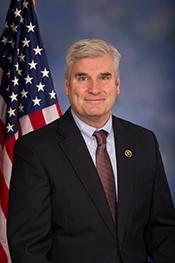
Tom Emmer
RRepublicanMN-6 · Representative
53
/ 100
Average
Attendance99
Avg: 96
Independence1
Avg: 4
Bipartisan Tone18
Avg: 15
Ethics Record100
Avg: 99
Transparency29
Avg: 53
Accountability Score — composite of attendance, independence, bipartisan tone, ethics record & transparency.
Methodology8
Bills Sponsored
0
Enacted into Law
2
Passed a Chamber
6
In Committee
All Sponsored Bills
HR10493In Committee
Reclaim Local Control Act
HR7030In Committee
Securing Facilities for Mental Health Services Act
HR4398In Committee
Veteran Burial Timeliness and Death Certificate Accountability Act
This bill would require the Department of Veterans Affairs to bury deceased veterans within a specific timeframe and establish accountability measures when those deadlines are missed. It aims to address delays that have left some veteran families waiting extended periods for their loved ones' final burials, while also ensuring death certificates are processed promptly. The legislation would affect veterans' families and VA burial operations across the country.
HR3234Passed House
Keeping Deposits Local Act
This bill increases the amount insured depository institutions may accept as reciprocal deposits. (Reciprocal deposits are used by institutions to increase the availability of deposit insurance by splitting large deposits using a reciprocal network of institutions.) The bill creates a tiered system so that the allowable amount is based on the institution's total liabilities. Additionally, the bill changes certain qualifications insured depository institutions may be required to have to accept reciprocal deposits. Under current law, institutions may qualify by having a composite rating of outstanding or good, among other requirements. The bill allows institutions with a 1, 2, or 3 rating under the CAMELS scale to qualify. (The Uniform Financial Institutions Rating System uses the characteristics of capital adequacy, asset quality, management, earnings, liquidity, and sensitivity to market risk (i.e., CAMELS ratings) to rate the health of financial institutions, with a 1 indicating the highest rating and least degree of supervisory concern and a 5 indicating the lowest rating and highest degree of supervisory concern.)
HR7156In Committee
SCAM Act
The SCAM Act addresses immigration policy, though the specific provisions are not detailed in the available information. Based on its referral to the House Judiciary Committee, the bill likely proposes changes to how immigration cases are handled or enforced, potentially affecting immigrants, immigration courts, or enforcement agencies. Without access to the bill's full text, the exact impact on workers, families, or immigration procedures cannot be determined.
HR2184In Committee
Firearm Due Process Protection Act of 2025
Firearm Due Process Protection Act of 2025 This bill expands the grounds for pursuing judicial remedies related to the denial of certain firearm transfers. Additionally, the bill establishes procedural rules applicable to actions for judicial remedies. Current law authorizes judicial remedies for an individual who is erroneously denied a firearm (e.g., an individual is denied a firearm but the individual is eligible to receive or possess a firearm). This bill authorizes remedies for an individual who experiences an extended delay (i.e., a delay of more than 60 days) on a firearm transfer. Additionally, the bill requires an expedited hearing on an action for judicial remedies and places the burden of proof on the respondent (i.e., the government) to show that the individual was ineligible to receive or possess a firearm.
HR1919Passed House
Anti-CBDC Surveillance State Act
Anti-CBDC Surveillance State Act This bill prohibits a Federal Reserve bank from offering products or services directly to an individual, maintaining an account on behalf of an individual, or issuing a central bank digital currency (i.e., a digital dollar). Further, the Board of Governors of the Federal Reserve System is prohibited from using a central bank digital currency to implement monetary policy or from testing, studying, creating, or implementing a central bank digital currency, with exceptions as provided by the bill.
HR3533In Committee
Blockchain Regulatory Certainty Act
This bill would create clear federal rules for how blockchain technology and cryptocurrency businesses operate, giving companies and investors more certainty about what's legal and what regulators expect. It likely aims to reduce confusion between different government agencies about who oversees crypto activities and what standards apply, which could make it easier for legitimate businesses to comply with the law while protecting consumers from fraud and financial risks.