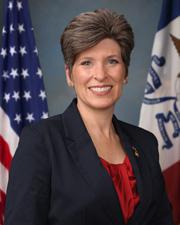
Joni Ernst
RRepublicanIA · Senator
56
/ 100
Average
Attendance98
Avg: 97
Independence23
Avg: 23
Bipartisan Tone11
Avg: 14
Ethics Record100
Avg: 100
Transparency32
Avg: 47
Accountability Score — composite of attendance, independence, bipartisan tone, ethics record & transparency.
Methodology69
Bills Sponsored
2
Enacted into Law
4
Passed a Chamber
51
In Committee
All Sponsored Bills
S766Enacted
Billion Dollar Boondoggle Act of 2025
Billion Dollar Boondoggle Act This act requires the Office of Management and Budget (OMB) to collect information from federal agencies and report to Congress regarding projects that are behind schedule or have expenditures that have exceeded the original cost estimate. Specifically, the act requires OMB to issue guidance directing federal agencies to annually submit specified information to OMB regarding certain federally funded projects that (1) are more than five years behind schedule, or (2) have expenditures that are at least $1 billion more than the original cost estimate for the project. Among other information, the agencies must submit to OMB a description of each project; an explanation of any change to the original scope of the project; the original and current expected dates for the completion of the project; the original and current cost estimates adjusted for inflation; an explanation for any delays in completing the project or increases in the cost; and the amount of and rationale for any award, incentive fee, or other type of bonus awarded for the project. The act also requires OMB to submit an annual report to Congress containing the information submitted by the agencies and post the report on the OMB website.
SRES916Introduced
A resolution designating the week of September 21, 2026, as the "Ray Gaesser Memorial Farm Safety Week" to recognize the life and legacy of Ray Gaesser, who passed away in a tragic farming accident, and promote farm safety in the honor of Ray Gaesser.
S5294In Committee
Keeping China Off the Rails Act of 2026
S4505Reported
A bill to require the United States Postal Service to designate ZIP Codes for certain communities.
The Postal Service would be required to assign ZIP Codes to certain communities that currently lack them, making it easier for residents and businesses in those areas to receive mail and access postal services. This would affect people living in underserved communities who may struggle with mail delivery or conducting business without a proper ZIP Code. The bill is currently under review by the Senate committee responsible for postal operations.
S5314In Committee
No Cash for Cohabitating Kins of Crooks Act
S4952Introduced
Protecting American Taxpayers Act
The legislation would strengthen efforts to detect and prevent fraudulent activities across federal benefit programs like Medicare, Medicaid, Social Security, and federal employee benefits. It would likely increase penalties for people who commit fraud, improve coordination between federal agencies to catch wrongdoing, and potentially require better tracking systems to identify suspicious claims. The changes would affect federal agencies administering these programs, beneficiaries receiving federal benefits, and potentially taxpayers by helping reduce waste and misuse of federal funds.
S4892In Committee
SMART Energy Efficiency Standards Act
The federal government would allow different regions of the country to set their own energy efficiency standards for furnaces, air conditioners, and heat pumps, rather than having one national standard apply everywhere. This could let states and regions tailor requirements to match their local climates and energy needs, though it might create different rules for manufacturers and consumers depending on where they live. Homeowners and businesses that buy or replace heating and cooling equipment would potentially see different efficiency requirements and costs depending on their region.
S4940In Committee
Specialized Infant Formula Protection Act
The bill would protect the supply of specialized infant formula designed for premature and medically fragile babies by ensuring the Food and Drug Administration maintains oversight while keeping these products available to families who need them. Premature infants often cannot tolerate standard formula and require specific medical formulations, so this legislation aims to prevent shortages that could harm vulnerable newborns. The measure affects parents of preterm babies, hospitals, and formula manufacturers who produce these specialized medical products.
S4891In Committee
Preventing Fugitive Fraudsters Act
When someone is charged with fraud-related crimes, judges would be required to take away their passport as a condition of letting them stay out of jail while awaiting trial. This prevents defendants accused of fraud from fleeing the country before their case is resolved. The measure affects people facing fraud charges and aims to reduce the risk that they'll disappear before facing justice.
S4789In Committee
Blue Star Mothers Day Act
The proposal would officially recognize February 1st each year as "Blue Star Mothers Day," a national observance honoring mothers whose children are currently serving in the U.S. military. This designation would give these families a dedicated day for public recognition and appreciation of their sacrifice and service to the country. The change would be added to federal law but would not require any government spending or create new programs.
S872Passed Senate
Stop Secret Spending Act of 2025
Stop Secret Spending Act of 2025 This bill expands a requirement for federal agencies to report expenditures on the USAspending.gov website to include other transaction agreement expenditures. (Other transaction agreements, or OTAs, are contractual instruments other than standard procurement contracts, grants, or cooperative agreements; they are exempt from many federal procurement laws and regulations). Under current law, federal agencies must report expenditures on federal awards to USAspending.gov with the term federal award defined as federal grants, loans, cooperative agreements, contracts, and certain other types of expenditures. This bill expands the definition of federal award to include expenditures under OTAs, and therefore such expenditures must be included on the USAspending.gov website. The Department of the Treasury must ensure that data relating to OTAs are automatically transmitted to the website and a centralized view of this data is available on the website. Treasury must also annually post on the USAspending.gov website a report that includes (1) the total amount of federal spending on federal awards for which data has not been posted on the website, and (2) the reason why such spending data was not posted. For 10 years after enactment, the Office of Inspector General of specified federal agencies must periodically submit to Congress and make publicly available a report assessing the agency's spending data and use of data standards.
S4747In Committee
Stopping Fraudulent Payments Act
The federal government would gain the ability to pause or break up payments it makes to contractors and vendors, allowing it to manage cash flow and spending more flexibly. This change would affect businesses that receive government contracts and payments, potentially delaying when they get paid for work or services. The measure is intended to give federal agencies more control over their payment schedules and financial management.
S4685In Committee
Ending Double Dealing Act of 2026
The Department of Defense would be banned from hiring consulting firms that also work for certain foreign governments or entities, preventing potential conflicts of interest where a contractor might have divided loyalties. This rule would affect defense contractors and consulting companies that do international business, potentially limiting their ability to work with both the Pentagon and foreign clients simultaneously. The measure aims to protect sensitive military information and ensure that defense consultants prioritize U.S. national security interests.
S1555Reported
Made in America Manufacturing Finance Act of 2025
This bill would create new financing programs and incentives to help American manufacturers, particularly small and medium-sized companies, expand production and compete globally. It likely includes provisions for loans, grants, or tax benefits aimed at supporting domestic manufacturing operations and reducing reliance on foreign production. The legislation would affect manufacturers across various industries and potentially create jobs by making it easier and cheaper for these companies to grow their operations in the United States.
S1199Passed Senate
SBA Fraud Enforcement Extension Act
This bill extends the Small Business Administration's authority to investigate and prosecute fraud cases involving small business loans and assistance programs, helping prevent misuse of federal funds meant to support entrepreneurs. The measure affects both the SBA's enforcement capabilities and small business owners by strengthening oversight of loan programs like those used during economic crises. By giving the SBA more time and resources to pursue fraudsters, the bill aims to protect legitimate small business owners and taxpayers from losses due to dishonest borrowers.
S4447In Committee
No Taxpayer-Funded Pensions for Sex Criminals Act
Federal employees and military members convicted of certain sex crimes would lose their retirement benefits and pensions if this bill becomes law. Currently, some individuals can continue receiving these payments even after conviction, but the legislation would cut off that income as a consequence of their crimes. The change would affect both civilian federal workers and military personnel who have already retired or are eligible to retire.
SRES722In Committee
A resolution addressing the politicization of war crimes allegations against allied special operations forces.
This resolution honors the service and sacrifice of the armed forces of the United Kingdom, Australia, and other partner nations that fought alongside U.S. troops in Afghanistan, Iraq, and other collective security and counterterrorism missions. The resolution expresses concern that retrospective, politically motivated accusations and investigations of war crimes against the forces of U.S. allies are harmful to alliance unity and servicemember confidence.
SRES703Introduced
A resolution expressing support for the designation of the week of May 3, 2026, through May 9, 2026, as "National Small Business Week" to celebrate the contributions of small businesses and entrepreneurs in every community in the United States.
This resolution honors the contributions of small businesses in the United States and supports the designation of National Small Business Week.
S4378Introduced
Protecting American Taxpayers Act
I don't have enough information to write an accurate summary. The bill's subjects are listed as "None," and only the title is provided, which doesn't clearly indicate what specific policies the bill would implement. To write a factual summary, I would need details about the bill's actual provisions, such as what taxpayer protections it proposes or what changes it would make to tax law or government spending.
S4335In Committee
HERO Child Care for Military Families Act
This bill would help military families access affordable and reliable child care by addressing gaps in available services on and near military bases. The legislation likely includes funding, support for child care providers, or new programs to make it easier for military parents—particularly those in lower-income brackets—to find quality care while they work or serve. Military families often struggle with child care costs and availability, which can affect military readiness and retention.
S3971Enacted
Small Business Innovation and Economic Security Act
Small Business Innovation and Economic Security Act This act reauthorizes through FY2031 and modifies the Small Business Innovation Research (SBIR) program, the Small Business Technology Transfer (STTR) program, and related pilot programs. (The SBIR and STTR programs are administered by various federal agencies and provide competitive awards for domestic small businesses to conduct research and development projects that have the potential for commercialization.) Specifically, the act expands the requirements for federal agencies administering these programs to evaluate the security risks of the small businesses that apply for awards under the programs. If an agency denies an application for security reasons, the agency must provide the small business with the basis for such determination. Further, each agency must set a maximum number of proposals per fiscal year that a small business concern may submit in response to Phase I and Phase II solicitations. The act expands the training requirements for agencies' contracting officers and acquisition workforce with respect to Phase III (commercialization of technologies) awards under the SBIR and STTR programs. The act also establishes strategic breakthrough allocations for critical technology areas. These are additional Phase II SBIR and STTR awards to small businesses that demonstrate an effective technology and receive matching funds.
SRES653Introduced
A resolution designating March 21, 2026, as "National Women in Agriculture Day".
This resolution designates March 21, 2026, as National Women in Agriculture Day. It also recognizes the important role of women in agriculture as producers, educators, leaders, mentors, and more.
S4130In Committee
COST Act
The COST Act would require federal agencies to analyze the costs and benefits of their regulations before implementing them, with a focus on how those rules affect small businesses. The bill aims to reduce unnecessary regulatory burdens on entrepreneurs and small business owners by making sure agencies carefully consider the economic impact of new rules. Small business owners and federal agencies would be the primary groups affected by this requirement.
S4059In Committee
End-of-Year Fiscal Responsibility Act
Based on the vague title and referral to the Small Business Committee, this bill likely addresses government spending, budget management, or fiscal accountability measures that could affect federal agencies and small businesses. The specific details of what spending cuts, budget reforms, or oversight changes it would make are unclear from the title alone, but the focus on "fiscal responsibility" suggests it aims to reduce government waste or improve how federal money is spent. Hearings before the Small Business Committee indicate the proposal may have particular implications for how regulations or spending decisions impact small business owners and entrepreneurs.
S1070Passed Senate
National STEM Week Act
National STEM Week Act This bill requires the National Science and Technology Council's Committee on STEM to designate a week each calendar year as National STEM Week. (STEM refers to science, technology, engineering, and mathematics.) During this established week, the committee must encourage educational institutions (i.e., elementary schools, secondary schools, and institutions of higher education) to participate in the week and also encourage families of students attending these educational institutions to participate in STEM activities. Additionally, the committee must encourage STEM industries to (1) engage with students enrolled in educational institutions by providing mentorship programs, site visits, and guest lectures; and (2) support STEM education initiatives at these educational institutions through funding, resources, and expertise. The committee must annually report to Congress on the activities conducted during the established week.
S3954In Committee
No Lifeline for Dead People Act
This bill would prevent telecommunications companies from continuing phone service for deceased individuals, stopping the practice of carriers keeping accounts active after a customer dies. The measure aims to protect families from unexpected charges and prevent potential fraud or misuse of dead people's phone numbers. It affects both telecom companies and consumers, particularly families dealing with a loved one's death.
S3902In Committee
RECEIPTS Act
The RECEIPTS Act appears to address military or national security matters, though the specific policy details are not clear from the title alone. Based on its referral to the Armed Services Committee, it likely involves changes to how the Department of Defense, military personnel, or defense contractors operate or are regulated. Without access to the bill's full text, the exact impact on service members, defense workers, or military operations cannot be determined.
S3837In Committee
Iowa National Guard Heroes Commemoration Act
This bill would establish a way to honor and commemorate members of the Iowa National Guard who have died or been seriously injured in military service. The legislation likely creates a memorial, recognition program, or official designation to remember these service members and their sacrifices for their state and country.
S3789In Committee
Prospectus Modernization Act of 2026
This bill would update the rules for how companies and organizations present information to the public about their plans and activities, likely making it easier for them to share details through modern digital methods instead of traditional printed documents. The changes would affect businesses, government agencies, and anyone who needs to review official plans or disclosures, potentially speeding up the process while ensuring important information remains accessible and clear.
S3727In Committee
Putting an N to Learing about Fraud Act
This bill aims to improve how people learn about and understand health care fraud, likely through education programs or training initiatives. The legislation would help patients, health care workers, and the public recognize fraudulent practices in the health care system so they can better protect themselves and report suspicious activity. By increasing awareness about common fraud schemes, the bill intends to reduce waste and abuse in health care programs.
S2100In Committee
Modernizing Agricultural and Manufacturing Bonds Act
The proposal would update tax rules for bonds that help finance agricultural and manufacturing projects, making it easier for small businesses and farms to raise money for equipment, facilities, and expansion. By modernizing these bond programs, the legislation aims to reduce borrowing costs and increase access to capital for companies in these industries that might otherwise struggle to secure traditional financing.
SRES572Introduced
A resolution honoring the service and sacrifice of United States Army Sergeant William Nathaniel Howard and United States Army Sergeant Edgar Brian Torres-Tovar, who were killed in action in Palmyra, Syria, in a targeted assault against United States service members on December 13, 2025.
S3173In Committee
Stop 8(a) Contracting Fraud Act
S1991In Committee
Delivering On Government Efficiency in Spending Act
S3259In Committee
RECAPTURE Act
The bill aims to recapture and redirect federal funding or resources related to science, technology, and communications programs, likely to reallocate money from underutilized or completed projects toward new priorities or deficit reduction. The specific details of which programs would be affected and how the savings would be used depend on the bill's full text, but it generally targets efficiency in how the federal government spends money on research, innovation, and telecommunications initiatives.
S495In Committee
Prove It Act of 2025
Prove It Act of 2025 This bill expands the requirements for federal agency rulemaking with respect to small businesses, organizations, and governmental jurisdictions. Specifically, when conducting an initial regulatory flexibility analysis, agencies must include, where feasible, any reasonably foreseeable indirect costs the proposed rule may impose on small entities. Further, if an agency certifies that an initial regulatory flexibility analysis is not required because the rule will not have a significant economic impact on a substantial number of small entities, the agency must provide such certification within 10 days to the Office of Advocacy of the Small Business Administration. A small entity or group of small entities may petition the Office of Advocacy to review such certification. The petition must include specified information, such as the issues the petitioner believes should be addressed and a proposed solution to the issues raised. If the Office of Advocacy ultimately determines, upon a full review of the petition, that the proposed rule would have a significant economic impact on a substantial number of small entities, the agency promulgating the rule must perform an initial and final regulatory flexibility analysis for the rule. Additionally, if the agency does not participate or assist in the full review process, the finalized rule shall not apply to small entities. The bill also requires agencies to publish, and allow for comments on, all guidance documents with respect to any rule an agency determines is likely to have a significant economic impact on a substantial number of small entities.
S148In Committee
RED TAPE Act
Regulations Evaluated to Determine The Anticipated Price and Effect Act or the RED TAPE Act This bill prohibits federal agencies from considering any nonmonetized or unquantified factor when conducting a regulatory impact analysis or benefit-cost analysis for any proposed rule, final rule, or interim final rule. Each agency must publish each regulatory impact analysis and benefit-cost analysis conducted by the agency with respect to a proposed rule, final rule, or interim final rule. Additionally, the Office of Management and Budget may not (1) authorize or endorse an agency's use of any nonmonetized or unquantified factor when conducting a regulatory impact analysis or benefit-cost analysis on any proposed rule, final rule, or interim final rule; or (2) consider any nonmonetized or unquantified factor presented in a regulatory impact analysis or benefit-cost analysis of another agency. The bill provides for judicial review of a rule issued by an agency that considered a nonmonetized or unquantified factor when conducting a regulatory impact or benefit-cost analysis. If a court finds that an agency relied upon such a factor to evaluate a final rule or interim final rule, the court must declare the rule invalid. The bill takes effect 30 days after enactment.
S1872Passed Senate
Critical Infrastructure Manufacturing Feasibility Act
This bill directs the federal government to study whether the United States can manufacture critical infrastructure equipment domestically rather than relying on imports, and to identify barriers and costs involved in building this manufacturing capacity. The study would cover essential items like semiconductors, batteries, and other components needed for national security and economic resilience. The findings would help policymakers decide whether to invest in domestic factories and supply chains for these vital products.
S3091In Committee
DISPOSAL Act
S2650In Committee
DOCTORS Act
S2591In Committee
Ethanol for America Act of 2025
This bill would likely promote the use of ethanol as a fuel source in the United States, potentially through incentives, mandates, or infrastructure support for ethanol production and blending with gasoline. The measure would affect fuel producers, gas stations, vehicle owners, and farmers who grow corn used to make ethanol. The bill aims to address environmental concerns while supporting the domestic ethanol industry.
S2421In Committee
CLEAR Waters Act
S853In Committee
INNOVATE Act
The INNOVATE Act aims to support small businesses and entrepreneurs by making it easier for them to develop and bring new products and services to market, likely through streamlined regulations, improved access to funding, or support for research and development. The bill focuses on removing barriers that prevent startups and small companies from competing with larger corporations and growing their operations. Small business owners, entrepreneurs, and potentially consumers who benefit from new innovations would be the primary groups affected by this legislation.
S2173In Committee
For Sale Act of 2025
For Sale Act of 2025 This bill requires the General Services Administration (GSA) to sell the following federal buildings for fair market value at highest and best use: the Department of Agriculture South Building, the Hubert H. Humphrey Federal Building, the Frances Perkins Federal Building, the James V. Forrestal Building, the Theodore Roosevelt Federal Building, and the Robert C. Weaver Federal Building. Federal agencies currently occupying these buildings must vacate them and relocate to another federal building within 18 months of enactment. GSA must sell the buildings within two years of vacancy. GSA may not sell these buildings to any foreign person, foreign entity, or entity of which a foreign person is a beneficial owner. The sales of these buildings are exempt from certain statutory requirements, including those associated with specified environmental and historic preservation laws.
SRES295In Committee
A resolution supporting the designation of the week of June 23 through June 29, 2025, as "National Women's Sports Week" to celebrate the anniversary of the enactment of title IX of the Education Amendments of 1972 and the growth of women's sports.
S1922In Committee
FIREARM Act
Fighting Irrational Regulatory Enforcement to Avert Retailers’ Misfortune Act or the FIREARM Act This bill prohibits the Bureau of Alcohol, Tobacco, Firearms and Explosives (ATF) from bringing an enforcement action to revoke or deny renewal of a federal firearms license on the basis of a self-reported violation that is correctable, so long as the violation did not involve the transfer of a firearm to a prohibited person. The term self-reported violation means a violation of a statutory provision or implementing regulation by a federal firearms licensee (e.g., a gun dealer) that the licensee reports to the ATF before it is discovered during a compliance inspection. The bill applies retroactively.
S1779In Committee
LOCOMOTIVES Act
The proposal would establish new environmental standards and regulations for locomotives to reduce air pollution and emissions from trains used in freight and passenger transportation. Railroad companies would need to upgrade or replace older engines to meet stricter pollution limits, which could improve air quality in communities near rail lines and reduce the industry's environmental impact. The changes would affect railroad operators, manufacturers of locomotive equipment, and potentially shipping costs for businesses that rely on rail transport.
SRES222Introduced
A resolution expressing support for the designation of May 2025 as "Motorcycle Safety Awareness Month".
This resolution expresses support for the designation of May 2025 as Motorcycle Safety Awareness Month. It also recognizes the contribution of motorcycles to transportation.
SCONRES13In Committee
A concurrent resolution recognizing the critical importance of the United States Special Operations Forces community and expressing support for the designation of SOF Week.
Congress would formally recognize the importance of the U.S. Special Operations Forces—elite military units trained for difficult and sensitive missions—and support an official "SOF Week" to honor their contributions. This resolution expresses congressional support for celebrating and acknowledging the special operations community's critical role in national security. The measure does not create new laws or funding, but rather serves as a statement of appreciation for these specialized military personnel.
SRES201Introduced
A resolution expressing support for the designation of the week of May 4, 2025, through May 10, 2025, as "National Small Business Week" to celebrate the contributions of small businesses and entrepreneurs in every community in the United States.
This resolution honors the contributions of small businesses in the United States and supports the designation of National Small Business Week.
S1517In Committee
BE GONE Act
The proposal would establish new procedures for removing undocumented immigrants from the United States, affecting both immigration enforcement agencies and individuals in the country without legal status. It would likely streamline deportation processes and potentially expand the categories of immigrants subject to removal. The bill is currently under review by the Senate Judiciary Committee.
S1502In Committee
Felony Murder for Deadly Fentanyl Distribution Act of 2025
Felony Murder for Deadly Fentanyl Distribution Act of 2025 This bill makes the distribution of fentanyl resulting in death a first-degree murder. An individual who is guilty of first-degree murder by distributing fentanyl is subject to death or life in prison.
S1427In Committee
Audit the IRS Act
Audit the IRS Act This bill prohibits an individual who has a seriously delinquent tax debt from being appointed or continuing to serve as an officer, employee, or contract employee of the Internal Revenue Service (IRS). The bill defines seriously delinquent tax debt as any tax debt for which the IRS has filed a notice of a tax lien other than a tax debt (1) that is being paid in a timely manner pursuant to an installment agreement or offer in compromise, or (2) for which a collection due process hearing or innocent spouse relief is requested or pending. The bill requires the IRS to verify annually that IRS officers, employees, and contract employees do not have a seriously delinquent tax debt. The IRS also must verify that applicants for such positions do not have a seriously delinquent tax debt prior to hiring. Finally, the bill requires Office of Personnel Management to issue regulations necessary to carry out the provisions of this bill.
S1490In Committee
GHOST Act of 2025
S1444In Committee
Tax DODGER Act
Tax Delinquencies and Overdue Debts are Government Employees Responsibility Act or the Tax DODGER Act This bill disqualifies individuals with delinquent tax debt from federal employment and requires the Internal Revenue Service (IRS) to regularly publish a report on the tax liabilities of federal employees. Specifically, the bill disqualifies both applicants and current employees with seriously delinquent tax debt from federal employment. The bill defines seriously delinquent tax debt as a federal tax liability that has been assessed by the IRS and that may be collected via levy or court proceeding, with specified exceptions. Agencies must provide for appropriate review of public records to determine if there are any liens against applicants or current employees, and may take certain personnel actions against employees who willfully fail to file taxes or understate their liability. The bill also directs the IRS to publish an annual report on current and retired federal civilian and military employees who have delinquent tax debt or an unfiled tax return for the most recent fiscal year. (The IRS currently investigates and reports on similar information through its Federal Employee/Retiree Delinquency Initiative, or FERDI.)
S1326In Committee
Food Security and Farm Protection Act
Food Security and Farm Protection Act This bill restricts state and local governments from imposing certain standards or conditions on the preharvest production of agricultural products in another state. Specifically, it prohibits the imposition of such standards or conditions on products sold or offered for sale in interstate commerce if (1) the production occurs in another state, and (2) the standard or condition adds to requirements applicable under federal law and the laws of the state and locality where the product is produced. The bill also allows for a private right of action to challenge state or local regulations relating to agricultural goods sold in interstate commerce. A person may bring an action in (1) the U.S. district court for the judicial district in which the person is affected by a regulation or the person resides, operates, or does business; or (2) any other appropriate court with jurisdiction.
S1091In Committee
Rural Housing Accessibility Act
Rural Housing Accessibility Act This bill requires a public housing agency (PHA) that uses less than 95% of its budget authority in a given year to accept a housing choice voucher from a family that received the voucher from an agency in a different jurisdiction. The PHA that accepts the voucher (1) must make assistance payments to the family under an annual contributions contract, and (2) may not bill the initial PHA for the assistance payments for more than 12 months.
S886In Committee
FARMLAND Act of 2025
Foreign Agricultural Restrictions to Maintain Local Agriculture and National Defense Act of 2025 or the FARMLAND Act of 2025 This bill expands federal authority and oversight over foreign investments in the U.S. agricultural industry. The bill expands the authority of the Committee on Foreign Investment in the United States (CFIUS) to include the review of land transactions (involving foreign entities) that exceed $5 million or 320 acres of land over the preceding three years. This applies to land that is primarily used for agriculture, the extraction of energy sources, or the extraction of critical precursor materials for biological technology industries, information technology components, or national defense technologies. Further, the bill adds the Secretary of Agriculture and the Commissioner of Food and Drugs to CFIUS membership. As background, CFIUS is an interagency committee that oversees the national security risks of certain foreign direct investment in the U.S. economy, including by reviewing certain real estate transactions. Further, the bill expands enforcement of the Agricultural Foreign Investment Disclosure Act (AFIDA). The Department of Agriculture (USDA) must appoint a Chief of Operations of Investigative Actions to (1) monitor AFIDA compliance, and (2) conduct investigations on efforts to steal agricultural knowledge and technology and to disrupt the U.S. agricultural base. The bill prohibits foreign persons who own or operate land from participating in Farm Service Agency programs and establishes penalties for violators. The bill also requires USDA and the Department of Homeland Security to jointly develop a database of agricultural land owned by foreign persons.
S298Reported
Returning SBA to Main Street Act
S651In Committee
Unplug the Electric Vehicle Charging Stations Programs Act
Unplug the Electric Vehicle Charging Stations Programs Act This bill repeals grant programs that provide funding for electric vehicle charging infrastructure and alternative fueling infrastructure. Specifically, the bill repeals the Charging and Fueling Infrastructure Grant Program under which the Department of Transportation provides grants for acquiring and installing publicly accessible electric vehicle charging infrastructure, hydrogen fueling infrastructure, propane fueling infrastructure, or natural gas fueling infrastructure that is directly related to the charging or fueling of a vehicle. It also repeals the National Electric Vehicle Infrastructure Formula Program under which the Federal Highway Administration (FHWA) provides grants for deploying electric vehicle charging infrastructure and establishing a network to facilitate data collection, access, and reliability. In addition, the bill rescinds unobligated funds that were provided to the FHWA for the program and prohibits funds from being used to carry out the program.
S538In Committee
Eliminating Leftover Expenses for Campaigns from Taxpayers (ELECT) Act of 2025
Eliminating Leftover Expenses for Campaigns from Taxpayers (ELECT) Act of 2025 This bill terminates (1) the taxpayer election (on the federal income tax form) to designate $3 of income tax liability to be paid to the Presidential Election Campaign Fund (which would otherwise go into the general fund of the Treasury) for financing of presidential election campaigns, (2) the Presidential Election Campaign Fund, and (3) the Presidential Primary Matching Payment Account. The bill also requires funds remaining in the Presidential Election Campaign Fund to be transferred to the general fund of the Treasury for the sole purpose of reducing the deficit.
SRES71In Committee
An original resolution authorizing expenditures by the Committee on Small Business and Entrepreneurship.
S68Reported
Complete COVID Collections Act
The legislation would establish procedures for collecting unpaid debts related to COVID-19 relief programs, allowing the government to recover funds that were improperly distributed or misused during the pandemic. This would affect businesses and individuals who received pandemic assistance but may have been ineligible or failed to repay loans as required. The bill aims to recoup taxpayer money while clarifying the rules for how these collections should be handled.
S469In Committee
Family Farm and Small Business Exemption Act
Family Farm and Small Business Exemption Act This bill restores an exemption for certain family farms and small businesses on the Free Application for Federal Student Aid (FAFSA) form. The bill applies to the net worth of (1) a family farm on which the family resides, or (2) a small business with not more than 100 full-time or full-time equivalent employees that is owned and controlled by the family. Prior to recent changes made to the FAFSA, the net worth of these family farms and small businesses were excluded as assets when calculating a student's financial need to determine federal student aid eligibility. Beginning with the 2024-2025 academic year, the net worth of these farms and businesses are treated as an asset and therefore included in the calculation. This bill restores the exemption to exclude such net worth from the calculation.
S177In Committee
Protect Funding for Women's Health Care Act
Protect Funding for Women's Health Care Act This bill prohibits federal funding of Planned Parenthood Federation of America or its affiliates, subsidiaries, successors, or clinics.
S178In Committee
Ensuring Accurate and Complete Abortion Data Reporting Act of 2025
Ensuring Accurate and Complete Abortion Data Reporting Act of 2025 This bill requires states, as a condition of federal payment under Medicaid for family planning services, to report certain abortion data to the Centers for Disease Control and Prevention (CDC). (Currently, reporting is voluntary.) The CDC must develop standardized questions for states with respect to specified variables (e.g., maternal demographics and methods of abortion).
S84In Committee
Sarah's Law
Sarah's Law This bill requires U.S. Immigration and Customs Enforcement (ICE) to detain a non-U.S. national ( alien under federal law) who is unlawfully present in the United States and has been charged with a crime that resulted in the death or serious bodily injury of another person. ICE must make reasonable efforts to obtain information about the identity of any victims of the crimes for which the detained individual was charged or convicted. ICE shall provide the victim, or a relative or guardian of a deceased victim, with information about the detained individual, including name, date of birth, nationality, immigration status, criminal history, and a description of any related removal efforts.
S50In Committee
Transnational Criminal Organization Illicit Spotter Prevention and Elimination Act
Transnational Criminal Organization Illicit Spotter Prevention and Elimination Act This bill provides for criminal penalties for certain conduct that interferes with U.S. border control measures. Specifically, a person who knowingly transmits the location or activities of law enforcement with the intent to further a crime related to immigration, customs, controlled substances, or other border controls may be imprisoned for a maximum of 10 years. A person who knowingly damages or destroys a device deployed to control the border or a port of entry may be imprisoned for a maximum of 10 years. Additionally, the bill provides for enhanced punishment for carrying or using a firearm in connection with certain criminal immigration violations such as assisting a non-U.S. national ( alien under federal law) who is inadmissible due to a felony conviction enter the United States.
S21In Committee
REMOTE Act
Requiring Effective Management and Oversight of Teleworking Employees Act or the REMOTE Act This bill directs executive agencies to track employees' computer network activity, compare the activity of teleworking and on-site employees, and report on any deficiencies in the performance of teleworking employees. First, the bill requires each agency to establish policies to track for every employee (1) the average number of daily logins, (2) the average daily duration of the network connection, and (3) the network traffic generated while the employee works. This information must be collected from employees working primarily on-site within 180 days after the bill's enactment and from teleworking employees within one year after the bill's enactment. The bill also directs each agency to publish this data in the agency’s fiscal year budget justification materials, including a comparison of the average login rates of on-site and teleworking employees. Next, the bill directs any manager who revokes a teleworking employee's authorization to telework (due to a reason specific to that employee) to document for the employee and the agency's Human Capital Office (1) the total number of days that the employee teleworked in the six work periods immediately preceding the revocation, (2) a narrative summary of the circumstances giving rise to the revocation, and (3) any steps the manager took to discipline the employee before revoking the employee's telework authorization. Finally, agencies must report to the Chief Human Capital Officers Council about any adverse effects of telework policies on the performance of the executive agency.