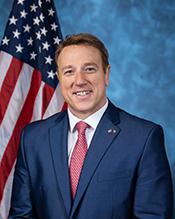
Pat Fallon
RRepublicanTX-4 · Representative
53
/ 100
Average
Attendance99
Avg: 96
Independence3
Avg: 4
Bipartisan Tone4
Avg: 15
Ethics Record100
Avg: 99
Transparency43
Avg: 53
Accountability Score — composite of attendance, independence, bipartisan tone, ethics record & transparency.
Methodology14
Bills Sponsored
0
Enacted into Law
3
Passed a Chamber
11
In Committee
All Sponsored Bills
HR10777In Committee
National Coordination Center and Commercial Cyber Capabilities Codification Act
HR3872Passed House
To amend the Mineral Leasing Act for Acquired Lands to make that Act applicable to hardrock minerals.
This bill specifies that all federally acquired lands are eligible to be considered for hardrock mineral leasing under the Mineral Leasing Act for Acquired Lands (MLAAL). The bill defines the term hardrock mineral to (1) include deposits of minerals found in sedimentary or other rocks, base metals, precious metals, industrial minerals, and precious and semi-precious gemstones; and (2) exclude deposits of coal, oil, oil shale, gas, sodium, potassium, sulfur, or mineral materials subject to disposition under the Materials Act of 1947. By way of background, hardrock minerals are not currently listed under the MLAAL as deposits subject to a lease, while mineral resources such as coal, phosphate, oil, gas, gilsonite, and sulfur are listed. As a result, federal lands may be leased for mining hardrock minerals only if the federal lands were acquired under a statute, such as the Weeks Act, that specifically authorizes the land to be used for hardrock mineral leasing.
HR10187In Committee
Missed Paychecks for Missed Deadlines Act
HR7283Passed House
Ensuring Federal Purchasing Efficiency Act
Ensuring Federal Purchasing Efficiency Act This bill requires the Federal Acquisition Regulatory Council to adjust certain acquisition-related dollar thresholds for inflation every three years instead of every five years. For example, the federal government uses less complex procedures for the purchase of property and services valued below the simplified acquisition threshold . Under the bill, this threshold would be adjusted for inflation every three years.
HR9575In Committee
Hold Vandals Accountable Act of 2026
The proposal would lower the dollar threshold that triggers federal criminal penalties for damaging or attempting to damage U.S. government property, making it easier to prosecute people for smaller-scale damage to federal buildings, monuments, or other government assets. This would affect anyone who damages federal property, from vandals to protesters, by allowing federal charges to apply to incidents involving less expensive damage than current law permits. The change aims to give federal authorities more tools to address property damage at government facilities.
HRES1335Passed House
Condemning actors seeking to defraud the United States Government, and expressing the sense of the House of Representatives that governmentwide fraud and improper payment prevention reforms will meaningfully improve the financial prosperity of the United States, and that Federal program eligibility should be verified before payment.
This resolution condemns the actions of those seeking to defraud the U.S. government. The resolution also expresses the belief of the House of Representatives that (1) legislative and policy reforms to prevent fraud and improper payment will meaningfully improve the continued financial prosperity of the U.S. government and the American taxpayer, and (2) federal program eligibility and spending activities should be verified prior to payments being issued.
HR9123In Committee
Espionage Prevention Act
The proposal would prevent U.S. intelligence agencies from providing funding to colleges and universities that have certain types of partnerships or relationships with Chinese entities or organizations. This would affect academic institutions, researchers, and students who rely on intelligence community grants, potentially limiting international research collaborations involving China. The goal appears to be protecting national security by reducing financial ties between American higher education and Chinese organizations that intelligence officials view as security concerns.
HRES1237In Committee
STOP Resolution
House members, officers, and staff would be required to complete training on how to protect classified information and recognize counterintelligence threats each time Congress convenes. The training would help prevent the accidental or intentional disclosure of sensitive government secrets and teach employees how to identify foreign intelligence operations targeting Congress. This requirement would apply to everyone working in the House of Representatives who has access to classified materials.
HR8610In Committee
Sudan Waiver Report Reduction Act
The federal government would be required to publicly report whenever the President grants a waiver allowing agencies to do business with companies that have ties to Sudan, a country previously subject to U.S. sanctions. This would increase transparency and oversight of presidential decisions to exempt companies from restrictions meant to pressure Sudan over human rights concerns. The reporting requirement would help Congress and the public track which companies receive these special exemptions and why.
HR2766In Committee
Special District Fairness and Accessibility Act
This bill would establish new rules to make special districts—local government agencies that provide services like water, fire protection, or schools—more transparent and accessible to the public. It likely requires these districts to hold open meetings, publish financial information, and make it easier for residents to participate in decision-making and understand how their tax dollars are being spent. The changes would affect millions of Americans who rely on special districts for essential services in their communities.
HR2426In Committee
Veterans Mental Health and Addiction Therapy Quality of Care Act
Veterans Mental Health and Addiction Therapy Quality of Care Act This bill requires the Department of Veterans Affairs (VA) to seek to enter into an agreement with an independent and objective organization to study the difference in quality of mental health and addiction therapy care provided by the VA compared to non-VA providers across various modalities. The organization must publish its findings publicly.
HR6853In Committee
Securing Energy Supply Chains Act
HR5179In Committee
District of Columbia Attorney General Appointment Reform Act of 2025
District of Columbia Attorney General Appointment Reform Act This bill vests the President with the authority to appoint the Attorney General for the District of Columbia (DC) for a term that coincides with the term of office of the President. The bill provides that the appointment is not subject to confirmation in the Senate. Under current DC law, the Attorney General is elected by DC voters for a four-year term that coincides with the term of office of the DC Mayor. The bill additionally provides that the term of the current Attorney General ends on the date of the bill's enactment.
HR3278In Committee
Protecting Critical Infrastructure Act
Protecting Critical Infrastructure Act This bill increases federal criminal penalties for computer fraud and abuse offenses that involve critical infrastructure. The term critical infrastructure means systems and assets, physical or virtual, so vital to the United States that the incapacity or destruction of such systems and assets would have a debilitating impact on security, national economic security, national public health and safety, or any combination of those matters. Specifically, the bill imposes a fine, a mandatory minimum prison term of 30 years, or both for a computer fraud or abuse offense that involves critical infrastructure. Additionally, the bill directs the President to impose asset- and visa-blocking sanctions on foreign individuals and entities that access or attempt to access critical infrastructure.