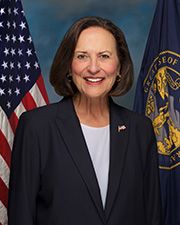
Deb Fischer
RRepublicanNE · Senator
59
/ 100
Average
Attendance99
Avg: 97
Independence23
Avg: 23
Bipartisan Tone14
Avg: 14
Ethics Record100
Avg: 100
Transparency46
Avg: 47
Accountability Score — composite of attendance, independence, bipartisan tone, ethics record & transparency.
Methodology28
Bills Sponsored
1
Enacted into Law
4
Passed a Chamber
18
In Committee
Bills That Became Law
All Sponsored Bills
SRES944Introduced
A resolution designating September 2026 as "School Bus Safety Month".
S1962Passed Senate
Secure Space Act of 2026
Secure Space Act of 2025 This bill prohibits the Federal Communications Commission (FCC) from granting satellite licenses or earth station authorizations, including U.S. market access for foreign-licensed satellites, to specified foreign entities of concern and their affiliates. (Earth stations, also commonly known as ground stations, are earth-based radio stations that communicate with satellites. A grant of U.S. market access permits one or more foreign-licensed satellites to communicate with one or more U.S.-licensed earth stations.) Specifically, the FCC may not grant a satellite license, an earth station authorization, or market access to any entity, or an affiliate thereof, that produces or provides communications equipment or services deemed to pose an unacceptable risk to the national security of the United States. (The FCC maintains a list of such equipment and services, known as the Covered List. Providers of such equipment and services include, for example, Huawei Technologies Company and ZTE Corporation.)
S5336In Committee
Uniform Vehicle Safety Standards Act of 2026
S629Enacted
Emergency Conservation Program Improvement Act of 2025
Emergency Conservation Program Improvement Act of 2025 This act revises the Emergency Conservation Program (ECP) and the Emergency Forest Restoration Program (EFRP) to expand eligibility for payments to agricultural producers and owners of forest land impacted by natural disasters. The act also provides additional options to receive an advance on cost-sharing payments before carrying out emergency measures. The act expands advance ECP payments to include the replacement, repair, or restoration of farmland or conservation structures requiring an immediate response. Producers may receive an advance on cost-sharing payments for 75% of the cost of the replacement and 50% of the cost of the repair or restoration. Current law limits advance payments to 25% of the cost of the repair or replacement of fencing. Under EFRP, the act allows owners of nonindustrial private forest land impacted by a natural disaster to receive an advance on cost-sharing payments for up to 75% of the cost of the emergency measures. Currently, advance payments are not available under the program. ECP and EFRP recipients must use the funds within 180 days after the funds are disbursed. This provides additional time to ECP recipients who currently must use the funds within 60 days. The act also expands eligibility for payments under the programs to include emergency measures to address damages caused by (1) a wildfire that is not caused naturally, if the damage is caused by the spread of the wildfire due to natural causes; and (2) a wildfire that is caused by the federal government.
S2585Passed Senate
MAP for Broadband Funding Act
Modernization, Accountability, and Planning for Broadband Funding Act or the MAP for Broadband Funding Act This bill requires the Federal Communications Commission (FCC) to coordinate with the National Telecommunications and Information Administration to collect data for the Broadband Funding Map on a reasonable and timely basis. It also requires information collection and reporting on the map’s functionality and management. (The map documents the location of each federally funded broadband project.) Specifically, the FCC must seek public comment on the functionality and transparency of the map and the quality and completeness of the data within the map. Further, the Government Accountability Office must report on the management and use of the map, as well as the extent to which federal agencies are complying with obligations to submit information for the map.
S4815In Committee
CHIP IN for Veterans Act of 2026
The Department of Veterans Affairs would be allowed to permanently accept donations of buildings, land, and construction services from individuals and organizations to help improve VA facilities, rather than having this ability expire as it currently does under a temporary pilot program. This would let the VA accept both physical donations and money specifically earmarked for maintenance projects and minor construction work without having to go through lengthy approval processes each time. Veterans and VA facilities would benefit from these donated resources, which could help expand or improve healthcare and services without requiring Congress to appropriate additional taxpayer funds.
S645Passed Senate
North Platte Canteen Congressional Gold Medal Act
North Platte Canteen Congressional Gold Medal Act This bill provides for the award of a Congressional Gold Medal to recognize the individuals and communities that provided financial and other support for the North Platte Canteen in North Platte, Nebraska, during World War II.
S4669In Committee
A bill to exempt stinger-steered combinations from a requirement to include warning flags on projecting loads.
Trucks with stinger-steered trailers (a type of semi-truck with an extra axle in the rear) would no longer be required to display warning flags on cargo that sticks out beyond the vehicle's normal width or length. Currently, federal safety rules require all vehicles carrying projecting loads to mark them with flags so other drivers can see the hazard. This change would apply specifically to this particular truck configuration.
SRES727In Committee
A resolution supporting the designation of May 29, 2026, as "Mental Health Awareness in Agriculture Day" to raise awareness around mental health in the agricultural industry and workforce and to continue to reduce stigma associated with mental illness.
This resolution designates May 29, 2026, as Mental Health Awareness in Agriculture Day to raise awareness around mental health in the agricultural industry and reduce the stigma associated with mental illness.
S2828In Committee
Child Care Modernization Act of 2025
This bill would update federal child care policies to make care more affordable and accessible for working families, likely through increased funding, tax credits, or support for child care providers. The changes would help parents—especially those with lower incomes—pay for quality child care while potentially improving wages and working conditions for child care workers. The bill is currently being reviewed by the Senate committee responsible for education and labor issues.
S4151In Committee
Unfunded Mandates Accountability and Transparency Act of 2026
This bill would require the federal government to identify and disclose the costs of new rules and regulations that it imposes on states, local governments, and private businesses without providing federal funding to cover those expenses. The legislation aims to make Congress more transparent about the financial burden these unfunded mandates place on states and communities, potentially making it harder to pass costly regulations without accounting for who pays for them. Taxpayers, state and local officials, and businesses would be the primary groups affected by increased scrutiny of these regulatory costs.
S337Reported
Household Goods Shipping Consumer Protection Act
Household Goods Shipping Consumer Protection Act This bill allows the Federal Motor Carrier Safety Administration (FMCSA) to assess civil penalties against motor carriers, brokers, and freight forwarders for violations related to the interstate transportation of household goods and provides states with additional related authorities. As background, a broker is the “middle person” between a shipper and a motor carrier and arranges for the transportation of household goods. A freight forwarder organizes shipments for individuals or corporations. Unlike a broker, freight forwarders assume responsibility for transportation and may transport the freight itself. The bill expands the FMCSA registration requirements to require motor carriers, brokers, and freight forwarders to designate a principal place of business (i.e., a single physical location where management officials report to work, a significant portion of the transportation business is conducted, and records are maintained). FMCSA may withhold, suspend, amend, or revoke any part of a registration for failure to designate. In addition, brokers and freight forwarders must disclose any common ownership, management, control, or familial relationship with any other carrier, freight forwarder, broker, or applicant in the previous three years. Under current law, motor carriers must disclose this information. Further, states may use certain grant funds to enforce federal household goods statutes and regulations for the interstate transportation of these goods by motor carriers and brokers. This applies to Motor Carrier Safety Assistance Program (MCSAP) grant funds and MCSAP High Priority discretionary grant funds. A state shall retain collected fines that are a result of enforcement.
S3802In Committee
Foster Care Stabilization Act of 2026
This bill would provide additional federal funding and support services to help keep children safely in foster care placements and reduce the number of times they move between homes. The money would go toward things like counseling, training for foster parents, and services to help reunite children with their biological families when possible. The goal is to give foster children more stable living situations during what is often a difficult time in their lives.
SRES592Introduced
A resolution supporting the designation of 2026 as the "International Year of the Woman Farmer" to recognize and honor the critical role of women in agriculture.
This resolution supports the designation of 2026 as the International Year of the Woman Farmer and recognizes the critical role of women in agriculture. The resolution also encourages citizens to celebrate the impact these women have on the food systems and agricultural workforce of the United States by encouraging and empowering women to pursue careers in agriculture and cultivate leadership opportunities.
S3656In Committee
A bill to designate the portion of Interstate Route 680 in Omaha, Nebraska, as the "Hal Daub Freeway".
This bill designates a portion of Interstate Route 680 in Omaha, Nebraska, as the Hal Daub Freeway. Harold John Daub Jr. served in the House of Representatives from 1981-1989 and as the mayor of Omaha, Nebraska, from 1995-2001.
S3552In Committee
HAULS Act of 2025
S3236In Committee
Increasing Tribal Input on Nutrition Act of 2025
Native American tribes would have a greater say in how federal nutrition programs are designed and run on tribal lands, allowing them to shape food assistance policies to better fit their communities' needs and cultural practices. The bill would require federal agencies to consult with tribes before making major decisions about nutrition programs that affect Native American reservations and tribal territories. This gives tribes more control over food policy rather than having decisions made solely by the federal government.
SRES484Introduced
A resolution designating October 2025 as "School Bus Safety Month".
This resolution designates October 2025 as School Bus Safety Month.
S259Passed Senate
Foreign Adversary Communications Transparency Act
Foreign Adversary Communications Transparency Act This bill requires the Federal Communications Commission (FCC) to annually publish a list of entities that hold a license or other authorization granted by the FCC and have ties to specified foreign countries. With respect to entities holding cable landing licenses (for the placement and operation of submarine communications cables) or other licenses granted via competitive auction, the FCC must publish a list of all such entities (1) in which a covered entity holds a specified voting or equity interest, or (2) that have been determined by a national security agency to be subject to the control of a covered entity. With respect to entities holding all other categories of FCC licenses or other authorizations, the FCC must first issue rules facilitating the collection of information on such licensees’ ownership structure. After that information is obtained, the FCC must add to the published list any such entity in which a covered entity holds a specified voting or equity interest. Under the bill, a covered entity is defined as an entity organized in China, Iran, North Korea, or Russia; a subsidiary of such an entity; or the government of China, Iran, North Korea, or Russia.
S161Reported
She DRIVES Act
She Develops Regulations In Vehicle Equality and Safety Act or the She DRIVES Act This bill directs the Department of Transportation (DOT) to revise motor vehicle safety standards to require the use of certain anthropomorphic test devices (i.e., crash test dummies) and testing on female crash test dummies. Specifically, DOT must issue final rules to revise the current testing regulations to include specific adult male and adult female frontal impact and side impact crash test dummies. The final rules must establish or update the testing injury criteria based on real-world injuries and the greatest potential to increase safety. The injury criteria must include head, neck, chest, abdomen, pelvis, upper leg, and lower leg criteria for the crash test dummies. The final rules must also establish crashworthiness frontal and side impact tests for adult female occupants in all front seating positions that are currently tested for adult male occupants (as of the date of the bill's enactment). Further, DOT must promulgate a final decision notice to update the testing procedures for the New Car Assessment Program of the National Highway Traffic Safety Administration to require the use of these crash test dummies for frontal and side impact crashworthiness testing. Finally, DOT must submit reports to Congress that, among other things, identify timelines for DOT to incorporate additional types of crash test dummies into the regulations and identify testing devices used in other countries for similar crashworthiness standards.
S1878In Committee
ATTAIN Mental Health Act
This bill would expand access to mental health services and treatment options for Americans by increasing funding and resources for mental health programs, training more mental health professionals, and making it easier for people to get care through telehealth and other delivery methods. The legislation would affect patients seeking mental health treatment, healthcare providers, and mental health organizations working to address the growing demand for these services.
SRES143In Committee
A resolution supporting the designation of May 29, 2025, as "Mental Health Awareness in Agriculture Day" to raise awareness around mental health in the agricultural industry and workforce and to continue to reduce stigma associated with mental illness.
This resolution designates May 29, 2025, as Mental Health Awareness in Agriculture Day to raise awareness around mental health in the agricultural industry and reduce the stigma associated with mental illness.
S1616In Committee
PRECISE Act of 2025
Producing Responsible Energy and Conservation Incentives and Solutions for the Environment Act of 2025 or the PRECISE Act of 2025 This bill incorporates support for precision agriculture into various programs of the Department of Agriculture (USDA). Precision agriculture refers to managing, tracking, or reducing crop or livestock production inputs, including seed, feed, fertilizer, chemicals, water, and time, at a heightened level of spatial and temporal granularity to improve efficiencies, reduce waste, and maintain environmental quality. Precision agriculture technology includes any technology and equipment that directly contributes to a reduction in, or improved efficiency of, inputs used in crop or livestock production. Specifically, the bill makes changes to eligibility criteria, payments, and other aspects of the Environmental Quality Incentives Program and the Conservation Stewardship Program. These changes include allowing the programs to support the adoption of precision agriculture practices and acquisition of precision agriculture technologies. In addition, the bill expands a program through which USDA makes and insures loans to for-profit and nonprofit organizations that invest in rural areas by allowing the loans to be used for precision agriculture practices. Also, USDA must emphasize the use of third-party providers when providing technical assistance on matters related to soil health for participants in certain USDA conservation programs. This includes planning related to the use of cover crops, precision agriculture practices, and comprehensive nutrient management.
S1423In Committee
Hammers' Law
Based on the vague title and transportation focus, this bill likely addresses infrastructure, road safety, or public works projects, though the specific details aren't clear from the title alone. The bill has been sent to the Commerce, Science, and Transportation Committee for review, suggesting it may involve federal funding, regulations, or standards related to transportation systems or construction. Without access to the bill's actual text, the exact impact on workers, commuters, or transportation companies cannot be determined.
SJRES46In Committee
A joint resolution providing for congressional disapproval under chapter 8 of title 5, United States Code, of the rule submitted by the Environmental Protection Agency relating to "California State Motor Vehicle and Engine Pollution Control Standards; Heavy-Duty Vehicle and Engine Emission Warranty and Maintenance Provisions; Advanced Clean Trucks; Zero Emission Airport Shuttle; Zero-Emission Power Train Certification; Waiver of Preemption; Notice of Decision".
This joint resolution nullifies the Environmental Protection Agency notice titled California State Motor Vehicle and Engine Pollution Control Standards; Heavy-Duty Vehicle and Engine Emission Warranty and Maintenance Provisions; Advanced Clean Trucks; Zero Emission Airport Shuttle; Zero-Emission Power Train Certification; Waiver of Preemption; Notice of Decision (88 Fed. Reg. 20688) and published on April 6, 2023. Among other elements, the notice grants the California Air Resources Board request for a waiver several of its regulations, including the Heavy-Duty Vehicle and Engine Emission Warranty Regulations and Maintenance Provisions. (Under the Clean Air Act, California may seek waivers of the preemption prohibiting states from enacting certain emission standards.)
S593In Committee
Nationwide Consumer and Fuel Retailer Choice Act of 2025
Nationwide Consumer and Fuel Retailer Choice Act of 2025 This bill amends the Clean Air Act to address the limitations on Reid Vapor Pressure (a measure of gasoline's volatility) that are placed on gasoline during the summer ozone season. Specifically, the bill applies the waiver for Reid Vapor Pressure requirements that is applicable to gasoline blended with 10% ethanol (E10) to gasoline blended with up to 15% ethanol (E15). This change allows gasoline that is blended with 10% to 15% ethanol to be sold year-round. Currently, states may be excluded from the waiver for Reid Vapor Pressure requirements by submitting documentation supporting that the waiver would increase air pollution. The bill nullifies existing state exclusions, but states may submit documentation after enactment of the bill to be excluded going forward. The bill also modifies the Renewable Fuel Standard Program, which requires transportation fuel sold or introduced into commerce in the United States to contain minimum volumes of renewable fuel. Under the existing program, obligated parties, such as small refineries, must satisfy the volume obligations by either blending renewable fuels into their gasoline or diesel fuel products or by acquiring credits that represent the required renewable fuel volume. The bill directs the Environmental Protection Agency to return compliance credits to small refineries under certain circumstances.
S400In Committee
Paid Family and Medical Leave Tax Credit Extension and Enhancement Act
Paid Family and Medical Leave Tax Credit Extension and Enhancement Act This bill makes the paid family and medical leave tax credit permanent, expands eligibility for the credit, requires outreach to increase awareness of the tax credit, and makes other changes to the credit. Currently, an eligible employer may claim a tax credit (through 2025) for up to 25% of wages paid to a qualifying employee (who has worked for the employer for one year or more) while the employee is on family and medical leave. The bill makes the tax credit for paid family and medical leave permanent and allows an eligible employer to claim the tax credit for 25% of either (1) wages paid to a qualifying employee while the employee is on family and medical leave, or (2) premiums paid for paid family or medical leave insurance. The bill also allows an employer to provide family and medical leave to an employee who has worked for the employer for six months or more, provides that leave that is paid by a state or local government or required by state or local law must be taken into account in determining the amount of leave provided by the employer but may not be counted when determining the amount of the credit, and provides a limited exception to the requirements related to written family and medical leave policies. Finally, the bill requires targeted outreach to employers and other relevant parties regarding the availability and requirements of the tax credit.
S174In Committee
Amtrak Transparency Act
Amtrak Transparency Act This bill increases Amtrak's open meeting and public disclosure requirements. Specifically, the Amtrak Board of Directors must comply with federal open meeting requirements under the Government in the Sunshine Act. In addition, at least 30 days prior to the board convening, the board must publicly post an announcement of the meeting and the anticipated meeting agenda. The board must also annually convene a meeting to which state departments of transportation with long-distance routes or state-supported routes are invited to participate. Further, Amtrak must publicly disclose the discretionary bonus compensation paid to an Amtrak officer or non-bargaining unit employee. Upon request, Amtrak must also disclose to a state or the State-Amtrak Intercity Passenger Rail Committee vendor agreements of $250,000 or more for certain services on state-supported routes.