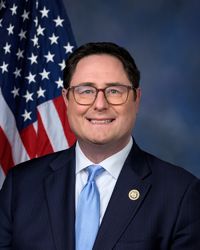
Mike Flood
RRepublicanNE-1 · Representative
53
/ 100
Average
Attendance99
Avg: 96
Independence2
Avg: 4
Bipartisan Tone3
Avg: 15
Ethics Record100
Avg: 99
Transparency51
Avg: 53
Accountability Score — composite of attendance, independence, bipartisan tone, ethics record & transparency.
Methodology25
Bills Sponsored
0
Enacted into Law
5
Passed a Chamber
20
In Committee
All Sponsored Bills
HR10552In Committee
Karly Rain Wood Act
HR10050In Committee
Uniform Vehicle Safety Standards Act of 2026
HR9851In Committee
Protecting Access to Spiritual Treatment and Organized Religion Act of 2026
Protecting Access to Spiritual Treatment and Organized Religion Act of 2026 or the PASTOR Act of 2026 This bill requires, as a condition of Medicare participation, health care providers to allow a clergy member access to a patient upon the patient's designation and request.
HR7128Passed House
TRIA Program Reauthorization Act of 2026
TRIA Program Reauthorization Act of 2026 This bill reauthorizes the Terrorism Risk Insurance Program through 2034. The program covers a portion of the losses incurred by private insurers for property and casualty insurance coverage for terrorism risk. The bill also increases the amount of property and casualty insurance losses required for certification under the program beginning in 2029 and provides statutory authority for Department of the Treasury public notification requirements regarding the determination process for whether an act qualifies as an act of terrorism under this program.
HRES1381Passed House
Electing a Member to certain standing committees of the House of Representatives.
The House of Representatives voted to elect a member to fill a vacant position on one or more of its standing committees. Standing committees handle specific areas like defense, healthcare, or taxes and are responsible for reviewing bills before they go to the full House for a vote. This action allows the House to maintain its committee structure and ensure all committees have their full membership.
HR8671In Committee
Bank Fraud Technology Advancement Act of 2026
Bank Fraud Technology Advancement Act of 2026 This bill directs federal banking agencies (the Office of the Comptroller of the Currency, the Federal Deposit Insurance Corporation, the Federal Reserve Board, and the National Credit Union Administration) to jointly study and report on the use of advanced fraud detection technology by insured depository institutions and credit unions. The study must evaluate, among other topics, the current use and effectiveness of this technology, access by community financial institutions to such technology, and the use and governance of artificial intelligence and machine learning in detecting fraud. Federal banking agencies must report all findings, determinations, and legislative recommendations to the appropriate congressional committees and make the report publicly available. The bill also allows federal banking agencies to jointly establish a temporary pilot program to facilitate community financial institution access to advanced fraud detection tools for small insured depository institutions and credit unions.
HR9311In Committee
Build Housing Affordably Act
The proposal would allow certain construction or development projects to skip federal requirements that normally apply to federal contracts and purchases. These exemptions would affect companies bidding on federal projects by removing specific labor and wage rules they would otherwise have to follow. The bill is currently under review by the House Committee on Financial Services.
HR6740In Committee
VA TRUST Act
The VA TRUST Act would establish new requirements and oversight mechanisms for the Department of Veterans Affairs to improve transparency and accountability in how it manages programs and spending. The bill aims to give veterans and Congress better visibility into VA operations and decision-making, potentially including requirements for regular reporting on service quality, financial management, and program effectiveness. Veterans, VA employees, and taxpayers would be affected by these changes, which are designed to ensure the agency operates more efficiently and responsively to veterans' needs.
HR8507In Committee
Precision Agriculture Workforce Training and Development Act
The proposal would direct the federal government to fund research and training programs focused on developing workers skilled in precision agriculture—the use of technology like GPS, sensors, and data analysis to optimize farming. This would help farmers and agricultural companies find trained employees who can operate and maintain these advanced farming technologies. The bill aims to address a potential shortage of workers with the technical skills needed for modern, technology-driven agriculture.
HR6547In Committee
Least Cost Exception Act
Least Cost Exception Act This bill allows the Federal Deposit Insurance Corporation (FDIC) to waive the least-cost resolution requirement for failed insured depository institutions and use alternative methods of resolution, particularly alternatives that do not involve global systemically important banks (G-SIBs). Under current law, the FDIC must use the resolution method (such as a deposit payoff or the purchase and assumption of a bank’s assets and liabilities) that costs the FDIC's Deposit Insurance Fund the least to implement when an insured depository institution fails. The bill provides an exception to this requirement if the following criteria are met: the alternative method is the least costly of all alternatives that do not involve a G-SIB and that do not exceed the cost of liquidation; the difference in cost between the selected alternative and the cost of a resolution involving a purchase and assumption by a G-SIB is less than a maximum cost as established by rule; if the alternative involves a person purchasing assets or assuming liabilities, that person must pay an assessment to the FDIC; and it is determined that the risks to the fund are outweighed by the benefits of limiting the concentration of U.S. banking under G-SIBs. FDIC must issue a report on any use of the exception established by this bill containing an analysis of the economic impact of cost differences between the selected alternative and the least-cost alternative.
HR5946In Committee
Stamp Out Veterans Medical Debt Act
Stamp Out Veterans Medical Debt Act This bill requires the U.S. Postal Service to issue and sell a Veterans Medical Debt Relief Stamp to help pay medical debt incurred by veterans for hospital care, medicals services, and extended care services furnished by the Department of Veterans Affairs, including through the Veterans Community Care Program.
HR5945In Committee
USS Frank E. Evans Act
USS Frank E. Evans Act This bill requires the Department of Defense to authorize inclusion on the Vietnam Veterans Memorial Wall in the District of Columbia of the names of the 74 crew members of the USS Frank E. Evans killed on June 3, 1969.
HR5878In Committee
HOME Reform Act of 2025
The proposal would make changes to federal housing programs and policies to address housing affordability and development. It would affect homebuyers, renters, real estate developers, and housing agencies by modifying how federal housing assistance is distributed and how housing projects are approved and funded. The specific reforms would be determined as the bill moves through the House Financial Services Committee.
HR5798In Committee
HOME Reform Act of 2025
The proposal would make changes to federal housing programs and policies to address housing affordability and development. It would affect homebuyers, renters, real estate developers, and housing agencies by modifying how federal housing assistance is distributed and how communities can develop new housing. The specific reforms would be determined as the bill moves through the House Financial Services Committee.
HR5357In Committee
College Students Continuation of Mental Health Care Act of 2025
This bill would help college students maintain access to mental health care when they transition between insurance plans, such as when they age out of their parents' coverage or graduate. It aims to reduce gaps in mental health treatment for young adults during these vulnerable periods by ensuring continuity of care with their current providers. The legislation would affect college students, their families, health insurance companies, and mental health providers.
HR5263In Committee
To require approval from the Secretary of Housing and Urban Development for any Federal manufactured home and safety standards, and for other purposes.
This bill would give the Secretary of Housing and Urban Development the power to approve all federal safety and quality standards for manufactured homes before they take effect. The change would centralize decision-making about mobile home regulations under one federal official, potentially affecting manufacturers who build these homes and the millions of Americans who live in them. The bill is currently being reviewed by the House Committee on Financial Services.
HR4660In Committee
Unlocking Housing Supply Through Streamlined and Modernized Reviews Act
The legislation would speed up the process for approving new housing construction by streamlining federal environmental and regulatory reviews that currently delay projects. This would affect developers, construction companies, and communities looking to build more homes, potentially making it faster and cheaper to add new housing to the market. The changes aim to address housing shortages by removing bureaucratic obstacles while maintaining safety and quality standards.
HR4659In Committee
Identifying Regulatory Barriers to Housing Supply Act
The legislation would require federal agencies to identify and report on rules and regulations that make it harder or more expensive to build new housing. By examining barriers created by federal policy, the bill aims to help policymakers understand what changes might increase the housing supply and make homes more affordable for renters and homebuyers.
HR3339Passed House
Equal Opportunity for All Investors Act of 2025
Equal Opportunity for All Investors Act of 2025 This bill expands who may be considered an accredited investor for purposes of participating in private offerings of securities. (Certain unregistered securities may only be offered to accredited investors.) Specifically, the bill allows an individual to qualify through an examination established by the Securities and Exchange Commission. The examination must be designed with an appropriate difficulty level such that an individual with financial sophistication or training would be unlikely to fail, include methods to determine competency and knowledge in certain areas such as the disclosure requirements of different securities, and be administered by a registered national securities association and offered free of charge to the public. Currently, accredited investors must satisfy certain requirements indicating their reduced exposure to financial risk, including those related to income, net worth, or knowledge and experience.
HR4562In Committee
Sustainable Aviation Fuel Information Act
This bill would require airlines and fuel suppliers to provide information about sustainable aviation fuel (SAF)—cleaner fuel made from renewable sources like plants and waste—including how much they use and its environmental benefits. The measure aims to give passengers, investors, and regulators better visibility into the aviation industry's efforts to reduce carbon emissions and transition away from traditional jet fuel. Airlines, fuel companies, and potentially consumers would be affected by these new reporting requirements.
HR2840In Committee
Housing Supply Frameworks Act
This bill would establish new rules and frameworks to help increase the supply of affordable housing across the country, likely by streamlining the approval process for new housing developments and removing regulatory barriers that slow construction. The changes would affect homebuilders, local governments, and people looking for affordable places to live by making it faster and potentially cheaper to build new homes and apartments.
HJRES64In Committee
Disapproving the rule submitted by the Bureau of Consumer Financial Protection relating to "Defining Larger Participants of a Market for General-Use Digital Consumer Payment Applications".
This joint resolution nullifies the final rule issued by the Consumer Financial Protection Bureau (CFPB) titled Defining Larger Participants of a Market for General-Use Digital Consumer Payment Applications and published on December 10, 2024. The rule defines larger participants in the general-use digital consumer payment application market (i.e., payment apps) that are subject to CFPB supervisory authority. The rule defines larger participants in this market as nonbanks (1) with an annual volume of at least 50 million transactions, and (2) that are not small business concerns.
HR1305In Committee
Improving Measurements for Loneliness and Isolation Act of 2025
Improving Measurements for Loneliness and Isolation Act of 2025 This bill requires the Department of Health and Human Services to establish a Working Group on Unifying Loneliness Research. The working group must recommend standardized measurements of loneliness and social isolation for use in research and educating the public. The working group must report to Congress on its work and recommendations and make this information publicly available online. The working group sunsets on December 31, 2027.
HRES39Passed House
Ranking a Member on a certain standing committee of the House of Representatives.
This resolution ranks Representative Celeste Maloy of Utah immediately after Representative Dale Strong of Alabama on the Committee on Appropriations.
HRES38Passed House
Electing Members to certain standing committees of the House of Representatives.
This resolution elects Members to the committees on Appropriations; Education and Workforce; Homeland Security; Rules; Small Business; and Transportation and Infrastructure.